
Battle of the Granicus
A moment of silence fell over both armies. Then Alexander ordered the charge. It was May 334 BC, somewhere on the banks of the Granicus River in what is now northwestern Turkey — the same river that farmers today call the Biga Çayı, a modest stream flowing past olive groves toward the Sea of Marmara. The Persian cavalry lined the far bank, javelins ready, defending the higher ground. What happened next, on a single afternoon, would open the door to the Persian Empire and change the direction of history. Historians still argue over the exact details. The bones of the matter are not in dispute.
The Weight of What Led Here
Alexander crossed the Hellespont in the spring of 334 BC with roughly 32,000 infantry and 5,000 cavalry — an army assembled to fulfill a promise his father Philip II had made before his assassination two years earlier. The promise was revenge: to punish the Persian Empire for its invasion of Greece in 480 BC, a campaign that had burned Athens and scarred Greek memory for generations. Before engaging the main Persian army Alexander paused at Ilium, the site of ancient Troy, to make offerings at the tomb of Achilles — a gesture that announced to anyone paying attention what kind of war this would be, and what kind of king intended to fight it. The Persian satraps who would face him at the Granicus had been warned. A council at Zeleia debated strategy. Memnon of Rhodes, who commanded their Greek mercenary infantry, advised scorched-earth tactics: burn the crops, deprive Alexander of supplies, avoid pitched battle. The Persian commanders rejected his advice. They wanted to protect their subjects' property. They also distrusted Memnon, a Greek in Persian service, and perhaps resented the mercenaries who had defeated the Macedonians the year before. They chose to fight.
The Crossing
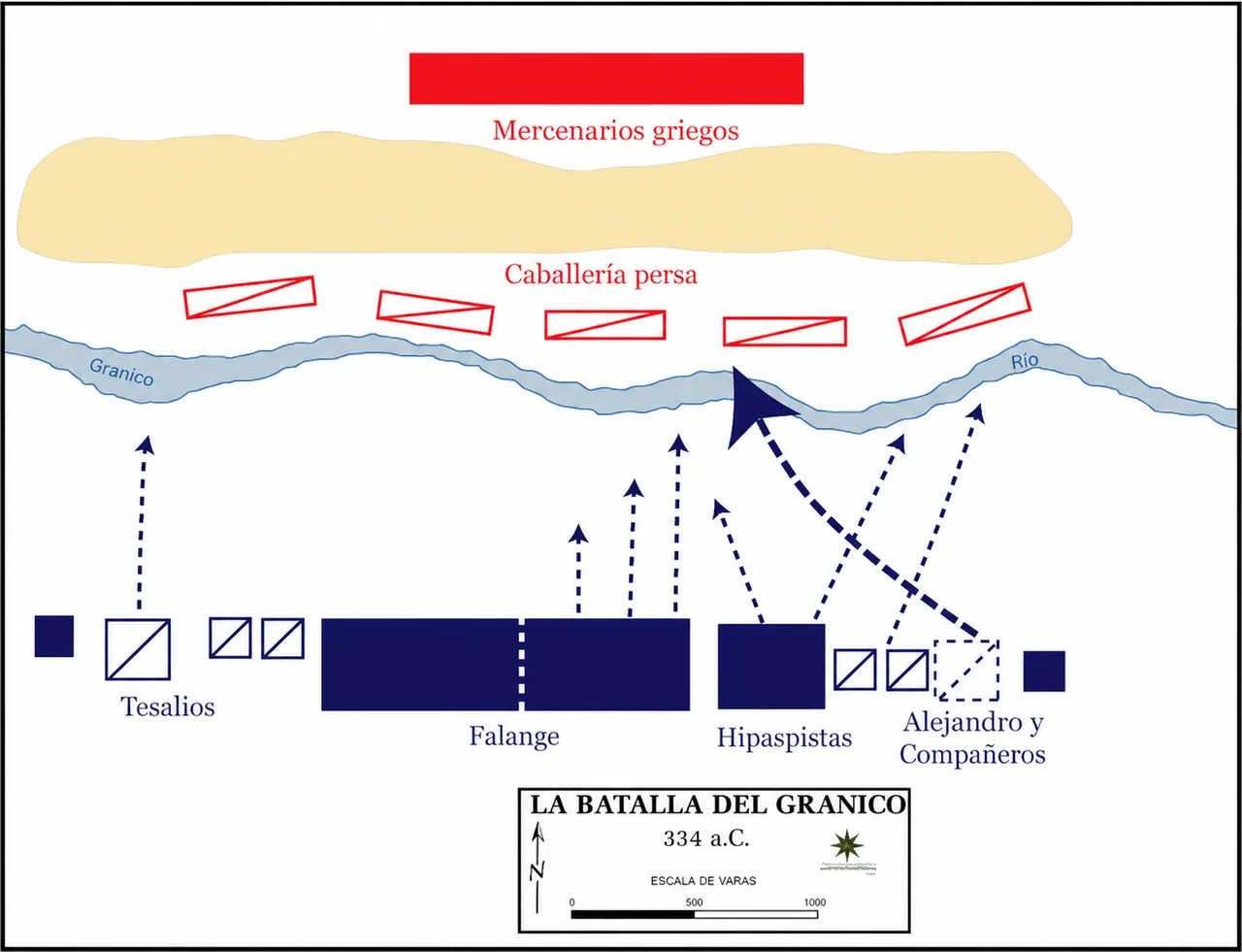
The Persians stationed their cavalry along the eastern bank of the Granicus, with their Greek mercenary infantry held back — a decision historians have questioned ever since. The cavalry could not charge from a static position on a riverbank; Persian tactical doctrine of the era relied on disrupting enemy formations with javelin volleys rather than shock charges, and the bank gave them elevation advantage. When Alexander's vanguard under Amyntas plunged into the river it was met with volleys from above and suffered losses before retreating. What came next is debated. According to Arrian's account — the most detailed surviving source, drawing on the testimony of Ptolemy, who was there — Alexander then led the full weight of his Companion cavalry into the river himself, striking obliquely to destabilize the Persian line. The Macedonian infantry simultaneously pressed across the water. The lances they carried, the xyston, outreached the Persian javelins in close melee, and as the cavalry fight developed on the Persian left, Alexander rode into the thick of it and killed several Persian nobles in personal combat before Cleitus the Black severed the sword arm of the satrap Spithridates, who had been an instant away from striking Alexander from behind.
The Men Who Fell
The ancient sources disagree sharply on casualties. Arrian, whose figures modern historians consider most reliable, records 115 Macedonian dead: 25 Companion cavalry lost in the initial assault, 60 more cavalry, and 30 infantry. On the Persian side, Arrian counts roughly 1,000 cavalry killed; the Greek mercenaries, surrounded and cut off, suffered badly — perhaps 2,000 to 3,000 killed or captured out of a force that may have numbered 4,000 to 5,000 men. Persian commanders died in considerable numbers: Niphates, Petenes, Mithrobuzanes, Pharnaces, and others are named in the sources. Arsites, the satrap who had rejected Memnon's counsel and commanded the Persian force, fled to Phrygia and took his own life — blaming himself, the ancient sources say, for the defeat. Those figures, extracted from texts written decades after the battle and inflected by propaganda on both sides, represent real men: farmers' sons from Macedonia, Greek mercenaries who had simply hired out to whoever paid, Persian cavalrymen defending their satrap's territory. They died on a summer afternoon beside a river that still flows.
What Alexander Did Afterward
Victory at the Granicus opened the western coast of Asia Minor almost immediately. Dascylium, the administrative capital of Hellespontine Phrygia, was evacuated without a fight. Sardis surrendered. Ephesus capitulated. Alexander sent Parmenion to Magnesia and Tralles; he dispatched Lysimachus to break up Persian-backed oligarchies in Aeolis and Ionia and restore democratic government — a message about what kind of liberator he intended to be. To Athens he sent 300 suits of captured Persian armor, to be dedicated to Athena on the Acropolis, with an inscription noting pointedly that the Spartans had taken no part in the campaign. He commissioned the sculptor Lysippus to create the Granicus Monument: bronze equestrian statues of the twenty-five Companion cavalrymen who had died in the opening charge, erected at the sanctuary of Zeus at Dion. In 146 BC, more than a century and a half later, a Roman general named Quintus Caecilius Metellus Macedonicus carried those statues back to Rome. They were displayed in a portico below the Capitoline Hill. The battle's echo traveled far.
A River with Two Names
The Granicus is today called the Biga Çayı. Drive through the countryside around the modern town of Biga and you will cross it on an ordinary road bridge — a modest river, flowing clear over gravel in summer, its banks unremarkable. Scholars who have studied the battle's location place the most likely crossing site near the confluence of a tributary near the villages of Gümüşçay and Çeşmealtı, where a long ridge — the only good candidate for the one described in ancient accounts — still stands. The river is not particularly difficult to ford today, which has puzzled historians, since the ancient sources emphasize how hard the crossing was. Perhaps the banks were steeper in antiquity; perhaps the emphasis on difficulty was meant to make Alexander's boldness seem more formidable. Either way, the water still moves north toward the Sea of Marmara, indifferent to the armies that crossed it twenty-three centuries ago.
From the Air
The Battle of the Granicus took place along the Biga Çayı (ancient Granicus River) at approximately 40.228°N, 27.242°E, in the rolling agricultural lowlands of Çanakkale Province, northwestern Turkey. From the air at 3,000–5,000 feet the river is clearly visible as a silver thread through agricultural land; the Sea of Marmara lies roughly 30 km to the north. The town of Biga is visible about 5 km to the northwest of the likely battle site. The nearest airport is LTBH (Çanakkale Airport), approximately 50 km to the southwest; LTBG (Bandırma Airport) is about 70 km to the northeast and serves the eastern Marmara region.
Nearby Stories
- Kapıdağ Peninsula 7.4 km away
- 1912 Mürefte Earthquake 8.7 km away
- Lake Kuş 17 km away
- Battle of Aegospotami 17 km away
- Balıkesir 30 km away
- Northern Aegean 38 km away
- Cunda Island 61 km away
- Uzunköprü Bridge 94 km away