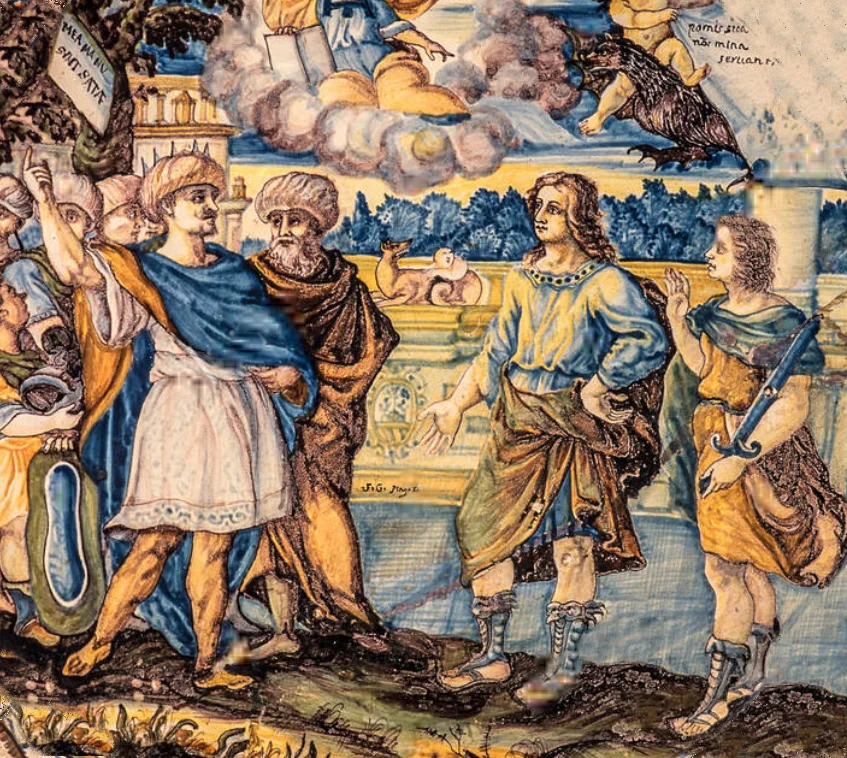
,_maiolica_with_a_dusting_technique,_Castelli_manufacture,_Abruzzo._Italy,_17th_century.jpg)
Battle of Aegospotami
Most of the Athenian sailors were looking for lunch when the Spartan fleet came across the strait. They had pulled their ships up on a long beach near the mouth of a small river called Aegospotami, the Goat Rivers, on the European side of the Hellespont. They had been there for days, sailing out each morning in formation to challenge the Spartans at Lampsacus, three kilometers across the water, and each evening returning to camp because Lysander would not come out to fight. The exiled Athenian general Alcibiades, watching from a private fortress nearby, had warned the generals that the position was indefensible: the beach had no harbor, no walls, and no nearby town to feed the men. They sent him away. On the fifth day, the Spartan fleet crossed the strait and captured most of the Athenian ships before a single sea-fight had begun. The war that had ground on since 431 BC was over, and Athens had lost.
How Lysander Won Without Fighting
Lysander was the kind of commander who treated patience as a weapon. After the Spartan disaster at the Battle of Arginusae the previous year, the city had recalled him to command, even though Spartan law forbade any man from holding the office of navarch twice. They got around the rule by appointing him vice-admiral, with everyone understanding it was a fiction. He had something the Athenians did not: Persian money. The young Persian prince Cyrus had given him the revenues of all the Persian cities of Asia Minor, and with that wealth Lysander rebuilt a fleet that could take its time. He led the Athenians on a chase across the Aegean, hit Aegina and Salamis to draw their fleet south, then slipped past them to the Hellespont and seized Lampsacus, which sat astride the grain route from the Black Sea. Without grain, Athens would starve. The Athenian fleet had no choice but to follow.
The Beach with No Town
Two ancient accounts of the battle survive and they disagree about the details. Diodorus Siculus says the Athenian general Philocles sailed out on the fifth day with thirty ships, planning to lure the Spartans into an attack so the rest of the fleet could spring on them from behind. Xenophon, who knew several of the men involved, says the Athenians simply went home as usual, beached their ships, and dispersed to forage for food, and that Lysander rowed across an empty strait and walked up to the unmanned ships. Whichever account is right, the result was the same. Of 180 Athenian triremes, only nine escaped. The general Conon led that small group to take refuge with Evagoras, a friendly ruler in Cyprus. The messenger ship Paralus carried the news home to Athens. Lysander captured perhaps three or four thousand Athenian sailors at the beach. Some historians, ancient and modern, suspect that a faction inside the Athenian high command sold out the city to bring down the democracy. The evidence is circumstantial. The dead remain dead either way.
Three Thousand Men in a Field
What happened next was not part of the battle and is not always told as part of it. Lysander gathered the Athenian prisoners and, with the agreement of his Peloponnesian allies, ordered the execution of three thousand of them, including the Athenian general Philocles. The reason given was retaliation for various wartime cruelties Athens had been accused of, including a vote in the Athenian assembly to cut off the right hands of any Spartan sailors captured. Captives from other Greek cities were spared. The killings happened in the days after the battle. Three thousand men, sailors and rowers from the slums of Piraeus and the small farms of Attica, were marched out and put to death. They were not statistics. Each had relatives who learned the news when the Paralus reached Athens, and Xenophon writes that the wail rose from the harbor that night and ran up the Long Walls into the city, and no one slept, because everyone had a brother or a son or a neighbor who had not come back.
The End of an Age
Lysander did not march on Athens. He did not have to. With the fleet gone, Athens could not import grain from the Black Sea, and with the Spartan garrison at Decelea blocking land routes through Attica, the city began to starve. The siege lasted through the winter of 405 to 404 BC. People died of hunger in the streets. The city surrendered in March 404 BC. The Long Walls came down, dismantled stone by stone while Spartan flute players celebrated, an image that struck contemporaries as the literal end of an age. A pro-Spartan oligarchy, the Thirty Tyrants, took power for a brief and bloody year before the democracy was restored. Twenty-seven years of war ended on the beach at Aegospotami, and Sparta inherited a Greece it had no real idea how to govern. The Spartans set up statues at Delphi commemorating their trierarchs with a verse: These men, sailing with Lysander in the swift ships, humbled the might of the city of Cecrops and made Lacedaemon the high city of Hellas. The high city would not stay high for long.
From the Air
Located at 40.25N, 26.55E on the European shore of the Dardanelles, near the mouth of the Karakova Stream on the Gallipoli peninsula in modern Turkey. Recommended viewing altitude 5,000 to 7,000 feet to take in the strait, the Asian shore at Lampsacus (modern Lapseki) about 3 kilometers across, and the long sloping beaches of the European side. Nearest airport is Istanbul (LTBA, Ataturk historical, or LTFM new airport) about 250 kilometers northeast; Canakkale Airport (LTBH) is closer at about 50 kilometers south. The Sea of Marmara opens to the northeast, the Aegean to the southwest. The same waters host Cynossema (411 BC) and the WWI Gallipoli campaign. Best in clear summer light when the dual-shore geography of the strait is fully visible.
Nearby Stories
- Battle of Imbros 8.6 km away
- Altıkulaç Sarcophagus 10 km away
- 1912 Mürefte Earthquake 14 km away
- Bolayır 20 km away
- Mount Ida (Turkey) 33 km away
- Samothrace temple complex 42 km away
- Lyrnessus 44 km away
- Sigri (village) 78 km away