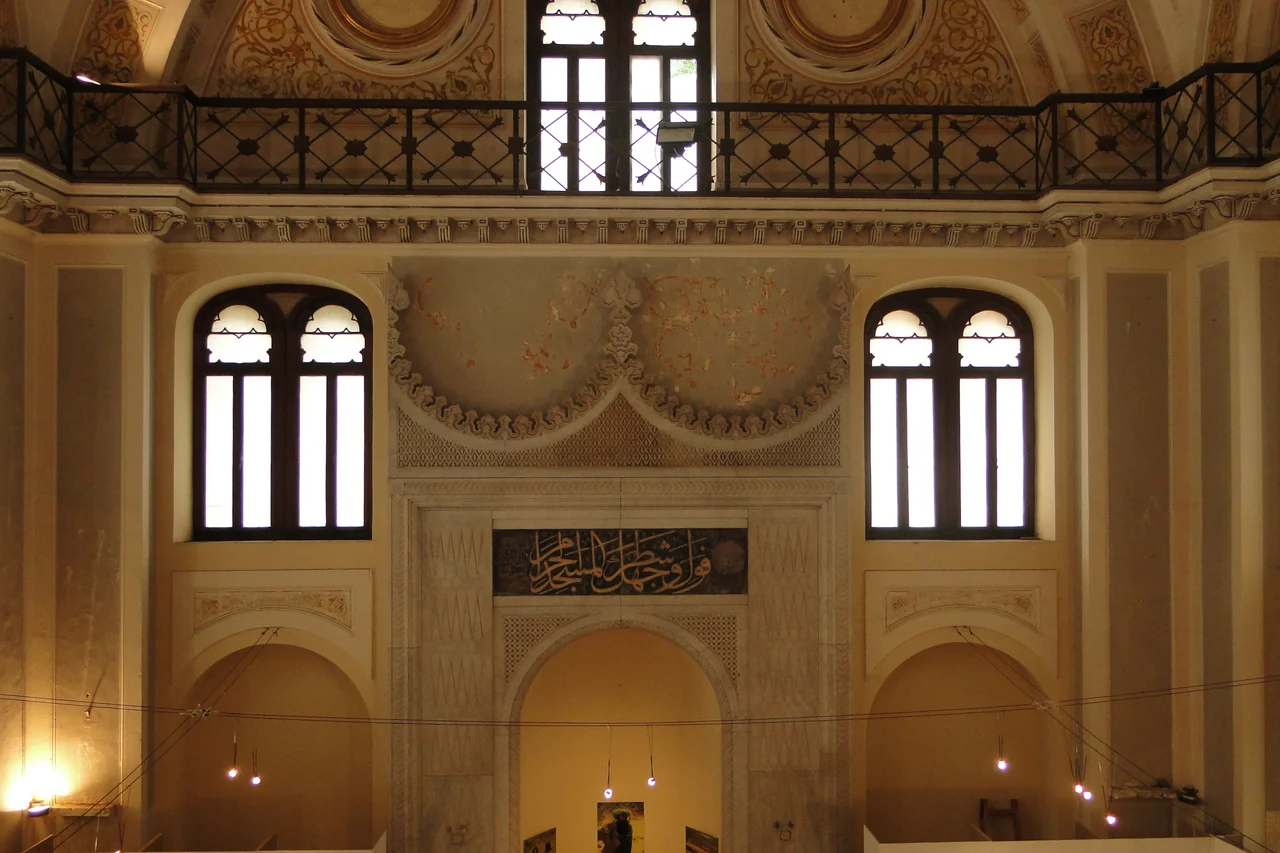

Yeni Mosque, Thessaloniki
The Italian architect Vitaliano Poselli was commissioned in 1902 to design a mosque for a community whose religious identity defied the categories of the Ottoman Empire it served. The result was the building locals call Yeni Cami — the New Mosque — and what Mark Mazower described as art nouveau meets a neo-Baroque Alhambra, with a discreet hint of the ancestral faith in the star-of-David patterns worked into its windows. It was the last mosque built in Thessaloniki under Ottoman rule. The community it served, the Dönmeh, would not survive in this city for another generation.
Who the Dönmeh Were
In 1666 a Sephardic rabbi named Sabbatai Zevi declared himself the messiah, gathered an enormous following across the Jewish world, and was promptly summoned to Constantinople by an alarmed Ottoman sultan and given a choice: convert to Islam or be executed. He converted. Most of his followers were devastated and returned to mainstream Judaism. But several thousand families, mostly in Salonika, made the same choice as their leader and converted to Islam outwardly while continuing to observe Jewish practices in private. They became known as the Dönmeh — a Turkish word that originally carried derogatory weight, though the community itself accepted the name. By the late nineteenth century there were perhaps ten to fifteen thousand Dönmeh in Thessaloniki, organized into three internal sub-groups, prominent in the city's commerce and intellectual life, kept at arm's length by both their Muslim neighbors and their Jewish ones.
The Building Poselli Made
Vitaliano Poselli designed the mosque in the eclectic style Europe was producing at the turn of the twentieth century. There are Baroque elements and Renaissance ones, neoclassical columns and traditional Islamic ornament — a hemispherical dome over a square prayer hall thirteen and a half meters across, a colonnade separating the prayer space from the entrance vestibule, a sundial inscribed in Ottoman Turkish, and inscriptions in both Italian and Turkish bearing Poselli's signature. Six-pointed star patterns appear in the window grilles, half-acknowledging the community's Jewish ancestry. The building faces Mecca, which means it sits at an awkward angle to the surrounding street grid — a small geometric reminder that mosques and city plans operate by different orientations.
1923
After the Greco-Turkish war ended in 1922, the Lausanne Convention of January 1923 mandated a population exchange between Greece and Turkey on the basis of religion. Orthodox Christians living in what was now Turkey were sent to Greece. Muslims living in what was now Greece were sent to Turkey. The Dönmeh, however much of their internal life remained Jewish, were officially Muslim. They had to leave. About fifteen thousand people were uprooted from a city their families had lived in for two and a half centuries and resettled mostly in Istanbul. The community has never reformed in any one place. The Yeni Mosque, abandoned by the people it had been built for, was used briefly to shelter Greek Orthodox refugees arriving from Asia Minor before being shut down. Its minaret and fountain were demolished in 1938 to make room for what would become its next life: an archaeological museum.
What Happens to a Building
From 1925 to 1963 the Yeni Mosque housed the Archaeological Museum of Thessaloniki, before a purpose-built museum opened nearby. The marble sarcophagi and ancient stelae once displayed inside still lie scattered in the courtyard, slowly weathering, never reinstalled. The municipality acquired the building in 1986 and turned it into an exhibition space. In 2012 the Muslim community of Thessaloniki was allowed to use the building for prayer for the first time in ninety years — three people came. In April 2024, ahead of the Eid al-Fitr that ends Ramadan, the city opened the building for celebrations led by an Egyptian imam in Greek and Arabic, the first such observance there in 102 years. The Dönmeh themselves have never returned. Their building still stands, still beautiful, still unsettled, holding the memory of a community that was forced into existence by one religious crisis and forced out of its home by another, three centuries apart.
From the Air
Yeni Mosque, Thessaloniki: 40.6155 N, 22.9567 E, in the Hamidiye district of southeastern Thessaloniki, northern Greece, about 1.3 km southeast of the White Tower. Best viewed below 2500 feet. The mosque has a hemispherical dome over a roughly rectangular structure; its minaret and fountain were demolished in 1938, so it lacks the obvious profile of most mosques. Use the White Tower or the Thermaic Gulf coastline as primary visual landmarks. Thessaloniki Airport (LGTS) is about 12 km south on the coast. Class D airspace around LGTS.
Nearby Stories
- Battle of Kilkis (1944) 14 km away
- Byzantine Empire under the Palaiologos Dynasty 15 km away
- Vergina 28 km away
- Battle of Spartolos 28 km away
- Mount Olympus 41 km away
- Battle of Philippi 62 km away
- Battle of Athos 124 km away
- Ohrid 144 km away