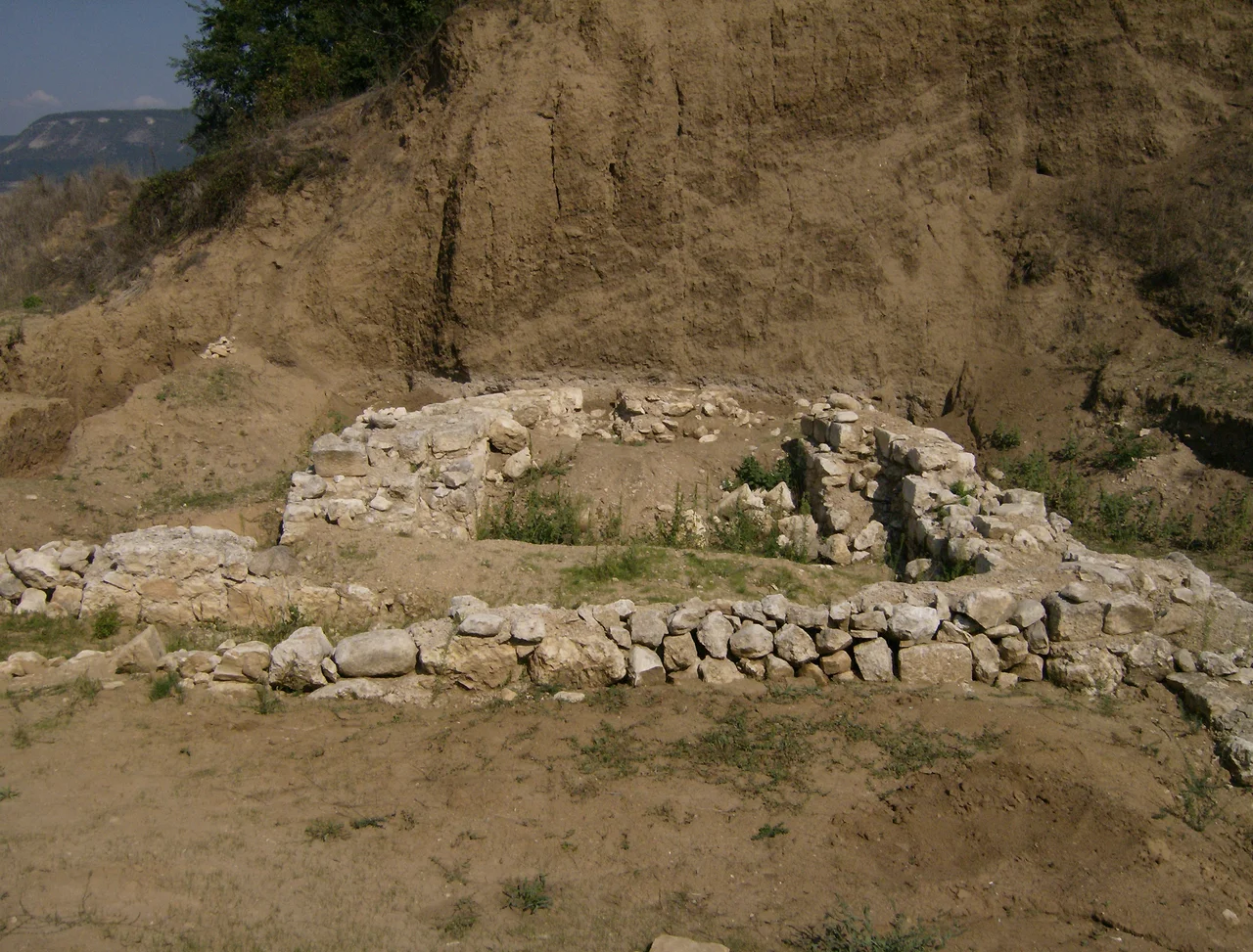

Palace of Omurtag
Two civilizations are buried under the same field. Beneath the village of Han Krum in northeastern Bulgaria, archaeologists have uncovered the fortified palace of Omurtag, ruler of the First Bulgarian Empire from 815 to 831 CE, a Bulgar khan who worshipped the sky-god Tangra and resisted the spreading Christianity of his neighbors. Beneath that palace, in older layers, they have found the foundations of four Late Antique churches, a basilica, a bath, and Gothic graves with chain mail and gold-inlaid brooches. This was the world of Ulfilas, the 4th-century Gothic bishop who translated the Bible into the Gothic language and gave Christianity to peoples who would later sweep across Rome.
Who Was Omurtag
Omurtag inherited an empire from his father Krum, the fearsome khan who had killed the Byzantine emperor Nikephoros I in battle in 811 and reportedly turned his skull into a drinking cup. Where Krum was a conqueror, Omurtag was a builder and an administrator. He signed a 30-year peace treaty with Byzantium, organized the Bulgar state into administrative regions, and erected stone monuments commemorating his works, several of which survive. The famous Chatalar Inscription of 822, written in Greek, describes a fortress and palace he built on the Tica River, which historians eventually matched to this site at Han Krum. He was a pagan to the end of his life, ruling under the title kanasubigi, a phrase that means roughly khan from God or khan by God's grace, blending steppe political theology with whatever Christian terminology he had absorbed from Greek scribes.
The Older Christianity
Long before Omurtag's rampart rose here, this place belonged to the Goths. In the 4th century CE, before the Huns drove them west, Gothic foederati lived across this stretch of the lower Danube basin. The most famous of them was Ulfilas, also called Wulfila, a bishop of Arian Christianity who translated the Bible into the Gothic language at Nicopolis ad Istrum, not far away. Excavators here have identified four Late Antique churches, dating roughly between 250 and 650 CE. Two were built one on top of the other. One small church, unearthed in 1976, has been tentatively identified by its excavator Todor Balabanov as a personal chapel of a high-ranking Goth, possibly Ulfilas himself. The faintest traces of Christian frescoes on its walls are believed to be the oldest in Bulgaria. The Hunnic invasions of the 5th century probably destroyed the churches. The Goths who survived moved on. The buildings sat empty for centuries.
Bulgar on Top of Goth
When Omurtag chose this site for his palace in the early 9th century, he did not know about the Gothic basilica or the bishop. He saw a defensible hill near the Tica River, close to his capital at Pliska, and he ordered a fortress built. The rampart at Han Krum is smaller than Pliska's but follows the same defensive logic: thick stone walls, towers at the corners, a gate facing the safest approach. Within the walls, archaeologists have found a pagan sanctuary where animal sacrifice was practiced. Buried carcasses of rabbits and dogs lie in pits. A plastered stone with carved channels allowed sacrificial blood to flow into a collecting basin. The Bulgar elites of the early 9th century practiced their old steppe religion alongside whatever Christian traditions had survived in the conquered Slavic populations around them. Omurtag himself, late in his reign, reportedly executed Christian missionaries who had converted his sons. Two of those sons would later embrace Christianity anyway.
Layered Discovery
Excavations began in 1957 but progressed slowly under the Communist government, which had limited funds for archaeology that did not directly serve nationalist narratives. After 2000, joint Bulgarian and German teams resumed serious work. They unearthed Gothic graves containing medical kits, chain mail, and characteristic Germanic jewelry: belt buckles, fibula brooches inlaid with gold and gemstones, decorated with stylized animal motifs. They found that the medieval Bulgar site was inhabited for more than 150 years, from 822 until the late 10th century, when the fortress was finally razed, possibly during Byzantine campaigns against the First Bulgarian Empire. Even after the fortress fell, people kept living here, building modestly on top of the ruins. In 2009, archaeologist Kremena Stoeva discovered a fifth church, this one dating to the 10th century, after Bulgaria had officially converted to Christianity in 864. It has three naves and three apses, and it stands as evidence that the site continued to matter, religiously and politically, after Omurtag's pagan world had ended.
Standing in the Field
Today the site is open ruins under open sky, low stone walls tracing rooms whose roofs collapsed a thousand years ago. The Bulgarian countryside around it is rolling, agricultural, mostly empty. The village of Han Krum, named for a different khan, sits a short walk away. The Chatalar Inscription itself, the stone text that helped identify this place as Omurtag's palace, is held now in a museum at Shumen, the regional center. There is no grand visitor experience here, no recreated palace or museum building. Just stones, grass, and the layered presence of Goths and Bulgars and the slow Christian centuries that followed both. Ulfilas's translation of the Bible into Gothic survives only in fragments, but it remains the most important early evidence we have for the Gothic language and for the spread of Christianity among the Germanic peoples of the late Roman world. Some of that history happened here, in this field, before Omurtag and his fortress arrived to bury it.
From the Air
The Palace of Omurtag site sits at 43.1853 N, 26.8983 E near the village of Han Krum in Shumen Province, northeastern Bulgaria. From above, the ruins are difficult to spot from cruising altitude; look for the village of Han Krum and the Tica (Ticha) River valley, with the larger fortified outline of Pliska, the First Bulgarian Empire's capital, about 23 km north-northeast. Varna International (LBWN) is 75 km east; Burgas (LBBG) is 110 km southeast; Sofia (LBSF) is 350 km west. Recommended viewing altitude 1,000 to 2,500 ft AGL with sun at low angle for relief shadows.
Nearby Stories
- Varna Necropolis 37 km away
- Tsarevets Fortress 59 km away
- National Transport Museum, Bulgaria 59 km away
- Buzludzha Monument 81 km away
- Bucur Church 128 km away
- Bridges of Edirne 136 km away
- Battle of Constantinople (922) 156 km away
- Danube Delta 258 km away