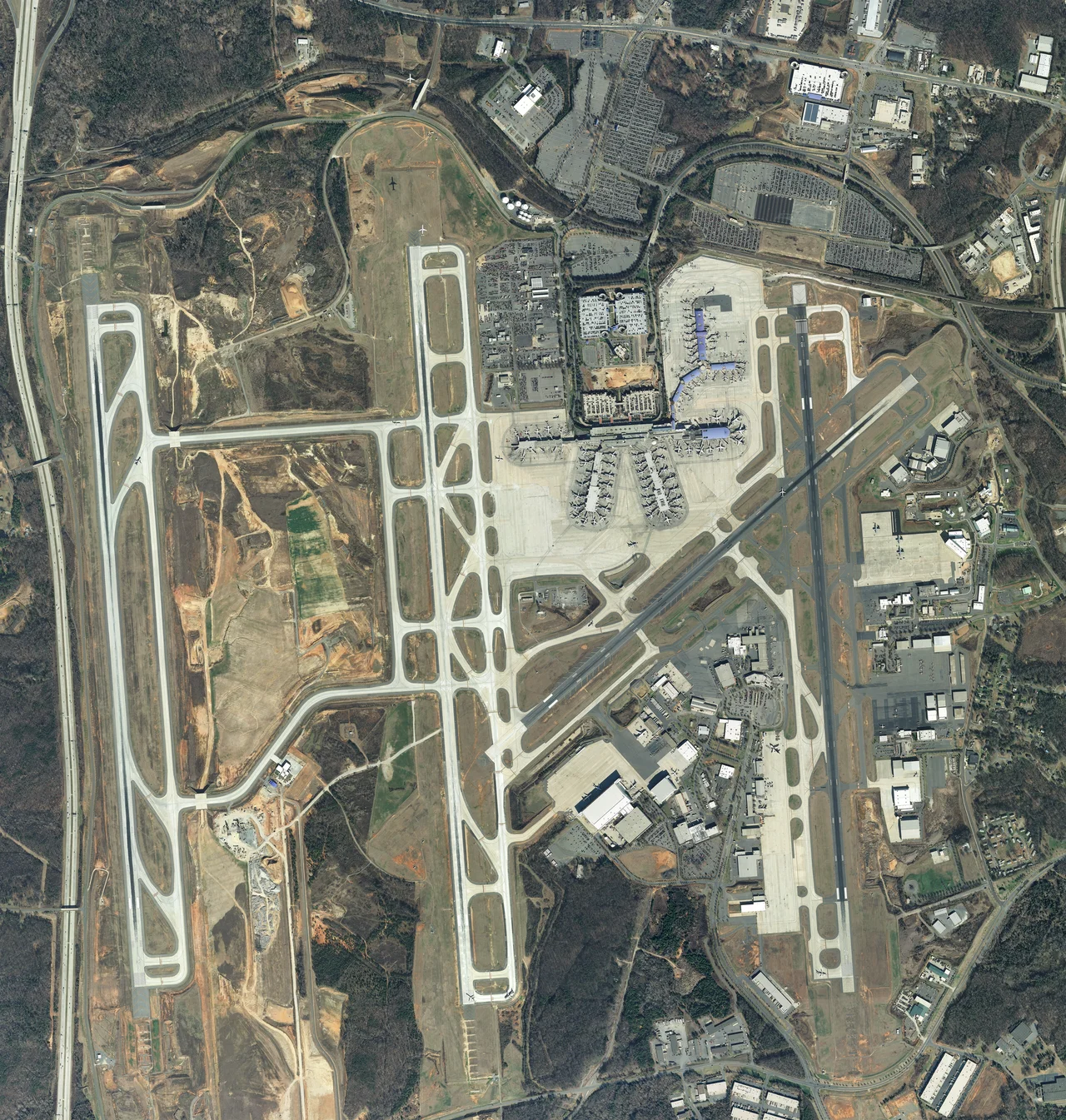

Charlotte Douglas International Airport
The largest single project the Works Progress Administration ever funded in the United States was not a bridge or a dam. It was an airport in Charlotte. In 1935, with the country still climbing out of the Depression, WPA workers laid out a terminal, a hangar, a beacon tower, and three runways on 5,558 acres of red Carolina clay west of town. The hangar they built in 1936 still stands on the field, watching American Airlines jets push back from the same ground where Eastern Air Lines began scheduled service in 1937.
Morris Field Goes to War
The Army Air Forces took the field in early 1941 and renamed it Morris Field after Pearl Harbor. Over the next five years, the military poured more than five million dollars into the airfield - runway extensions, hangars, dispersal pads, training facilities. When the war ended and Charlotte got its airport back in 1946, what returned to the city was not the modest municipal field of 1936 but a hardened, expanded facility ready for the postwar airline boom. Eastern took the west pier. Piedmont and Delta worked the center. United and Southern Airways shared the east. The bones of a hub were already in place, even if nobody quite called it that yet.
Piedmont Picks Charlotte
Airline deregulation hit in 1978, and passenger numbers at Charlotte nearly doubled in two years. In 1979 Piedmont Airlines made the decision that would define the next half-century of the city: it chose Charlotte as the hub for its expanding network. A new 325,000-square-foot terminal opened in 1982, designed by Odell Associates, and the field took its current name. Piedmont was eventually absorbed by USAir, USAir became US Airways, US Airways merged with America West in 2005, and US Airways merged with American Airlines in 2013. Through every reshuffle, Charlotte stayed a hub. Today it is American's second-largest, behind only Dallas/Fort Worth.
The Airbus from the Hudson
In June 2011, the Sullenberger Aviation Museum on the airport's grounds acquired N106US - the US Airways Airbus A320 that Captain Chesley Sullenberger ditched in the Hudson River on January 15, 2009, after a bird strike took out both engines. The aircraft was donated by AIG and delivered to Charlotte that summer. It sits in the museum's Innovation Nation gallery in as-recovered condition, everything aboard except the passengers' personal belongings. The Miracle on the Hudson aircraft is about 35 years younger than any other commercial airliner displayed in an American museum. Most museum airliners are retired veterans. This one is a survivor.
Destination CLT
Between 2007 and 2015, CLT spent $1.5 billion on construction. Then it kept going. Destination CLT, the current master plan, represents another $2.5 billion. A new sixteen-lane terminal roadway opened in late 2019. Concourse A North added nine gates the year before, anchored by a 139-foot digital artwork called Interconnected by Refik Anadol that turns the airport's own air-traffic data into ever-shifting visuals. A new 370-foot FAA control tower south of the terminal replaced the old tower - now the second-tallest air traffic control tower in the United States, behind only Atlanta's 398-foot tower. Ground broke in 2023 on a fourth parallel runway, scheduled for 2027. The airport served 50.2 million passengers in 2019, then a record 58.8 million in 2024.
The Overlook and the Rocking Chairs
Two small details make Charlotte stand out among American hubs. The first is the Overlook, a public viewing area where visitors can watch aircraft taxi to runway 18R/36L. There are bathrooms, food trucks, a children's playground, and a restored F-4 Phantom II on display. The second is the rocking chairs - white wooden rockers placed throughout the concourses, an idea borrowed from Southern porch culture and adopted by exhausted travelers everywhere as a kind of unofficial state symbol. For a fortress hub processing tens of millions of connecting passengers a year, CLT has kept hold of something the larger airports lost. People sit. They rock. They wait.
From the Air
Charlotte Douglas International (KCLT) sits at 35.214 N, 80.943 W, roughly 6 miles west of uptown Charlotte. Three operating runways (18L/36R, 18C/36C, 18R/36L) with a fourth under construction west of the existing trio. Field elevation 748 feet. Nearby: Concord-Padgett Regional (KJQF) 18 miles northeast, Statesville Regional (KSVH) 45 miles north, Hickory Regional (KHKY) 60 miles northwest. The 370-foot new tower south of the terminal is a striking visual landmark from any approach.
Nearby Stories
- Winthrop University 4.4 km away
- Reed Gold Mine 5.7 km away
- Grace Evangelical and Reformed Church 8 km away
- Gardner-Webb University 9.8 km away
- 2025 North Carolina Cessna Citation II Crash 30 km away
- Spartanburg 34 km away
- Joara 38 km away
- Cheraw, South Carolina 64 km away