.jpg)
Chikan, Kaiping
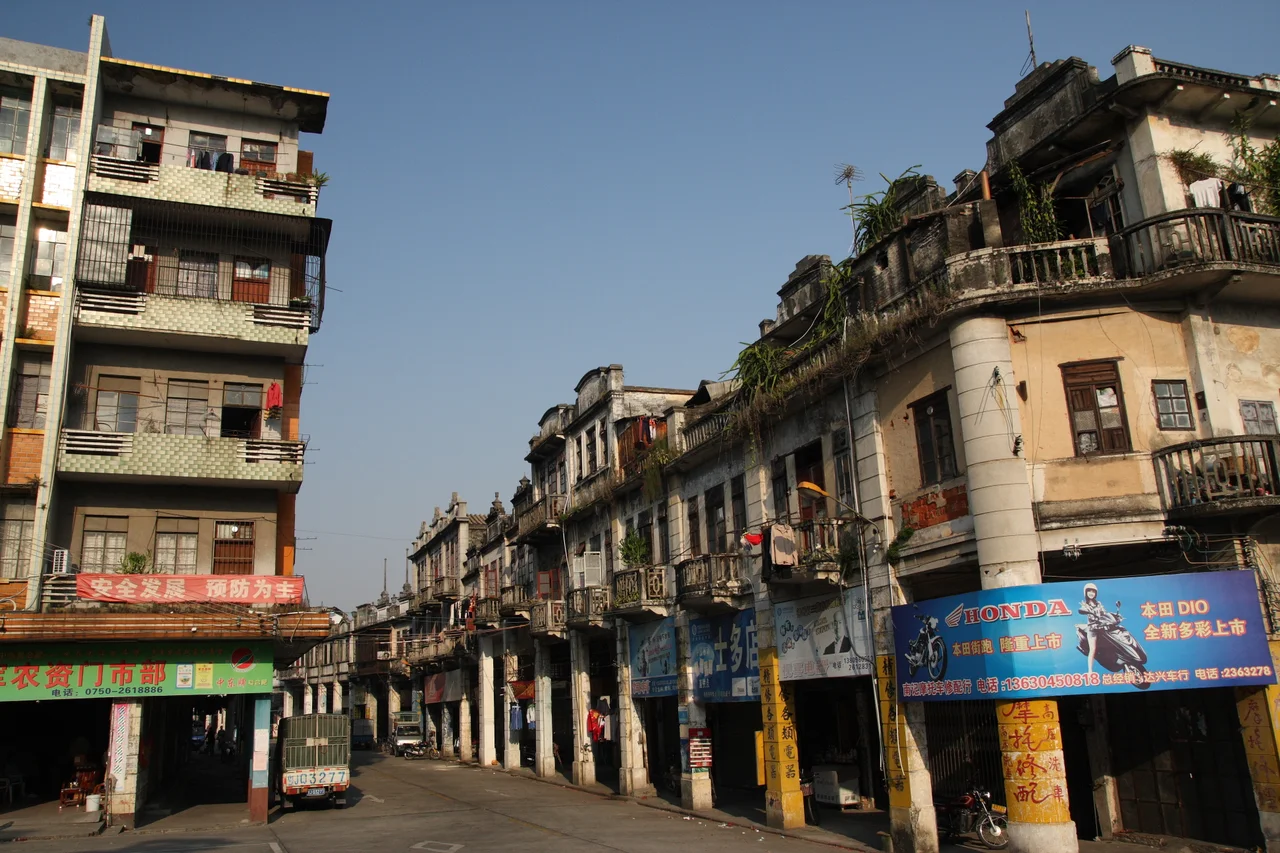
There are more people from Chikan living abroad than there are living in Chikan. That single fact shapes everything about this old town on the Tan River — its architecture, its clan rivalries, its periods of prosperity and abandonment, and the extraordinary buildings that still line its streets. When the overseas Chinese who left for North America, Southeast Asia, and Australia sent money home, they sent ambitions with it: visions of what a building should look like, fragments of styles picked up in faraway cities, a determination to prove that the village they had left behind was as sophisticated as anywhere they had gone. Walk the old town today and you walk through the evidence.
A River Town That Built Itself on Departures
Chikan was founded in 1649, originally part of Xinhui County. The Tan River, which surrounds it on all sides, made it a natural hub for waterway commerce; a pier was recorded by 1676. By the late nineteenth century, Chikan had become the primary maritime transportation center for Kaiping county, its ferries connecting the inland Pearl River Delta to the markets of Jiangmen. The town's prosperity and its role as an emigration gateway went together — boats left for Jiangmen and beyond, and some of those who boarded them eventually reached California, Canada, and Australia. The silting of the Tan River in the twentieth century ended Chikan's role as a working port. What it left behind was the town itself: a three-kilometer stretch of late Qing and early Republic architecture, over 600 historic Tong lau qilou buildings, intact and mostly empty, preserved less by design than by being left alone.
The Arcade Streets and Their Makers
Qilou — also called Tong lau — are the covered arcade buildings that define Chikan's streetscape. Their ground floors open to covered walkways for pedestrians; upper floors provide commercial or residential space. In Chikan, the emigrants who funded their construction brought back architectural references from every place they had been: Baroque cornices sit above Chinese roof ridges; Roman arches frame doorways that open onto Cantonese courtyards. UNESCO calls this hybrid style 'Qiaoxiang architecture' — literally, 'emigrant home style.' In 2005, the density of historic buildings prompted the creation of Chikan Studio City, and the streets have since served as locations for period films including The Grandmaster and Drunken Master II. Filmmakers keep coming back because the buildings are the real thing: not a reconstruction but a surviving original, worn and sun-faded and stubborn.
Nan Lou: Seven Days in a Tower
Among the diaolou watchtowers scattered through Chikan township, one stands apart. Nan Lou, the Southern Tower, is a defensive diaolou in Chikan town. In the summer of 1945, seven members of the Situ clan climbed to its upper floors and refused to surrender as Japanese forces advanced into Chikan. They held the tower for seven consecutive days. When the Japanese eventually deployed poison gas against the defenders, all seven were captured and killed. A monument now stands on the Tanjiang riverside in their memory. The story of those seven people does not appear in most histories of the Pacific War — they were local men defending their town, not soldiers in any formal sense — but the tower still stands, and the plaque at the river's edge is still there.
Clan Libraries and the Weight of Remittances
The Situ and Guan clans have dominated Chikan for centuries, and their rivalry shaped the town's built environment in a way that reads almost like architectural one-upmanship. In 1923 the Situ clan used overseas donations to build a public library — Situ's Library — which opened in 1926 at a cost of more than 30,000 silver dollars. The Guan clan, feeling their reputation was at stake, built their own Guan's Library at comparable scale, opening in 1931. Both were funded by emigrants who had never stopped thinking of Chikan as home. After 1949 the libraries became government offices; after 1968 they were abandoned. Only in the 1980s, with economic reform and a new wave of overseas donations, were they reopened. The libraries outlasted the clan system that built them, the ideological campaigns that repurposed them, and the decades of neglect that followed. They are still there.
A Town Waiting to Return to Itself
In April 2017, the government announced a 6-billion-yuan renovation plan for Chikan's historic old town — a project projected to cover nearly 4,000 historic homes. The scale of the plan reflects both the scale of the architectural heritage and the scale of the problem: buildings abandoned when their owners emigrated, maintained by nobody, slowly weathering toward collapse. The hope embedded in the plan — that development would attract overseas Chinese descendants to return — carries a particular poignancy in a town that has defined itself by departure for more than a century. Whether the renovation transforms Chikan or simply changes it is a question the town's diaspora, scattered across four continents, will ultimately help decide.
From the Air
Chikan sits on the Tan River in Kaiping county, Guangdong province. Coordinates: 22.32°N, 112.58°E. At 2,000–3,000 feet the Pearl River Delta's flat geometry of waterways, rice paddies, and clustered towns is visible in all directions. The characteristic rooflines of the qilou arcade streets are not easily distinguishable from altitude, but the town's position on the river bend is clear. The nearest airport is Jiangmen Xinhui Airport (ZGSD), approximately 25 km to the east. Guangzhou Baiyun International Airport (CAN / ZGGG) is about 100 km to the northeast.
Nearby Stories
- Zhongshan 16 km away
- Lampacau 30 km away
- Xinhui, Jiangmen 37 km away
- Wanshan Archipelago Campaign 57 km away
- Battle of Nanpeng Island 68 km away
- Temple of the Five Lords 287 km away
- Cua Ong Temple 512 km away
- Erhai Lake 1266 km away