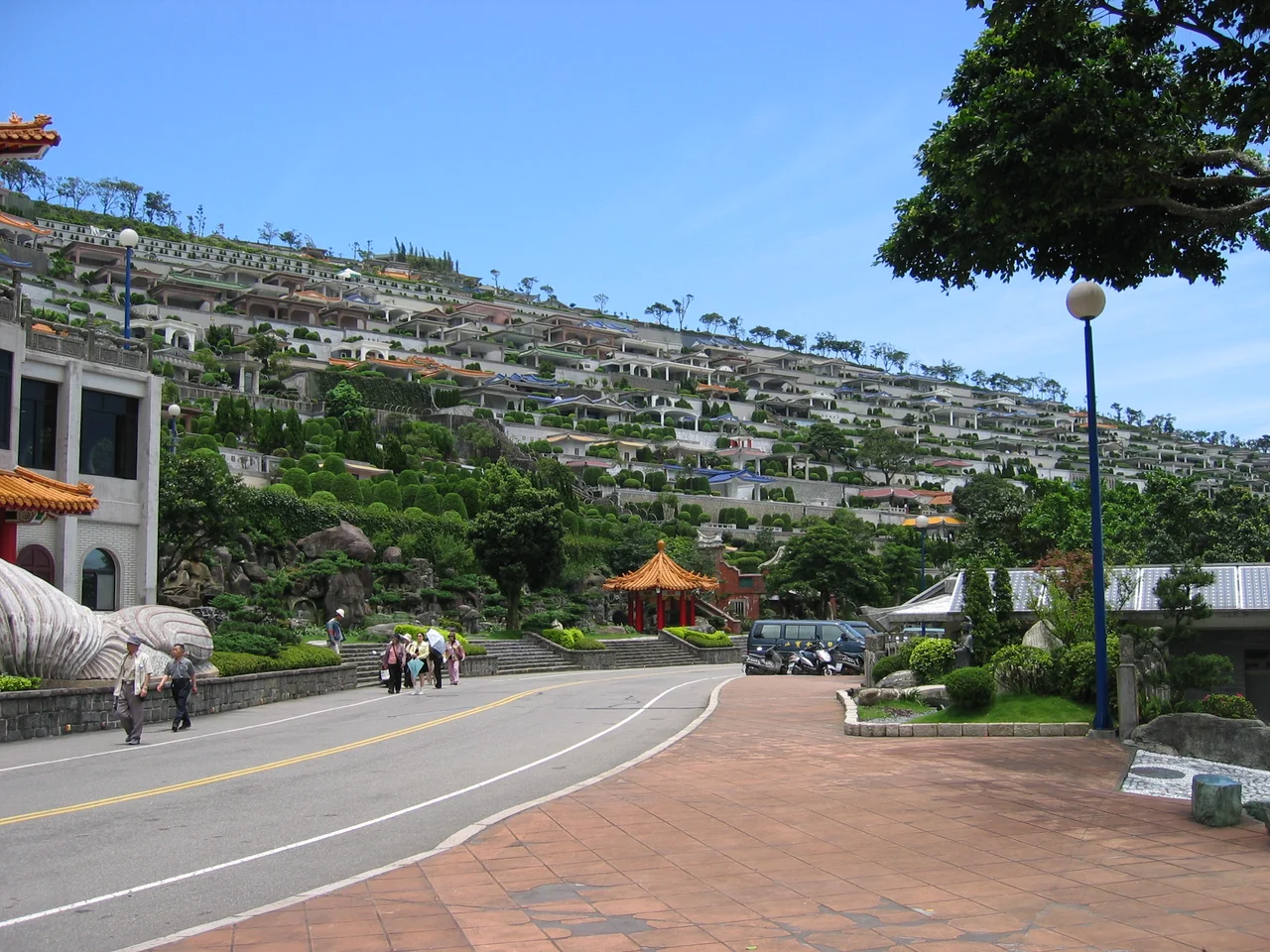

Chin Pao San
There is a keyboard set into the earth at Chin Pao San, and people step on its keys. Not carelessly — with intention, the way you might press a key to hear a single note, to let the sound carry for a moment before it fades. The keyboard is part of Teresa Teng's memorial garden, and the people who walk across it are doing something that, in a different context, would look like play. Here, it is something else: a way of touching the music of a woman who died in 1995 and is still, by some measures, one of the most beloved singers in East Asia. The notes drift across the hillside, above the terraced grounds where urns are set both indoors and out, and beyond the slope the East China Sea holds the horizon.
A Hillside Above the Sea
Chin Pao San — also written Jinbaoshan — occupies a mountainside in Jinshan District, in the northern reaches of New Taipei. The location was chosen with care. The site looks down over the Ju Ming Museum, named for the Taiwanese sculptor whose work fills the adjacent grounds, and beyond the museum the terrain opens to the East China Sea. On clear days the water is visible from the upper slopes, a blue line at the edge of the land. The cemetery is accessible to visitors using wheelchairs, a practical detail that reflects the site's understanding of itself as a place for families — for the living who come to remember, not only for the dead who rest there. Mountains bracket the grounds on the inland side; the sea anchors the view to the north.
Art Among the Graves
What distinguishes Chin Pao San from an ordinary burial ground is the deliberate presence of art throughout the property. The grounds and interiors hold original works by a number of artists, with Ju Ming's sculptures prominent among them — his modernist, often monumental figures appearing across the site with the same authority they carry at the museum below. The sculpture here tends toward the symbolic rather than the literally religious: forms that speak to passage, memory, and transformation without insisting on a specific creedal interpretation. Buddhist and Taoist imagery appears most frequently, reflecting the religious traditions of most families who rest here, but the range is wider than that. One of the main buildings gives explicit space to Christian iconography, and the site as a whole makes room for the full spectrum of belief that Taiwan's population carries. The art does not impose a single meaning. It opens space for the mourner to bring their own.
Teresa Teng, Still Remembered
Among all the graves at Chin Pao San, one receives the most visitors. Teresa Teng — Deng Lijun in Mandarin — died in May 1995 in Chiang Mai, Thailand, at the age of 42. She had been performing since childhood, had recorded across multiple languages and decades, and her voice had carried across borders in ways that outlasted the political divisions of her era. During the Cultural Revolution, when her recordings were officially banned on the mainland, they circulated in secret, played on smuggled cassette tapes. A saying that circulated in that period reflected her reach: "By day, listen to Deng Xiaoping; at night, listen to Teresa Teng." The memorial garden at Chin Pao San honors her with a life-size statue and the keyboard set into the ground, an invitation to participate in her music rather than only observe it. Families come here from Taiwan, from mainland China, from Hong Kong and Japan and Southeast Asia.
The Families Who Come Here
Any cemetery is, at its core, a place made by and for families. The decisions that bring someone to rest at Chin Pao San — the choice of this particular hillside, this particular view, this particular community of remembrance — belong to the families who make them, often after much deliberation and sometimes across distances. The site's accessibility, its art, its views, and the quiet dignity of its maintenance are all part of what families weigh. Urns are placed both in interior columbarium spaces and in outdoor settings, allowing families to choose the kind of resting place that matches their traditions and their wishes. On weekends and during the Qingming Festival each spring — when families across Taiwan and much of East Asia visit and tend the graves of their relatives — the grounds fill with the particular sounds of family life: quiet voices, the occasional weeping, children who do not yet understand but are learning what remembrance means.
Where Art and Memory Meet
The pairing of Chin Pao San with the Ju Ming Museum below it is not incidental. Ju Ming — born Zhu Ming in 1938 — is one of Taiwan's most celebrated sculptors, known for his Taichi Series and his monumental public works. The museum that bears his name holds a large collection of his pieces in a landscape setting, and the aesthetic sensibility that shaped the museum informed what was built on the hillside above it. The result is a cemetery that does not look or feel like most cemeteries — it looks like a place where something has been thought about carefully, where the placement of a stone figure or the angle of a path was considered in relation to the slope and the view and the people who would walk there carrying whatever they carried. That thoughtfulness is part of what draws visitors who are not coming to visit a specific grave, but simply to be somewhere that takes the weight of memory seriously.
From the Air
Chin Pao San sits at approximately 25.251°N, 121.604°E on a hillside in Jinshan District, northern New Taipei, close to the north coast of Taiwan. From the air, the site is identifiable as the terraced grounds on the southern slope of the coastal hills near Jinshan, with the East China Sea visible to the north. The nearest major airport is Taipei Songshan (RCSS), approximately 22 nautical miles to the south-southwest. Taipei Taoyuan (RCTP) is approximately 35 nautical miles to the southwest. The coastal terrain here is hilly; the ridgeline above Jinshan rises to several hundred feet. In clear conditions, the blue of the sea and the green of the hillside cemetery grounds make Chin Pao San straightforward to locate from a low cruise altitude.
Nearby Stories
- Sanxia Car Attack 9.6 km away
- Dapu Incident 28 km away
- 2022 Chinese Military Exercises Around Taiwan 45 km away
- North Jiangsu Main Irrigation Canal 960 km away
- General Cliff Rock Paintings 1031 km away
- Sinking of MV Sewol 1042 km away
- Yellow Sea 1091 km away
- Twin Forts of Romblon 1377 km away