
Clemson, South Carolina
The town and the university are separate legal entities, but no one in Clemson, South Carolina pretends they are separate places. The population swells from about 17,700 to nearly 50,000 when school is in session. The Amtrak Crescent rolls into town on tracks that pass within walking distance of the football stadium. Lake Hartwell laps at the western edge of both the city and the campus. On football Saturdays the town becomes a logistics problem dressed in orange. The rest of the year it is a small Piedmont college town with botanical gardens, a 1789-era stone church and cemetery, and a complicated history written into the buildings that bear John C. Calhoun's name.
Fort Hill, and the Family Who Lived There
The plantation at the center of present-day Clemson University is called Fort Hill. It was the home of John C. Calhoun, seventh vice president of the United States, senator, secretary of state, slaveholder, and the most influential American defender of slavery in the antebellum period. He died in 1850. His daughter Anna Maria had married Thomas Green Clemson in 1838, and through that marriage the Calhoun family's enslaved labor and inherited estate eventually became Thomas Clemson's. When he died in 1888, he willed Fort Hill and most of the property to the state of South Carolina to establish a college of agriculture and mechanical arts. The school that became Clemson University in 1893 was built on land worked by enslaved people, with the support of state legislator Benjamin Tillman, whose own legacy includes the violent restoration of white supremacy in post-Reconstruction South Carolina. The Fort Hill house still stands at the center of campus. So does the question of what to do with that history.
The Old Stone Church
Before the university and before the town, there was a Presbyterian congregation that built a fieldstone meetinghouse here in 1797. The Old Stone Church and Cemetery sits on a low hill about a mile from campus, the oldest building in Pickens County and one of the oldest in upstate South Carolina. Andrew Pickens, the Revolutionary War general, is buried in the churchyard. So is his descendant John C. Calhoun's mother-in-law Floride Calhoun, alongside generations of upstate families. The church itself is plain to the point of austerity, the way a frontier Presbyterian congregation built in 1797 was supposed to be. It is on the National Register of Historic Places, as is the cemetery. The cemetery's headstones are a quiet running history of who lived and died in this corner of the Piedmont before the railroad and the university arrived.
South Carolina Botanical Garden
The 295-acre South Carolina Botanical Garden, on the Clemson University campus, is one of the older botanical gardens in the South and the only state-designated one in South Carolina. It includes the Bob Campbell Geology Museum, the Fran Hanson Discovery Center, a heritage garden of native plants, and walking trails that wind through stream beds and woodland gardens. Hanover House, a 1716 Huguenot building moved to Clemson from its original site near present-day Lake Moultrie, sits inside the garden grounds. The garden is free, open year-round, and busy enough on a spring afternoon to feel like a small park rather than a campus appendage. It is one of the things the town has in unusual abundance: green space that wasn't built for football.
Lake Hartwell, the Mountains, and a Train Through Town
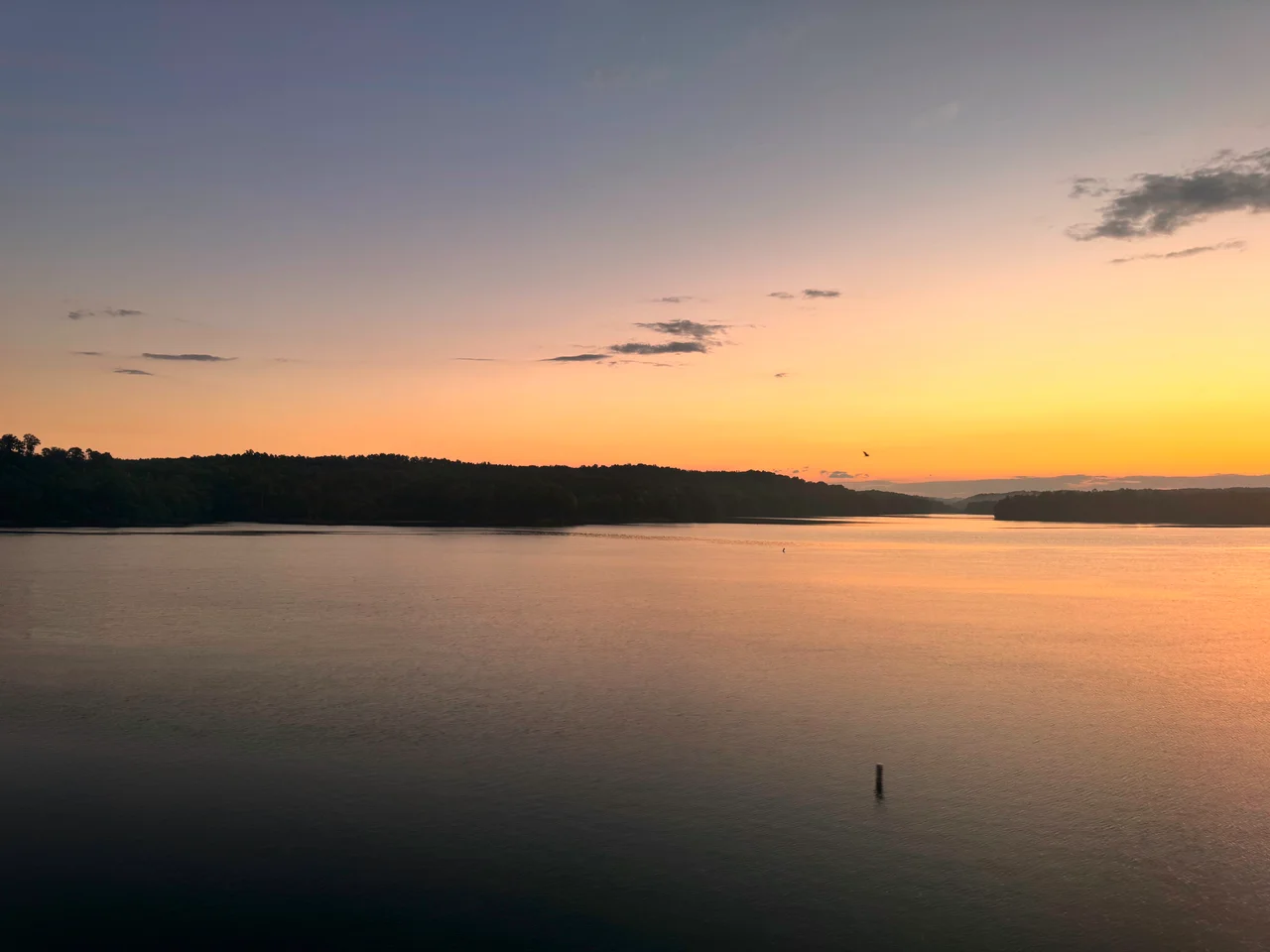
Lake Hartwell forms the western boundary of Clemson, a 56,000-acre reservoir created in 1962 when the Army Corps of Engineers dammed the Savannah River. The Blue Ridge Mountains begin their slow rise about thirty miles north, visible on clear days from the higher ground around campus. Clemson Area Transit, known as CAT, runs free buses through Clemson, Anderson, Pendleton, and Seneca, supported by Clemson University. The Amtrak station at the corner of Calhoun Memorial Highway and College Avenue handles the Crescent route, which runs from New Orleans to New York City and stops at Clemson once daily in each direction. The pronunciation of the town's name, by the way, is settled locally: it is CLEM-son, two syllables, the second one almost swallowed. Anyone who says CLEM-zun or makes three syllables of it has marked themselves as an outsider.
The Town, the Tigers, and the Tension
Clemson the city had about 17,681 residents at the 2020 census. The university has roughly 29,500 students. The math creates predictable strain: parking, housing prices, late-night noise, all the standard college-town tensions made worse by the fact that the university is so much larger than the city it grew next to. In 1992, the city proposed annexing the university. In 1993, the university said no. A 2019 article in the Greenville News described the relationship as strained, with the university's growth outpacing the city's ability to plan around it. The municipal government has tried various coordination mechanisms; the university generally does what it wants. On Saturdays in autumn, none of this matters much. The Tigers play, Memorial Stadium fills, the lake fills with pontoons, and Clemson, South Carolina becomes again what it has been for a hundred years: an orange-and-purple town that knows exactly what it is.
From the Air
Located at 34.685 degrees N, 82.815 degrees W in Pickens County, South Carolina, at the foothills of the Blue Ridge. Clemson University and its 1,400-acre campus dominate the southwest portion of the city. Oconee County Regional Airport (KCEU), about 4 nm west, is the primary general aviation field. Greenville-Spartanburg International (KGSP) lies about 35 nm east. Recommended viewing altitude 4,000 to 6,000 feet AGL. Memorial Stadium is the most distinctive structure from altitude. Lake Hartwell along the western and southern edge is the dominant visual reference. The Blue Ridge escarpment rises 20 to 30 nm north.
Nearby Stories
- Caesars Head State Park 23 km away
- Georgia Guidestones 26 km away
- 1988 Oakland Elementary School Shooting 28 km away
- Battle of Lindley's Fort 32 km away
- Green River (North Carolina) 41 km away
- Tree That Owns Itself 56 km away
- Dahlonega, Georgia 64 km away
- Great Smoky Mountains National Park 71 km away