
Concepción, Chile
Concepción has been destroyed more times than most cities are founded. Earthquakes and tsunamis razed it in 1570, 1657, 1687, 1730, and 1751, and that was before it even reached its current location. Mapuche armies overran and burned it twice in the 1550s. And yet here it stands, the second-largest urban area in Chile, a college town of guitars and granite, the capital of the Biobío Region. To understand Concepción is to understand a place that simply refuses to stay down, that has buried its dead, picked up its name, and started again so many times that resilience is less a virtue here than a habit.
A Fortress on a Hostile Frontier
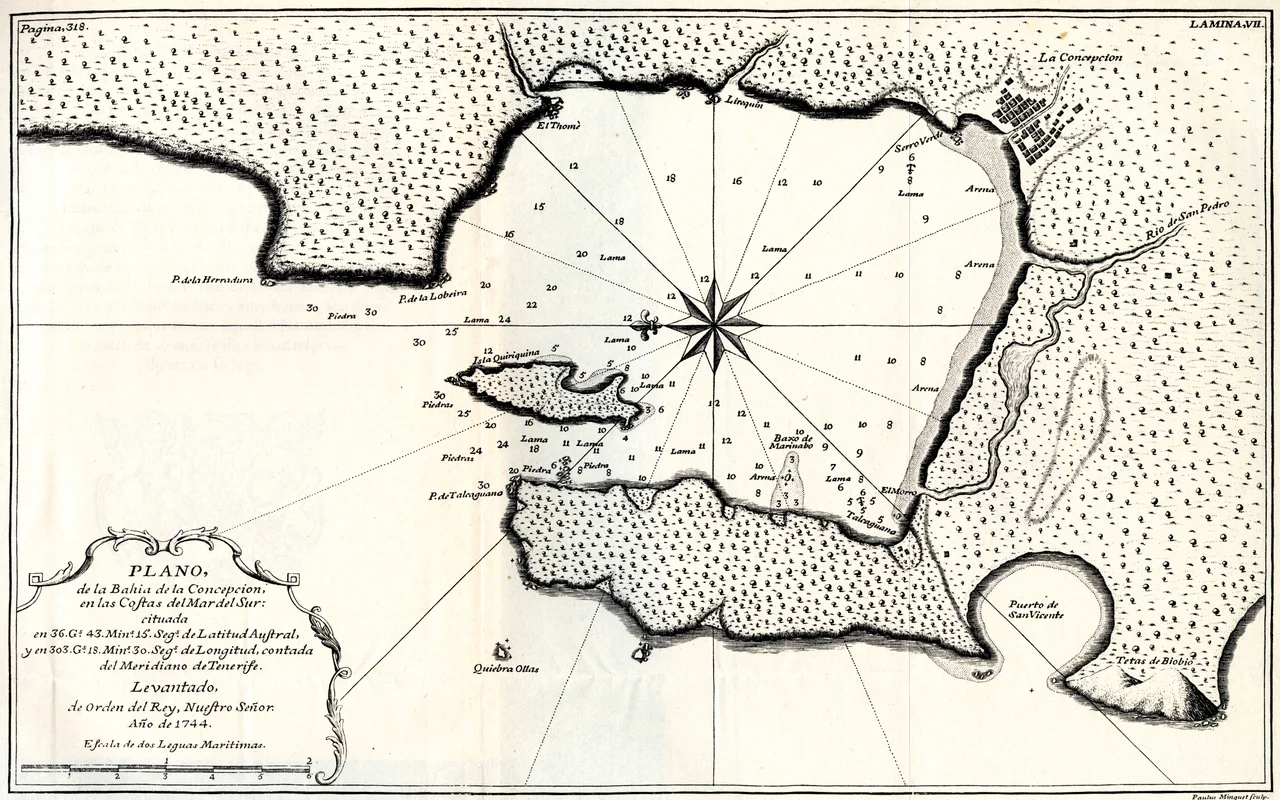
Don Pedro de Valdivia founded Concepción in 1550, planting it on the Bay of Concepción at the site now called Penco, just north of the Bío Bío River. This was no peaceful settlement. It rose right at the edge of La Frontera, the boundary between Spanish territory and the lands of the Mapuche, an Indigenous nation that would defend its independence successfully until the 1870s. The young city paid for its position. Mapuche forces overran and destroyed it in 1554, and again after it was refounded in 1555. Only in 1557 did García Hurtado de Mendoza restore it behind a fort, and the town was formally refounded once more in 1558. For two centuries it served as the military headquarters of the long war in La Araucanía, growing despite sieges to a population of 10,000. Spanish chroniclers noted the local Mapuche wearing gold and silver bracelets and crown-like ornaments, evidence of wealth and craft the newcomers struggled to explain.
The City That Moved
After the catastrophic earthquake and tsunami of 1751, the people of Concepción made a radical decision. They would not rebuild on the coast a fifth time. The entire city relocated inland to the Valle de la Mocha, alongside the Bío Bío River, where it sits today. The original site by the bay lay empty for nearly a century until the present town of Penco was founded there in 1842. This is why the city carries a curious double identity. People from Concepción are called penquistas, after the old coastal location, while people from modern Penco are pencones. The name of a place the city fled survives in the everyday speech of those who replaced it.
Where Chile Swore Its Freedom
For all its military hardship, Concepción became one of the cradles of the Chilean nation. On January 1, 1818, Bernardo O'Higgins proclaimed and swore the oath of Chilean independence in the city's main square, which has been called the Plaza de la Independencia ever since. The city's elites dominated executive power in the young republic until 1851. Concepción's first regional administrator was the Irishman Ambrose O'Higgins, Bernardo's father, who would rise to become Royal Governor of Chile and even Viceroy of Peru, an extraordinary arc from an Irish emigrant to the second-highest office in Spanish South America. The square where the oath was sworn still anchors the city's commercial and civic heart.
The Cradle of Chilean Rock
Today Concepción is best known for two things that seem to pull in opposite directions: its seismology and its sound. It remains one of Chile's great university cities, anchored by the University of Concepción, founded in 1919 as the country's first secular private university, its campanile a beloved landmark. But the city also calls itself the Chilean capital of rock. Bands like Los Tres, Los Bunkers, and Emociones Clandestinas launched their careers here, and the free outdoor Rock en Conce festival, born in 2015, fills the Parque Bicentenario each summer's end. The ground that keeps trying to swallow this city has produced, improbably, a place that sings. On February 27, 2010, a magnitude 8.8 earthquake struck again, killing more than 521 people across the nation and shoving Concepción roughly three meters to the west. The city, as it always has, rebuilt.
From the Air
Concepción sits at 36.83°S, 73.05°W in south-central Chile, on the plain of the Bío Bío River about 500 km south of Santiago. The nearest airport is Carriel Sur International (ICAO: SCIE, IATA: CCP) in neighboring Talcahuano, roughly 8 km from downtown and one of the busiest airports in Chile, serving domestic carriers and acting as a primary alternate for Santiago. From a viewing altitude of 7,000 to 12,000 feet in the area's mild, often clear Mediterranean climate, the city reads as a dense grid where the Bío Bío River meets the Pacific, with the port of Talcahuano (home to Chile's largest naval base) on the coast to the northwest and the original coastal site of Penco visible along the Bay of Concepción. The campanile of the University of Concepción is a useful landmark in the urban core.
Nearby Stories
- Battle of El Roble 7.8 km away
- Chivilingo Hydroelectric Plant 18 km away
- Ninhue 18 km away
- Santa María Island, Chile 25 km away
- Tucapel 47 km away
- 2010 Chile Earthquake 49 km away
- Coal Mining in Chile 51 km away
- 1687 Peru Earthquake 2386 km away