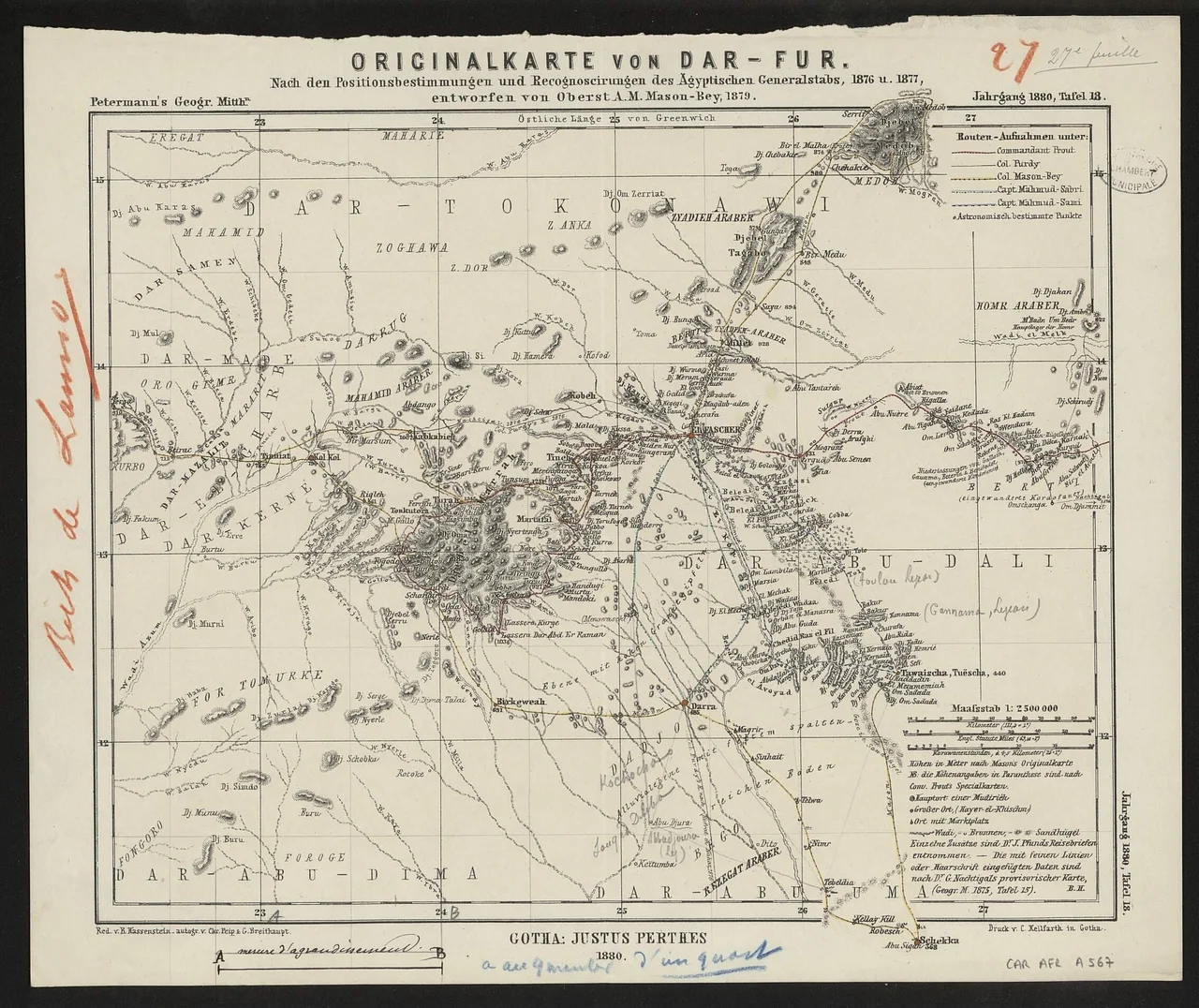

Conquest of Darfur (1873–1874)
Ibrahim Qarad died on horseback. On 25 October 1874, at a place called Manawashi in the southern approaches to the Marrah Mountains, the Sultan of Darfur charged the enemy line with his personal bodyguard. His army, according to an Arabic note written after the battle, did not know of war with rifles. The weapon that killed him was a Remington repeating rifle, carried by soldiers in the service of a Sudanese warlord named al-Zubayr Rahma Mansur, acting on behalf of the Khedive of Egypt. The sacred drum of the Fur Sultanate, called al-mansura, the victorious, was captured. The sultan's body was buried in the mosque of Shaykh Tahir Abu Jamus in Manawashi. The Keira dynasty, which had ruled Darfur as an independent Islamic kingdom for more than three centuries, fell in that single charge.
A Sultanate Older Than Most European Nations
The Sultanate of Darfur had existed since roughly the sixteenth century. Under the Keira dynasty, founded by Musa Sulayman, Darfur became a major Sahelian power, expanding at its height as far east as the Atbarah River and attracting immigrants from Bornu and Bagirmi. Its capital al-Fashir sat in the northern part of Darfur; its economy was built on caravan trade across the Sahara, on cattle, enslaved people, and grain. The sultans were Muslim, the court cosmopolitan. In 1821, Muhammad Ali Pasha's Egyptian army had swept through Sudan and taken Kordofan from Darfur, but Darfur itself remained independent. For fifty years after, successive Egyptian khedives watched Darfur warily, used propaganda against it, and presented it to European powers as a bastion of the slave trade to justify their own interventions.
The Warlord Who Was Not a Sultan
Al-Zubayr Rahma Mansur was one of the most successful traders to emerge from the chaos of Egyptian Sudan. He had moved into the Bahr al-Ghazal in 1856 and effectively controlled the region by 1865, trading in ivory and slaves despite Egypt's increasing anti-slavery rhetoric. He used Baqqara nomads as intermediaries. European travelers called him a villain. In 1866, he reached an alliance with a Baqqara tribe called the Rizayqat, living in the borderlands between his territories and Darfur. By 1873, Sultan Muhammad al-Husayn of Darfur had peeled away a faction of the Rizayqat, and after al-Husayn's death his successor Ibrahim Qarad imposed an embargo on grain exports south. A raid on one of al-Zubayr's caravans killed several of his relatives. The diplomatic correspondence between al-Zubayr and Ibrahim began in June 1873. It ended in war.
Seven Thousand Rifles
Al-Zubayr's army was not large, but it was experienced and well-equipped. Many of its officers had served in the regular Egyptian army. Its soldiers included men from the Azande, among others, and some of its leading generals, Hamdan Abu Anja, al-Zaki Tamal, Abd al-Rahman walad al-Nujumi, Rabih Fadl Allah, would later become major figures in Sudanese military history. Many carried Remington repeating rifles, a technology Darfur had barely encountered. The Fur army, by contrast, had not mounted a major foreign expedition since 1836. It was a small force of heavy cavalry and slave troops designed for internal security. Darfur had only just begun importing firearms and welcoming ex-Egyptian officers when war came. The disparity was decisive before the first shot was fired.
The Race to al-Fashir
Al-Zubayr occupied Dara on 11 February 1874. Within days, the Khedive declared war on Darfur, citing the sultan's aggression and the slave trade as the casus belli, and ordered the Sudanese governor-general Ismail Ayyub Pasha to advance from Kordofan. The Khedive's real purpose was to keep al-Zubayr from conquering Darfur alone, which would have concentrated too much power in the hands of an independent warlord. Campaign slowed in the rains. Sultan Ibrahim offered submission in a letter dated 17 August, delivered by the merchant brothers Hamza and Muhammad Pasha Imam al-Khabir, but al-Zubayr had already declared his intention to annex Darfur. Ibrahim sent his uncle, the emir Hasab Allah ibn Muhammad al-Fadl, south with an army. They besieged Dara. They were driven off. The counter-attack failed. Only then, in October, did Ibrahim ride south himself to meet the enemy that had already broken his cavalry.
Manawashi, and the Drum of Victory
At Dara on 16 October, the decisive engagement. The Fur sultan was forced to retreat in the face of al-Zubayr's superior weapons. He headed back toward the Marrah Mountains, the volcanic stronghold where his ancestors had ruled since the medieval period. He never reached them. At Manawashi, on 25 October, the retreat turned into a battle. Ibrahim died on horseback charging the enemy with his bodyguard. The al-mansura drum was taken. The sultan was buried in the mosque at Manawashi. On 2 November al-Zubayr entered al-Fashir. Ismail Ayyub Pasha arrived two days later. The conquest had been accomplished. The Fur Sultanate, as an independent state, was over.
Shadow Sultans in the Mountains
The Keira dynasty did not simply submit. Hasab Allah took refuge in the Marrah Mountains and was eventually captured by al-Zubayr, who wanted to make him a puppet governor-general; Ayyub Pasha refused. Bosh, a son of the earlier Sultan Muhammad al-Fadl, proclaimed himself sultan, held the mountains for a time, and was eventually killed at Kabkabiya. Al-Zubayr's campaigns depopulated valleys. His rift with Ayyub widened until in June 1875 al-Zubayr himself went to Cairo to complain and was detained. Turco-Egyptian rule in Darfur lasted barely eight years before the Mahdist revolution swept it away. Between 1874 and 1898, six so-called "shadow sultans" of the Keira dynasty ruled from the Marrah Mountains. In 1898, Ali Dinar, another descendant of the Keira, reestablished the sultanate in al-Fashir. He held it until 1916, when a British-led Anglo-Egyptian expedition killed him and incorporated Darfur into the Anglo-Egyptian Sudan.
What Was Lost, and What Was Not
The Keira dynasty's three-and-a-half centuries of independent rule ended at Manawashi, not at the whim of a European power, but through the combination of Egyptian imperial ambition and a Sudanese warlord's calculations. The Fur people, the Masalit, the Zaghawa, the Birged, and the other peoples of Darfur kept their languages, their land claims, and their memory of independence. When genocide came in 2003, and when the Rapid Support Forces besieged El Fasher in 2024-25, these were peoples whose political ancestry reached back to Ibrahim Qarad riding out to Manawashi, and further back to Musa Sulayman founding the Keira dynasty in the sixteenth century. The drum of victory was captured in 1874. The peoples of Darfur were not.
From the Air
The Conquest of Darfur campaign centered on the route from Dara through Manawashi to al-Fashir, at approximately 13°N, 25°E in what is now North Darfur, Sudan. Nearest airports include al-Fashir (IATA: ELF, ICAO: HSFS) and Nyala (IATA: UYL, ICAO: HSNN). The Marrah Mountains rise to about 3,042 meters at Deriba Crater, southeast of the campaign area. Recommended viewing altitude 10,000-14,000 ft AGL to appreciate the vast Sahelian landscape and the volcanic massif that sheltered Fur resistance for centuries.
Nearby Stories
- 2025 Tarasin landslide 28 km away
- Zamzam and Abu Shouk refugee camp massacres 39 km away
- Ain Farah 124 km away
- 1987 Dhein massacre 142 km away
- Wad Banda 248 km away
- Central African Republic–Chad border 269 km away
- Central African Republic–Sudan border 312 km away