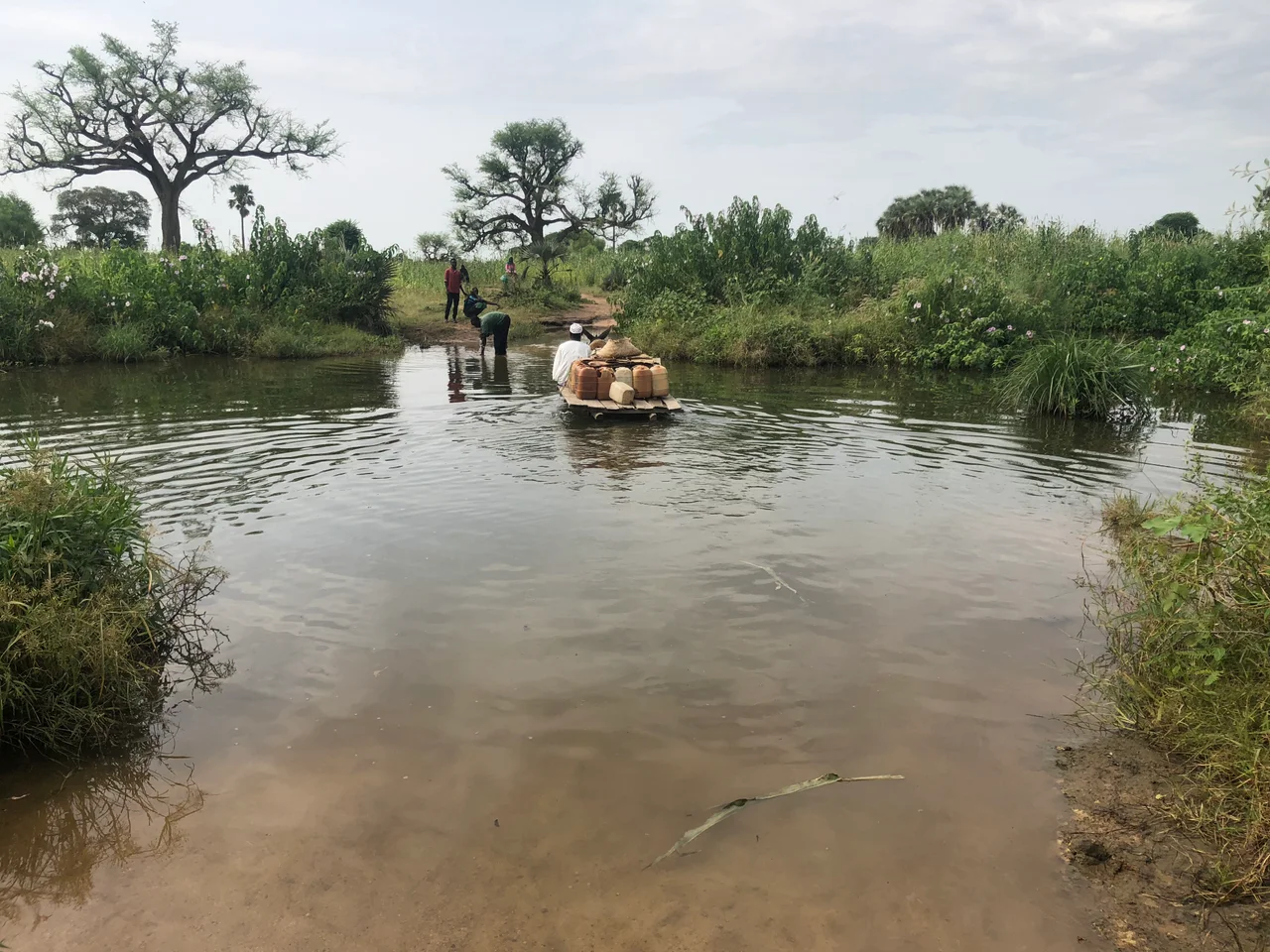

Darfur
The word means home. In Arabic, dar is home; Darfur is the home of the Fur. The region was called Dardaju when the Daju ruled it, Dartunjur under the Tunjur, and Darfur under the Keira dynasty and the Fur people whose name it now carries. For centuries, Darfur was a great kingdom of the Sahel, trading across the Sahara, fielding cavalry armies, attracting migrants from Bornu and Bagirmi. In the twenty-first century, the name Darfur has come to mean something else: the place where the word genocide was, finally, used again. The Fur, the Masalit, the Zaghawa, and the other peoples of this western Sudan region are still here. They have survived a great deal.
The Land Itself
Darfur covers 493,180 square kilometers, roughly the size of mainland Spain. Most of it is semi-desert plateau. At its heart rise the Marrah Mountains, Jebel Marra, a range of volcanic peaks reaching 3,042 meters at Deriba Crater. The Marrah have permanent springs, temperate pockets, and a microclimate that has sheltered Fur culture and Fur resistance for five centuries. Eastern Darfur is covered with plains of sandy goz soils and sandstone hills; western Darfur is basement rock; the north shades into the Sahara. Wadis, seasonal riverbeds, fan out toward Lake Chad hundreds of kilometers west. Remote sensing has detected the footprint of a vast underground lake beneath Darfur, estimated at 19,110 square miles, now dried up but a reminder that this landscape was once far wetter than it is today. Al Fashir, Geneina, and Nyala are the main cities.
Daju, Tunjur, Keira
By the twelfth century the Daju people, based in the Marrah Mountains, had founded the first historically attestable kingdom of Darfur. They left rock engravings, stone architecture, and an orally preserved list of kings. The Tunjur replaced them in the fourteenth century; the Daju moved west to Abyei, Denga, Darsila, and Mongo in what is now Chad. Tunjur sultans intermarried with the Fur people, and Sultan Musa Sulayman is credited with founding the Keira dynasty. Under the Keira, Darfur expanded east to the Atbarah River, attracted immigrants, and became a major Sahelian power. The dynasty fell in 1874 when Egyptian and warlord forces killed Sultan Ibrahim Qarad at Manawashi. The Keira kept resisting from the Marrah, under six "shadow sultans" through the Mahdist years, and Ali Dinar reestablished the sultanate in 1898 at al-Fashir. In 1916, Anglo-Egyptian forces killed Ali Dinar and incorporated Darfur into colonial Sudan.
A Century of Skewed Development
Under British rule, and then under independent Sudan from 1956, Darfur was treated as a periphery. Investment went to the Nile provinces. Education and infrastructure lagged. When Libyan leader Muammar al-Gaddafi, in power from 1969 to 2011, propagated an ideology of Arab supremacy across the Sahel, Darfur began to absorb that ideology in ways that would become catastrophic. A mid-1980s famine tore through the region, disrupted traditional land-sharing agreements between Arab pastoralists and Fur, Masalit, and Zaghawa farmers, and triggered the first significant modern violence between them. For fifteen years a low-level conflict simmered, with the government in Khartoum arming Arab militias called Janjaweed as proxies against opponents. In 2003, that simmering became open rebellion when the Sudan Liberation Movement and the Justice and Equality Movement rose against Khartoum.
2003: The Word Nobody Wanted to Say
Khartoum's response was to arm the Janjaweed and unleash them against Fur, Masalit, and Zaghawa villages. Villages were burned. Wells poisoned. Women raped systematically. Men and boys killed. By 2010, the UN's best estimate placed the death toll at around 300,000, with about 3 million displaced. Most of the displaced went to camps inside Sudan or in eastern Chad. Many of those children grew up knowing only the camps. International observers, including the U.S. government under George W. Bush, eventually called the campaign a genocide. The International Criminal Court indicted President Omar al-Bashir. Many of the displaced never returned; the world turned its attention elsewhere; the conflict was papered over with peace agreements at Abuja in 2006, Doha in 2011, and Juba in 2020, each of which produced partial reductions in violence without resolving the underlying land and ethnic disputes.
2023: It Happened Again
When the Sudanese civil war erupted on 15 April 2023 between the Sudanese Armed Forces and the Rapid Support Forces, Darfur became the RSF's stronghold. The RSF, under Mohamed Hamdan Dagalo (Hemedti), grew out of the same Janjaweed that had committed the 2003 atrocities. In West Darfur in 2023, they carried out massacres of Masalit civilians in El Geneina and surrounding areas that international observers described as ethnic cleansing and, again, genocide. In late October 2025, the RSF captured El Fasher after a long siege, and tens of thousands of people are feared killed. The Fur, Masalit, and Zaghawa peoples, whose ancestors had fought the Egyptians, the Mahdists, the British, and now two distinct iterations of a Janjaweed-derived force, were once again among the victims. More than 12 million people were displaced in Sudan by the civil war, with Darfur bearing much of that burden.
The Languages of Home
Darfur is not one people. The languages spoken here include Fur, Masalit, Zaghawa, Daju, Erenga, Fongoro, Fulbe, Sinyar, Tama, Midob, Berti, and Arabic. Each language carries a people, a history, a place in the land. The Fur live in the Marrah and surrounding plains. The Zaghawa extend across the border into Chad. The Masalit straddle the western frontier. The Baqqara, Arabic-speaking pastoralists, have their own deep roots here. The linguistic map is also an ethnographic map, and the ethnographic map tells you that "Darfuri" has always been a category with internal differences, not a single people. What binds them is the land, and now, tragically, the shared experience of having been targeted by forces that do not distinguish carefully between them. The Rapid Support Forces' attacks have treated Masalit villages one way and Fur villages another, but all have been told that they do not belong.
The Future, in Five States
Darfur is administratively divided into five federal states: Central Darfur, East Darfur, North Darfur, South Darfur, and West Darfur. A regional government was re-established in August 2021 with Minni Minnawi, a former rebel commander, as regional governor. A rival Government of Peace and Unity established a parallel administration in 2025 during the RSF takeover. The population, about 7.5 million in 2008, had grown nearly six-fold since 1973. Fifty-two percent of the population is sixteen or younger. This is a young region, still, despite everything, with most of its future yet to be written. The underground lake remains beneath the ground. The springs of the Marrah still run. The Fur, Masalit, and Zaghawa languages are still spoken. Home, in Arabic, is still dar. Darfur, the home of the Fur. What it will be when the current war ends is an open question. That the peoples who named it will still be here to answer is the oldest Darfuri certainty of all.
From the Air
Darfur lies at approximately 13°N, 25°E in western Sudan, covering 493,180 km². Major cities include al-Fashir (IATA: ELF, ICAO: HSFS), Nyala (IATA: UYL, ICAO: HSNN), and Geneina (ICAO: HSGN). The Marrah Mountains rise to 3,042 meters at Deriba Crater. Recommended viewing altitude 10,000-14,000 ft AGL to appreciate the volcanic massif, the Sahelian goz plains, and the wadi systems draining toward Lake Chad to the west.
Nearby Stories
- 2025 Tarasin landslide 28 km away
- Zamzam and Abu Shouk refugee camp massacres 39 km away
- Ain Farah 124 km away
- 1987 Dhein massacre 142 km away
- Wad Banda 248 km away
- Central African Republic–Chad border 269 km away
- Central African Republic–Sudan border 312 km away