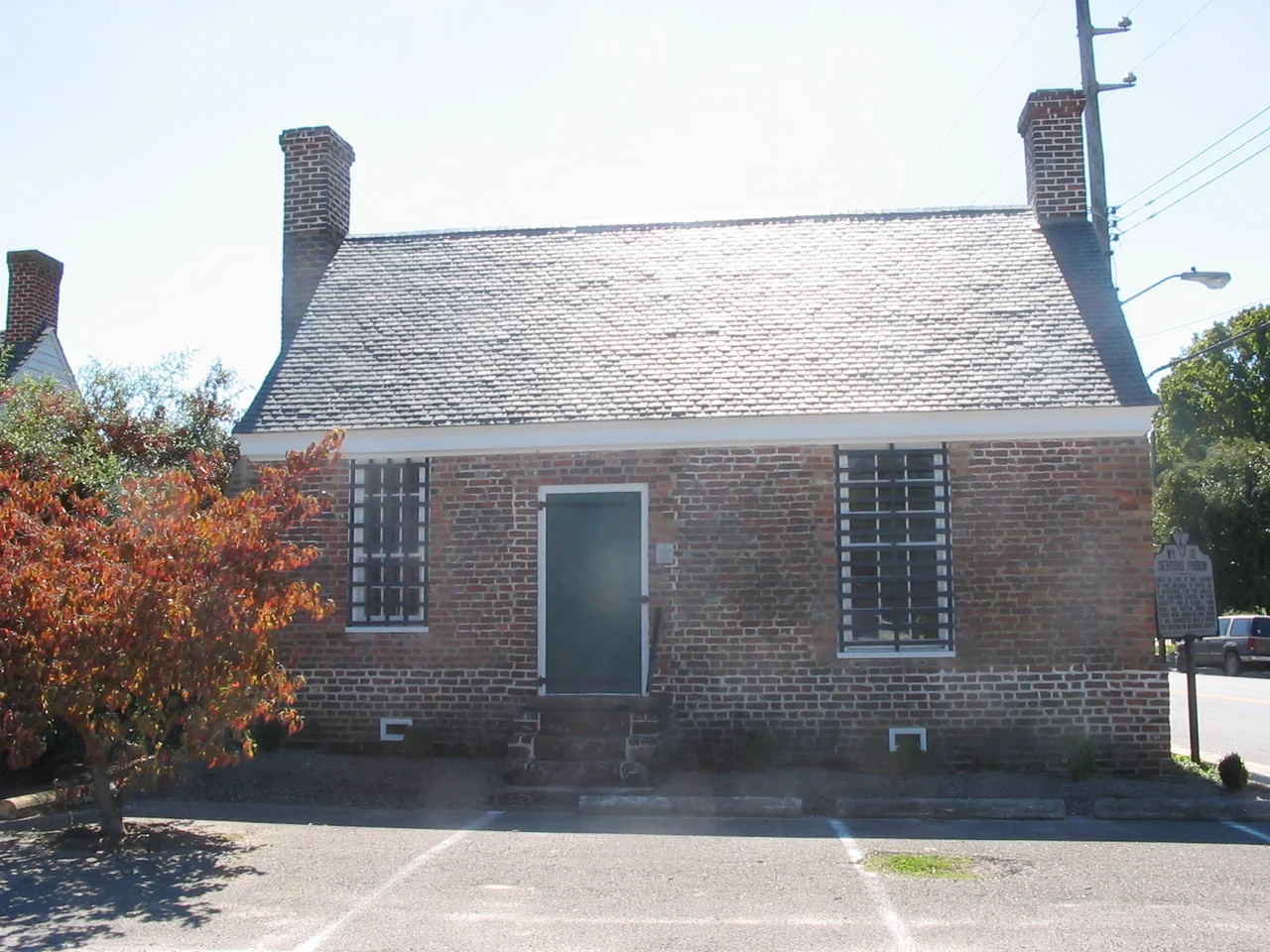

Debtors' Prison (Accomac, Virginia)
When the Accomack County court decided in 1824 to convert the jailer's house into a debtors' prison, the committee assigned to the work argued that the conversion would be simple. "Iron bars to the windows of inch iron and oak Batton doors to be hung outside, is all that is necessary," they wrote, "because it is believed that debtors have no inducement to brake prison, the Law authorizes them with little trouble to discharge themselves whenever they wish so to do." The committee had a point, if a cynical one. People who could not pay their debts had also not paid for an escape attempt. The iron bars went up. The oak doors were hung. People who owed money lived behind both for the next twenty-five years.
A House Before It Was a Prison
The small brick building in central Accomac, just down the road from the Accomack County Courthouse, was not built as a prison at all. In 1775 the county court ordered a committee to draw up plans for a new jail. The new jail went up, and alongside it a small house for the jailer. Both were completed in 1783, making the jailer's house, by accident of survival, the oldest public building still standing in Accomack County. For the next forty years a county jailer lived here with his family, walking to work next door. The arrangement was, even by the standards of the early American republic, unusual; the committee that examined the property in 1824 observed that almost no other county in Virginia provided housing for its jailer.
Debt as a Crime
In the early nineteenth century the Commonwealth of Virginia passed a law requiring separate facilities for people held on debt and people held on felony charges. The reasoning was practical and slightly less harsh than it sounds; debtors were not considered criminals in the modern sense, and confining them with felons was thought both dangerous and unjust. The Accomack court saw a chance to solve two problems at once. The jailer's house was in poor repair anyway. The state required a separate debtor facility. Converting the one into the other, the 1824 committee argued, would meet the law with minimal expense, and it would also remove the security risk of a jailer's family living wall-to-wall with felons. The recommendation passed. The bars went on. The doors were rehung. People who owed money were now Virginia's responsibility to hold, and the same brick walls that had sheltered the jailer's children began to confine the unfortunates of the Eastern Shore.
The Debtors Themselves
Imprisonment for debt was, by the standards of any modern reader, a cruelty disguised as a procedure. People held in places like the Accomac debtors' prison were not violent criminals. They were farmers who had lost a crop, shopkeepers who could not collect what they were owed, widows whose husbands had died holding promissory notes that no one would now pay. Some were also, in this period and place, formerly enslaved people whose freedom was conditional on payments they could not always make. The committee that designed the conversion was technically correct that the law allowed debtors to discharge themselves at any time, but only if they could find the money or the patron to clear the debt. For those who could not, the bars were the bars. The Accomac debtors' prison served in this capacity until 1849, when it was at last closed.
What Remains
The building is small: eighteen feet by thirty, a single story, three bays long, built of Flemish-bond brick with glazed headers. It sat in the southwest corner of a seventy-foot-square jailyard, and a fragment of the yard's brick wall still projects from the northeast corner, a scar from the same wall visible at the northwest. The east chimney is exterior, the west chimney interior. The iron lattice that the 1824 committee installed still covers the window openings. The heavy batten doors that the same committee specified still hang in place. The Historic American Buildings Survey documented the structure between 1958 and 1961 and found it intact. It went on the National Register of Historic Places in 1976. It is one of only three debtors' prisons in the country on the Register, along with two others in Worsham and Tappahannock, all three of them in Virginia. The Accomac debtors' prison is open by appointment, a quiet small brick house that holds the memory of a kind of cruelty Americans have mostly chosen to forget.
From the Air
The Accomac Debtors' Prison stands at 37.72N, 75.67W in the town of Accomac, county seat of Accomack County, Virginia. The small brick building sits near the Accomack County Courthouse in central Accomac. The structure is too small to spot from cruising altitude; best seen on approach at 1,000-2,000 feet AGL or via the courthouse green from above. Nearest airport: KMFV (Accomack County Airport) at Melfa, about 8 miles south. KWAL (Wallops Flight Facility) sits to the northeast and KSBY (Salisbury Regional) to the north in Maryland. The flat agricultural patterns of central Accomack County make a quiet, low-relief landscape from the air.
Nearby Stories
- Hog Island Light 7.5 km away
- Point Lookout Light 8.3 km away
- SS Monroe (1902) 9.8 km away
- Assateague Island National Seashore 13 km away
- Somerset County, Maryland 15 km away
- Gloucester County, Virginia 21 km away
- Werowocomoco 46 km away
- SMS Ostfriesland 67 km away