
Deia
In the summer of 1916, The Times of London printed Robert Graves among the war dead. A shell had torn through his chest at the Battle of the Somme, and word went home that he had died of his wounds. He had not. Graves recovered, read his own obituary, and lived another sixty-nine years, most of them in a small stone house on a mountainside above the Mallorcan sea. The village was Deià, and the poet who had survived a war he could never quite forget spent the rest of his life there, writing.
A Poet's Faraway Home
Graves came to Deià in 1929, the same year he published Goodbye to All That, the bitter, brilliant memoir in which he settled accounts with England and the war that had nearly killed him. A friend, the writer Gertrude Stein, had recommended the island. He built a house on the edge of the village and named it Ca n'Alluny, Catalan for the faraway home, and faraway was rather the point. Here, at a safe distance from the country he had said goodbye to, Graves wrote much of his most enduring work, including the Roman novels that won him a wide audience. The Greek myths and ancient histories he retold from this remove would shape how generations of readers imagined the classical world. He lived in Deià, with some interruptions, until his death in 1985, and his house is now a museum, opened to the public in 2006, its study and garden kept much as the poet left them.
The Village on the Cliff
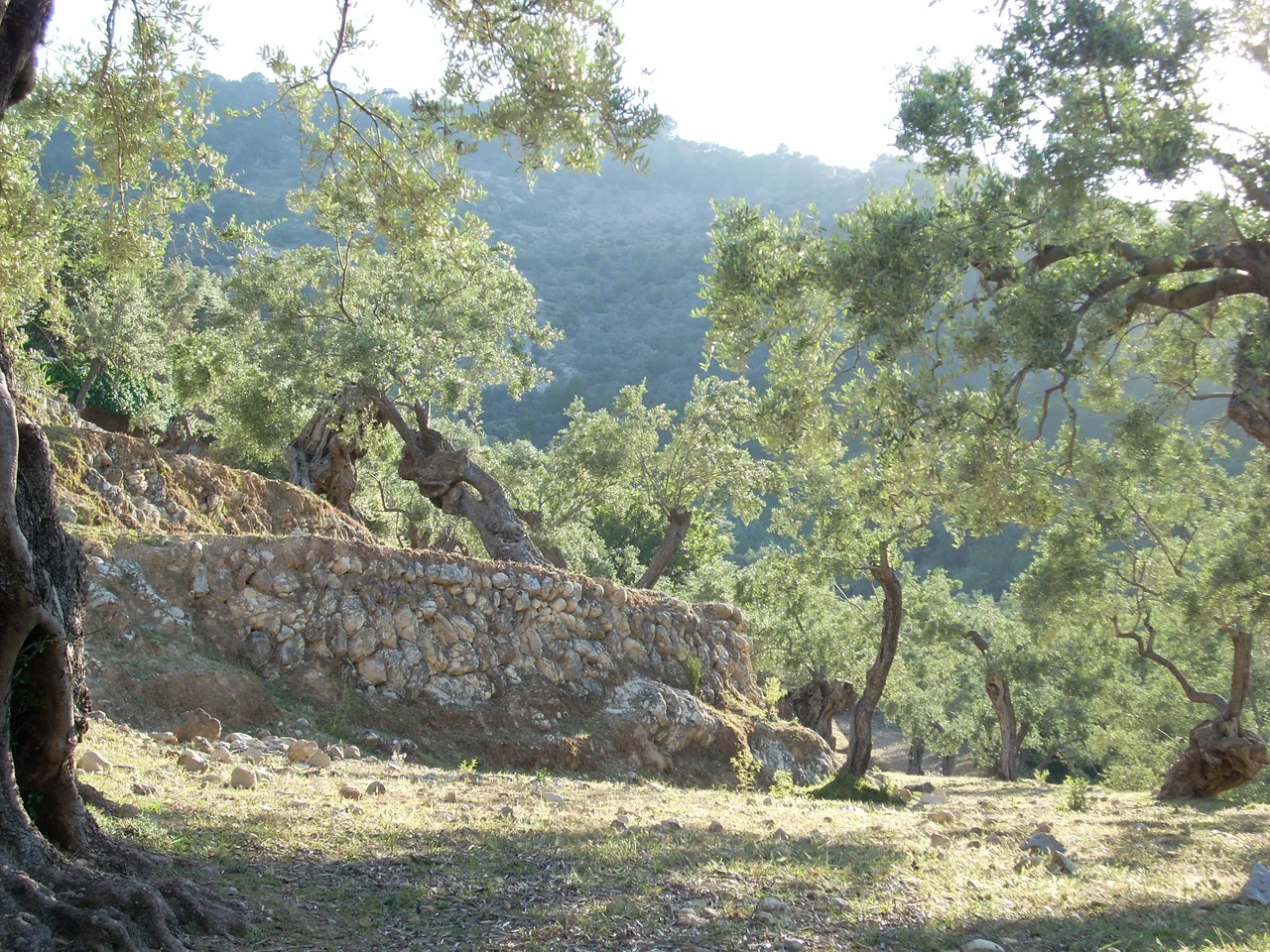
Deià is tiny, home to only about 700 people, and it clings to the steep western flank of the Serra de Tramuntana some 30 kilometers north of Palma. Terraces of olive and citrus step down toward the Mediterranean, held in place by dry-stone walls that generations of farmers built by hand. The road in from Palma runs first to Valldemossa and then twists north along the coast, a drive slow enough that the village feels genuinely remote even now. The village itself is walkable in minutes, its lanes winding up to an eighteenth-century church on the high ground to the north. Below, reached by a twisting path, lies Cala Deià, the village's only beach, a small stony cove sheltered between cliffs where boats still pull up. It is a place that rewards slowness, and it has drawn writers, painters and musicians for the better part of a century.
Buried Under a Cypress
When Robert Graves died, he did not go far. He was buried in Deià's small churchyard, on the hilltop at the edge of the village, beneath a great cypress tree that shades the graves. The setting is modest for a man of his fame, a simple slab in a country cemetery looking out over the mountains and the sea he had chosen above all others. Readers still make the climb to find it, tracing the same lanes the poet walked for half a century, past the olive terraces to the quiet plot where England's reluctant war poet finally came to rest in the hills of a Spanish island. Even in death he kept things plain, in keeping with the unshowy life he had built here.
The Archduke's Coast
Graves was not the first outsider to fall for this coast. The land around Deià had been lovingly guarded decades before his arrival by Archduke Ludwig Salvator of Austria, the Habsburg naturalist who bought the nearby Son Marroig estate and much of the shoreline between here and Valldemossa. An early champion of what we would now call conservation, he protected the wildlife and the views, and the village still names its streets for him, Arxiduc Lluís Salvador. The stretch of Tramuntana that so entranced him, and later Graves, is now recognized as a UNESCO World Heritage Site. The bus from Palma still winds up to the village square, disgorging day-trippers who rarely stay long enough to understand why others never left. Deià, it turns out, has a long history of making people never want to leave.
From the Air
Deià clings to the west coast of the Serra de Tramuntana (39.75°N, 2.65°E), roughly 30 km north of Palma where the mountains drop almost straight into the sea. From the air, look for the village terraced onto a steep green slope between the peaks and the shoreline, with the little cove of Cala Deià notched into the cliffs below and the Son Marroig headland along the coast to the southwest. Palma de Mallorca Airport (LEPA) lies about 30 km to the southeast, across the range. Treat this as mountain-and-coast flying: 3,000 to 5,000 feet, calm mornings preferred, with rotor turbulence and cloud likely along the ridgelines when the wind picks up.
Nearby Stories
- Palace of Marivent 2 km away
- Fundacion Yannick y Ben Jakober 3.4 km away
- Coves dels Hams 13 km away
- Cala de Sant Vicent 69 km away
- Portinatx 93 km away
- Battle of Ebro River 127 km away
- Llobregat Delta 143 km away
- Cosquer Cave 396 km away