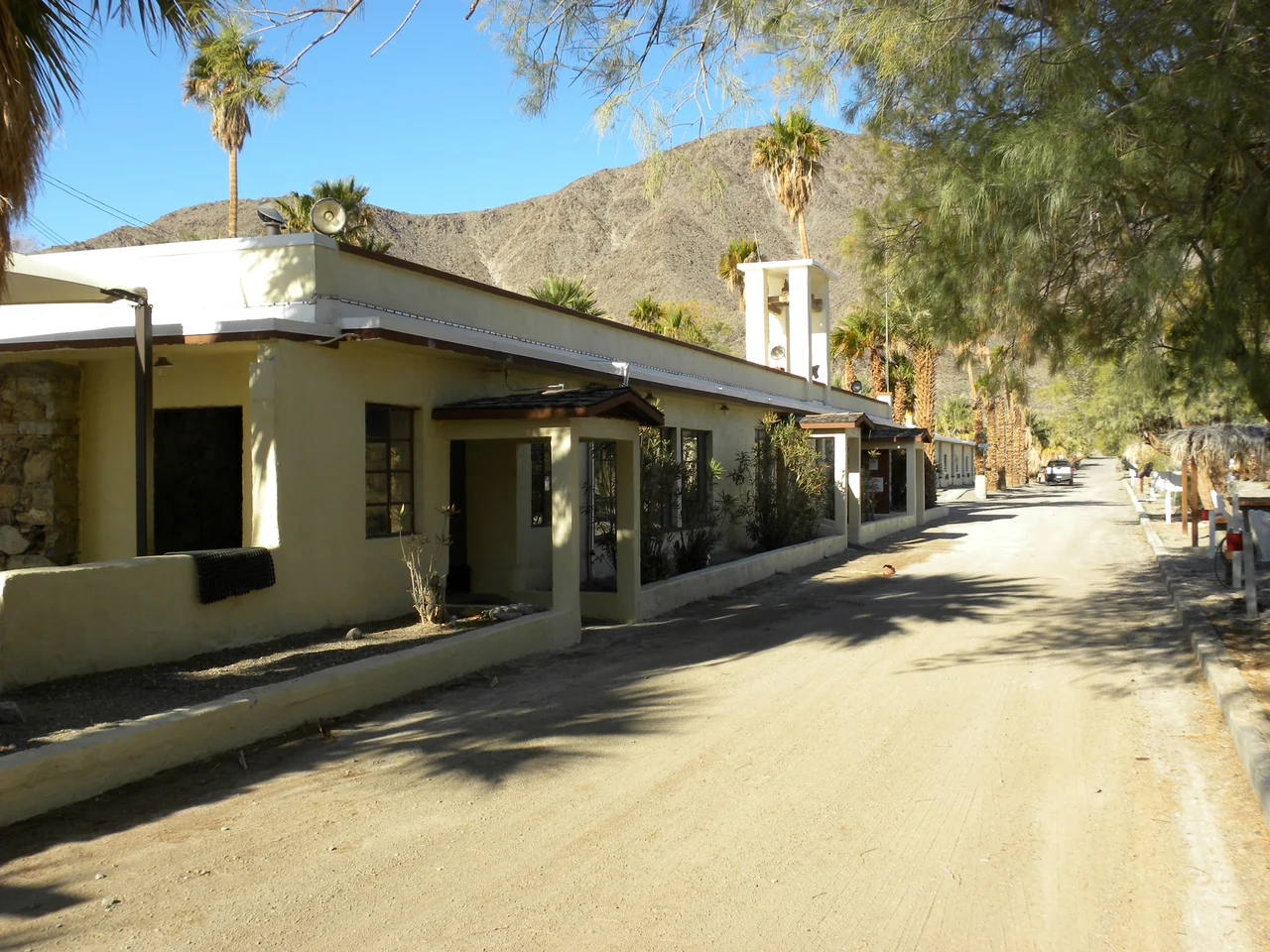

Desert Studies Center
The Mohave tui chub is an endangered fish that lives in Lake Tuendae at the Desert Studies Center — a body of water that did not exist before Curtis Howe Springer built it without permission on federal land. Springer was a fraud: a self-styled minister who manufactured dubious health products and operated an illegal spa on 12,000 acres of the Mojave Desert for thirty years before the Bureau of Land Management evicted him in 1974. The fish, transplanted to survive, did not know any of this. They simply adapted to the artificial lake and stayed.
After the Spa, the Science
California State University took over the former Zzyzx Mineral Springs in 1976, transforming what had been a health retreat into a genuine research facility. Seven CSU campuses participate in the consortium: Dominguez Hills, Fullerton, Long Beach, Los Angeles, Northridge, San Bernardino, and Cal Poly Pomona. Together they run a facility that offers what the Mojave Desert uniquely offers — extreme conditions, minimal light pollution, and ecosystems that have no analogs elsewhere.
The center's research programs span biology, geology, ecology, and environmental science. Students and researchers come to study what the desert contains rather than how to escape from it. Springer's spa cabins became dormitories. His auditorium became a lecture hall. The landscape that he cultivated for therapeutic tourism became the subject of actual inquiry.
The Fish That Shouldn't Be Here
Lake Tuendae was Springer's creation — a man-made pond intended to give his resort a picturesque focal point. When the California Department of Fish and Game transplanted the endangered Mohave tui chub into the lake in 1971, it was a conservation measure made necessary by the destruction of the species' natural habitat elsewhere. The fish survived. They are now one of only two populations of Mohave tui chub known to exist, which means that the continued existence of this species depends in part on a lake built by a man running an illegal operation in the desert.
The Saratoga Springs pupfish, another endemic desert species, also finds refuge in the center's area. Both fish represent a larger pattern: the Mojave Desert contains biological communities that evolved in isolation and have nowhere else to go.
What 200 Species of Birds Know
The Desert Studies Center has recorded more than 200 bird species in its area — a number that reflects the Mojave's role as a migration corridor. Birds moving between the Pacific Coast and the interior of North America cross the desert in great numbers, and the springs at Zzyzx, one of the few reliable water sources in this stretch of the desert, serve as a waystation.
The center's location on the edge of the Mojave Road and near Baker makes it accessible for researchers without being so developed that it loses the qualities they come to study. The night skies here are dark enough for serious astronomical observation. The silence, broken only by wind and wildlife, allows acoustic research impossible in urban environments.
The Name That Endures
Springer invented the name Zzyzx in 1944 because he wanted it to be the last word in the English language — a marketing gimmick that turned out to have more lasting power than anything else he created. Reader's Digest named it the most difficult place name to pronounce in California. Michael Connelly set scenes from his 2004 novel The Narrows there. The name persists in a way that Springer's health claims never did.
The Desert Studies Center operates under the name without irony. Researchers studying cactus wrens or measuring soil temperatures at Zzyzx are doing work that Springer never contemplated, in a place he created for entirely different reasons, with a name that has outlasted him by decades.
From the Air
Located at 35.143°N, 116.105°W adjacent to Zzyzx Road off Interstate 15 in San Bernardino County. The facility and Lake Tuendae are visible from low altitude as an unexpected patch of green and water in open desert. Nearest airport: Barstow-Daggett Airport (DAG), approximately 15 miles northwest.
Nearby Stories
- Kelso, California 6.2 km away
- Ragtown, California 16 km away
- Calico: The Ghost Town Walter Knott Saved 19 km away
- Trilobite Wilderness 21 km away
- The Trona Pinnacles: California's Most Alien Landscape 67 km away
- San Bernardino Train Disaster 94 km away
- The PEPCON Disaster 97 km away
- The 49ers of Death Valley: The Shortcut That Became a Deathtrap 117 km away