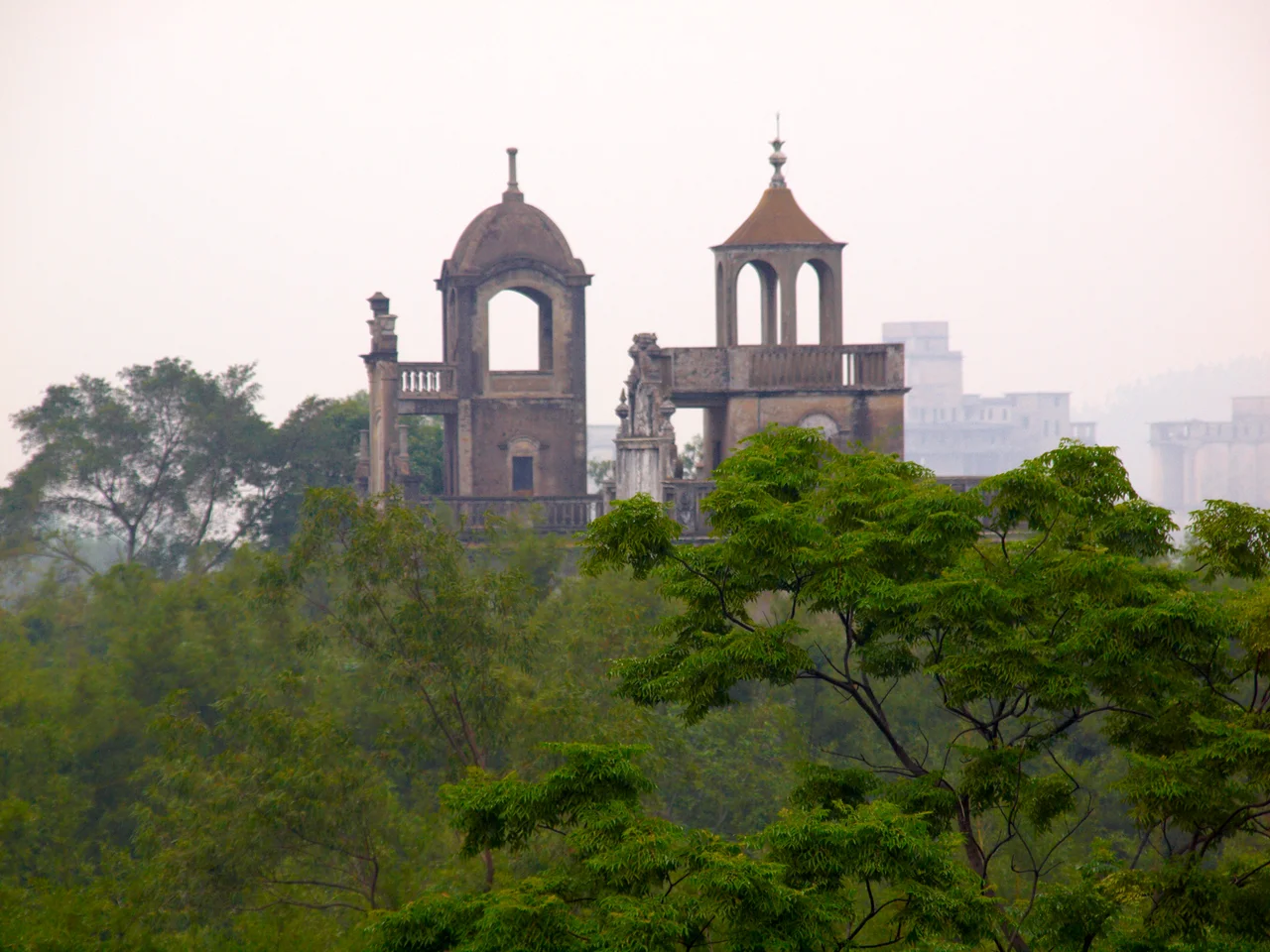

Diaolou
Stand in a rice paddy in Kaiping county on a clear morning and the towers appear almost surreal: nine-story columns rising from flat agricultural land, their upper floors capped with Byzantine domes, Roman arches, and Baroque cornices, as if someone had reassembled a Mediterranean street above a Cantonese village. These are diaolou — fortified watchtowers built from the Ming dynasty through the early twentieth century, reaching their peak during the violent, lawless Warlord Era of the 1920s and 1930s. More than three thousand were built; approximately 1,800 remain. In 2007, UNESCO designated the Kaiping Diaolou and Villages a World Heritage Site, recognizing in them something that is genuinely rare: buildings that embody two civilizations simultaneously, and that survive because the people who built them wanted their families to be safe.
Built for Dangerous Times
Kaiping was, for centuries, one of the principal sending areas for Chinese emigration to North America, Southeast Asia, and Australasia. The men who left — and it was mostly men — sent money home. During the Warlord Era, when bandits and competing military factions made rural Guangdong genuinely dangerous, those remittances went toward protection. Families built diaolou to secure their savings and their relatives. The towers were built high enough to overlook the surrounding countryside, thick-walled enough to resist attack, and equipped with iron shutters and corbelled battlements. UNESCO's inscription noted that the towers 'reflect the significant role of émigré Kaiping people in the development of several countries in South Asia, Australasia, and North America' — but from the perspective of the families who built them, they were simply trying to ensure that what their fathers and husbands had earned would survive.
Five Centuries of Tower-Building
The earliest surviving diaolou in Kaiping is Yinglong Lou — 'greeting the dragon tower' — built by the Guan lineage in the village of Sanmenli during the Jiajing reign of the Ming dynasty, between 1522 and 1566. It is a massive three-story rectangular fortress with meter-thick walls and no Western influence whatsoever; it looks exactly like what it is, which is a serious defensive structure built by people who had been building defensive structures in this landscape for a long time. Yinglong Lou was renovated in 1919 and stands 11.4 meters high. The towers built four centuries later, during the Warlord Era, are almost comically different in appearance — hybrid confections that layer Cantonese practicality with the architectural vocabulary their builders had collected abroad. The oldest and the newest diaolou stand within a few kilometers of each other, separated by four hundred years of migration.
The Four Heritage Clusters
UNESCO designated four groups of Kaiping diaolou for World Heritage recognition. Zilicun village, in Tangkou township, contains nine diaolous — the largest concentration — rising implausibly above flooded rice paddies. The Jinjiangli cluster, behind a village in Xiangang township, includes Ruishi Lou: constructed in 1921, nine stories tall, the tallest diaolou in Kaiping, with a Byzantine-style roof and a Roman dome. Majianglong, in Baihe township, spreads across five villages in a bamboo forest, where the Huang and Guan families built their towers within sight of each other. Sanmenli, in Chikan township, is the oldest cluster and the home of Yinglong Lou. Together the four sites hold roughly 1,800 tower houses in their village settings — structures that are, as UNESCO put it, a 'complex and flamboyant fusion of Chinese and Western structural and decorative forms.'
Abandoned and Enduring
Most diaolou are now empty. The families who built them emigrated generations ago; their descendants live in Vancouver and San Francisco and Sydney. The towers stand in fields and bamboo groves, their iron shutters rusted shut, their stairwells dark. Some have been restored for the tourist trade; most have not. The Kaiping diaolou served as a filming location for the 2010 movie Let the Bullets Fly — an appropriate setting for a film about chaos and survival in Republican-era China. What is remarkable is not that so many have been lost, but that 1,800 have survived: a century of wars, land reform, Cultural Revolution, and gradual abandonment, and the towers are still there. They were built to last, by people who knew that nothing else could be counted on.
From the Air
The Kaiping diaolou clusters are scattered across Kaiping county in Guangdong province, centered approximately at 22.29°N, 112.57°E. At 2,000–4,000 feet the Pearl River Delta landscape spreads in all directions — flat, intensively farmed, threaded with waterways. The towers are not visible individually from altitude, but the geographic setting that made Kaiping a major emigration source — its accessibility by river to Jiangmen and the Pearl River — is legible from the air. The nearest airport is Jiangmen Xinhui Airport (ZGSD), approximately 30 km to the east. Guangzhou Baiyun International Airport (CAN / ZGGG) is about 100 km northeast.
Nearby Stories
- Zhongshan 16 km away
- Lampacau 30 km away
- Xinhui, Jiangmen 37 km away
- Wanshan Archipelago Campaign 57 km away
- Battle of Nanpeng Island 68 km away
- Temple of the Five Lords 287 km away
- Cua Ong Temple 512 km away
- Erhai Lake 1266 km away