
Diving Sodwana Bay
Most of Sodwana Bay's wonders are invisible from the beach. Stand on the dunes of this remote Maputaland coast and you see only a long arc of pale sand and the warm Indian Ocean rolling in. But a short boat ride offshore, the ocean floor erupts into the southernmost coral reefs on the planet, sustained against the odds by the warm Agulhas Current sweeping down from the tropics. Divers come from all over the world, around 35,000 of them in a typical year, to drop into water that feels like a heated aquarium and to swim among corals that have no business growing this far south. The reefs are named, prosaically, for their distance from the launch site: Two Mile, Five Mile, Seven Mile. The names are plain. What they conceal is anything but.
Reefs at the Edge of the Possible
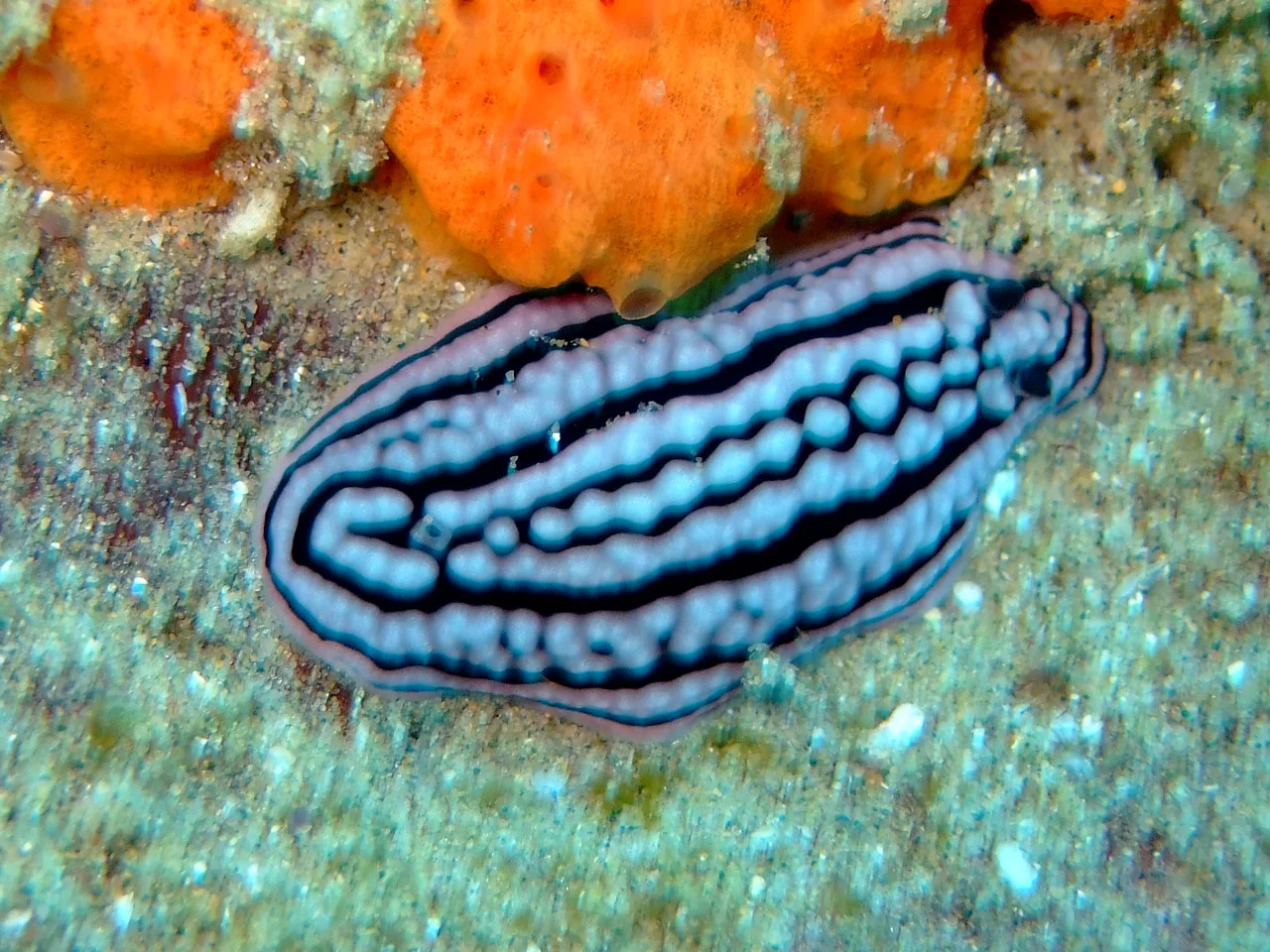
Sodwana sits in a tropical pocket of an otherwise temperate coastline, the last place heading south where true coral reefs can take hold. The result is an Indo-Pacific community of marine life flourishing at a latitude where it should not. Over the reef ledges and through the swim-throughs move ember parrotfish in metallic greens, humphead snapper, and clouds of smaller reef fish, while the rock itself blooms with soft and hard corals. Down in the crevices, jewel-bright nudibranchs the size of a thumb graze the encrusting growth. The dive sites range from a gentle ten meters at Quarter Mile Reef to deep walls and canyons plunging past fifty. Conditions can shift quickly here, and a permit is required to dive anywhere in the surrounding marine protected area, a small bureaucratic price for swimming over a reef that exists almost nowhere else.
The Fish That Refused to Die
For most of the twentieth century, the coelacanth was a fossil. Scientists believed this heavy, lobe-finned fish had vanished some 65 million years ago, until a live one turned up in a South African trawler's net in 1938 and rewrote the textbooks. Even then, coelacanths were thought to dwell only in deep, unreachable water. Then, on 28 October 2000, three mixed-gas divers off Sodwana, Pieter Venter, Peter Timm, and Etienne le Roux, descended into Jesser Canyon on a technical training dive. Near the end of it, Venter caught an eye watching him from a cave. It was a coelacanth, peering out at 104 meters down, the shallowest any had ever been seen. He called the others over and they found two more. For the first time, divers had met a living fossil face to face.
Diving the Canyons
What makes Sodwana possible is the shape of the seabed. Just offshore, deep submarine canyons cut into the continental shelf, channeling cool, nutrient-rich water up toward the reefs and creating the conditions that let coral and coelacanth coexist. Jesser Canyon, where the 2000 discovery happened, is part of this hidden topography. Most recreational divers never approach those depths, content with the shallow reefs where the light is bright and the fish are thick. But the canyons explain everything above them. They are the engine room of the whole ecosystem, drawing up the water that feeds the southernmost reefs on Earth. The coelacanth discovery led directly to the founding of a dedicated coelacanth research program in 2002, and Sodwana became a place where weekend divers and deep-sea science share the same patch of sea.
Permits, Currents, and Respect
Diving Sodwana is not a casual undertaking, and the reef rewards humility. Every dive sits inside the iSimangaliso Marine Protected Area, with sanctuary and restricted zones where no fishing or harvesting is allowed, a framework that has helped keep these reefs vivid while so many others have faded. The launches are surf launches, boats punching out through the breakers, and the open-water conditions demand a qualified diver who reads the sea well. But for those who make the effort, Sodwana offers something rare: water warm enough to dive in comfort, coral at its absolute geographic limit, and the knowledge that somewhere in the dark canyons below, the oldest fish in the sea is still swimming, exactly as it has for tens of millions of years.
From the Air
Sodwana Bay lies at roughly 27.53 degrees south, 32.68 degrees east on the northern Maputaland coast of KwaZulu-Natal, within the iSimangaliso Wetland Park. From the air, the reefs themselves are visible in clear, calm conditions as darker patches just offshore from a straight, dune-backed beach; the named dive sites run a few hundred meters to a couple of kilometers out. The deep submarine canyons offshore are not visible from the surface. The nearest airfield is at Sodwana itself for light aircraft; the closest airport with scheduled commercial service is Richards Bay Airport (ICAO FARB) to the south, with Mkuze also nearby. Best visibility is in the drier winter months; summer (November to March) brings warmer water but more storms.
Nearby Stories
- Border Cave 25 km away
- iSimangaliso Wetland Park 25 km away
- Kosi Bay Nature Reserve 44 km away
- Mpande kaSenzangakhona 81 km away
- Zulu Kingdom 104 km away
- Zavora 372 km away
- MS Africa Shell 396 km away
- Ngilgi Cave 7656 km away