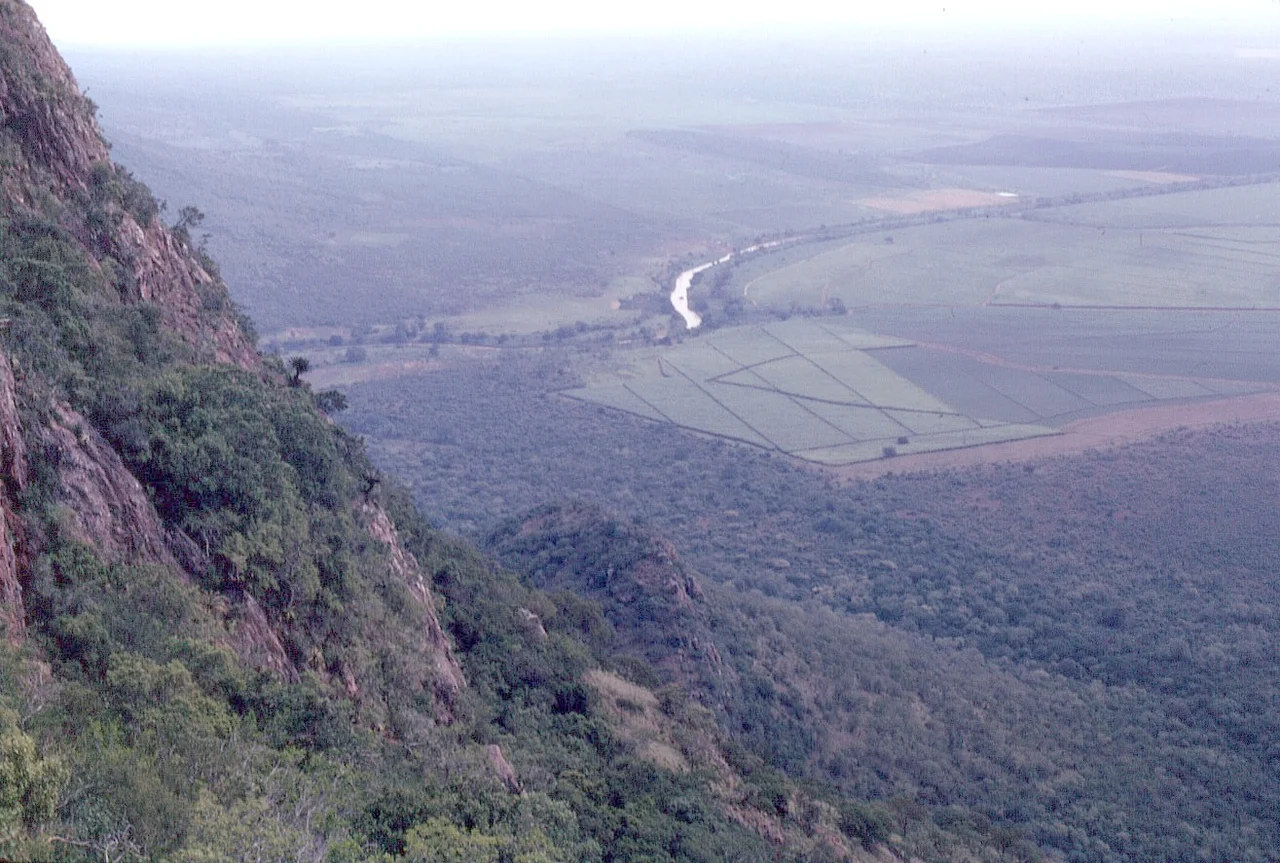

Border Cave
High on the western flank of the Lebombo Mountains, a few hundred feet below the ridgeline, a shelf of rock opens to the west and catches the afternoon sun. People sat here, slept here, cooked here, and buried their dead here for an almost unimaginable span of time. The deposits at Border Cave reach back roughly 227,000 years, one of the longest continuous archaeological records anywhere in southern Africa. Layer upon layer, the cave preserved the ordinary leavings of human life: ash, bone, stone tools, the husks of cooked snails, and the soft remains of bedding. To stand at its mouth is to look out over the same lowveld horizon that countless generations of early humans watched, while behind you the floor holds the compressed evidence of how they lived.
The Oldest Bed We Know
Among the cave's most quietly remarkable finds is something we all recognize: a bed. Researchers identified fossilized grass bedding here dating to around 200,000 years ago, the oldest known anywhere. The people who made it gathered broad-leaved grasses and laid them down in the shelter, sometimes over a fresh layer of ash. That detail matters. Ash repels ticks and other crawling insects, which suggests the bedding was placed deliberately, with an eye toward comfort and cleanliness. These were not simply bodies seeking shelter from the weather. They were people arranging a space to rest, tending a hearth, and thinking ahead to the small irritations of the next night. Across two hundred millennia, it is a startlingly familiar gesture.
A Child, Laid to Rest
In 1941, excavators uncovered the skeleton of an infant in a shallow pit in the cave floor. With the child lay a perforated Conus seashell, carried up from a coast many miles away and originally coated in red ochre. Researchers have long counted this among the earliest evidence anywhere of an ornament placed with a burial. The dating has been debated and the exact circumstances are imperfectly recorded, so scholars are careful not to call it definitively Africa's oldest grave. But the human meaning is hard to mistake. Someone carried a small treasure inland, colored it with ochre, and set it beside a child who had died. Whatever beliefs guided that act are lost to us. The tenderness in it is not. These were people who grieved, and who marked their grief with beauty.
Counting in Bone
Border Cave also yielded one of the most thought-provoking objects in the human record: a small length of baboon fibula incised with a row of notches, known as the Lebombo bone and dated to roughly 43,000 years ago. Twenty-nine deliberate marks run along its edge. What they counted, no one can say for certain, though the number has invited comparison to lunar cycles and to the tally sticks used by later hunter-gatherer peoples of the region. It may be among the oldest mathematical artifacts ever found. Here, in a mountain shelter, someone reached for a way to keep track, to record a quantity outside their own head. The notches are the faint beginning of a habit that would one day become arithmetic, calendars, and every ledger that followed.
An Argument Written in Stone
Border Cave is famous among archaeologists for a debate it helped ignite. Somewhere around 44,000 to 42,000 years ago, the toolmakers here shifted their methods, moving toward the smaller blades and techniques that define the Later Stone Age. It is one of the earliest such transitions known in southern Africa, and scholars still argue over whether the change began at Border Cave and spread, or arose independently in many places at once. Threaded through the science is a deeper humility about how much we can ever know of these ancient people from stone and bone alone. They were the direct ancestors, biologically and culturally, of the San and other peoples of the subcontinent, and they deserve to be understood as the inventive, deliberate humans the evidence shows them to be, not as a riddle to be solved.
From the Air
Border Cave lies at roughly 27.03 degrees south, 31.99 degrees east, set into the western escarpment of the Lebombo Mountains near the Eswatini border. The site sits about 100 m below the mountain crest and is not visible from altitude, but the long, low spine of the Lebombo range is an unmistakable north-south landmark separating the KwaZulu-Natal lowveld from Eswatini. The small town of Ingwavuma lies about 12 km to the south. The nearest airport with scheduled commercial service is Richards Bay Airport (ICAO FARB), well to the south; light aircraft also use Mkuze. The region is hot and subtropical, with most rain falling in summer (roughly 820 mm annually near Ingwavuma).
Nearby Stories
- Lobamba 31 km away
- Eswatini 46 km away
- Diving Sodwana Bay 46 km away
- Kosi Bay Nature Reserve 48 km away
- Battle of Hlobane 60 km away
- Mbabane 76 km away
- Maputo–Katembe Bridge 86 km away
- Hluhluwe 97 km away