
Lobamba
On the sixth of September, 1968, a man stood inside a cattle byre - a ring of logs meant for livestock - and announced that a kingdom was free. The speaker was Prince Makhosini, soon to be Eswatini's first prime minister, and the place was Lobamba. Most nations declare independence from a balcony or a parliament floor. The Swazi chose a kraal, the ancient center of every homestead, because in this small valley town the line between the political and the sacred has never really existed.
The Valley of Heaven
Lobamba lies in the Ezulwini Valley between Eswatini's two largest cities, Mbabane to the northwest and Manzini to the southeast, in the Hhohho region with the Lusushwana River running nearby. Ezulwini means "place of heaven," and the setting earns the name: a broad green corridor cradled by hills. Though small, the town carries outsized weight. It is the legislative and spiritual capital of the kingdom - the seat where political power and royal tradition are stitched together. Visitors pass craft markets, the wildlife of the Mlilwane sanctuary, and local hot springs on the valley roads, and the Malkerns Valley arts-and-crafts center lies just a few kilometers south. But the true gravity of the place comes from what it holds at its center: the institutions of the Swazi nation itself, gathered in a single small town.
Where the Crown Resides
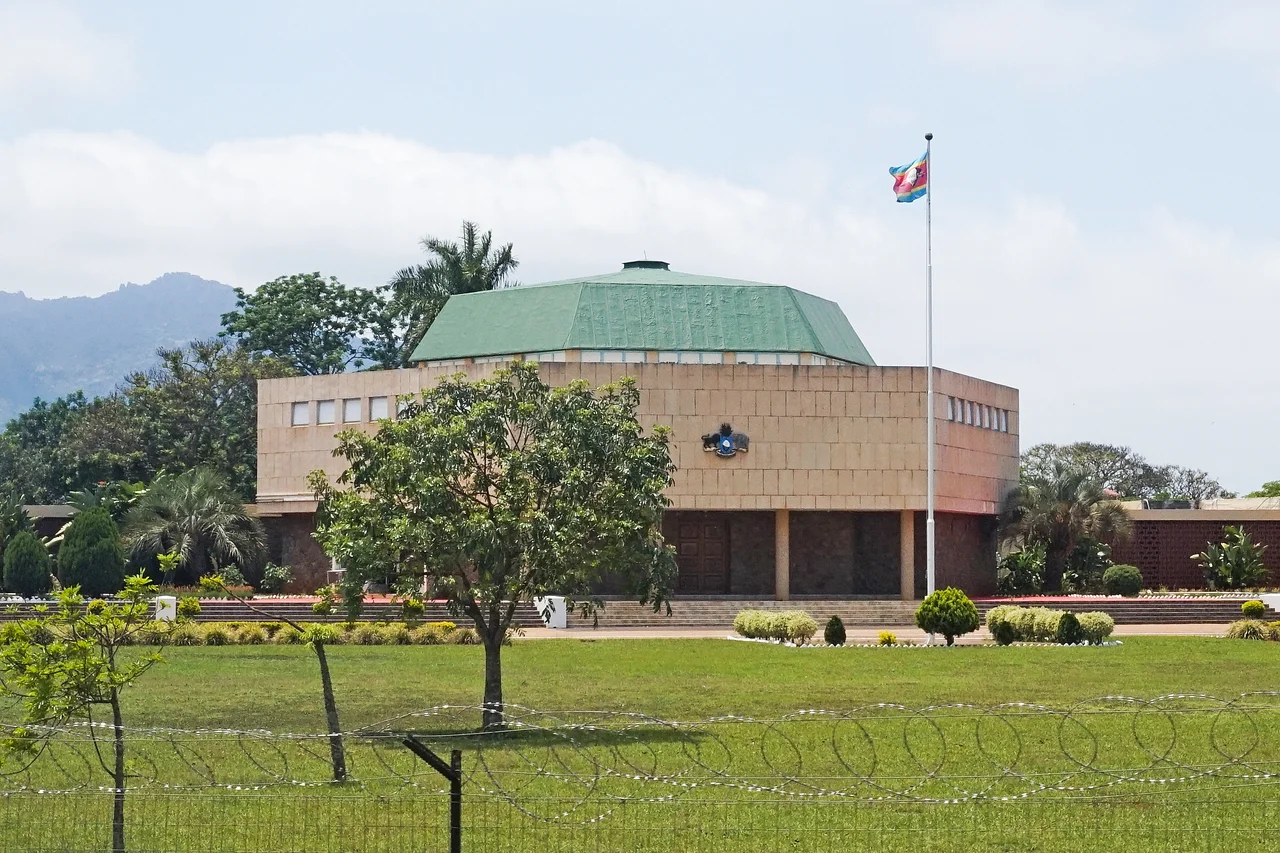
At the heart of Lobamba stands Ludzidzini, the Royal Village, residence of the ndlovukati - the Queen Mother, the "she-elephant" who in Swazi tradition shares the nation's leadership with the king. King Mswati III lives nearby at Lozitha Palace, roughly ten kilometers away, and returns to the Royal Kraal for the great ceremonies. Nearby sits the Parliament of Eswatini, the Libandla, and the Somhlolo National Stadium. The arrangement reflects Eswatini's dual system of authority: a modern legislature and an ancient royal household occupying the same patch of valley, neither fully separable from the other. To walk Lobamba is to move between a debating chamber and a sacred residence in the space of a few minutes.
Reed Dance and Kingship
Lobamba is where the kingdom's two most important ceremonies come alive. The Umhlanga, or Reed Dance, fills the Royal Village in late August or early September, when tens of thousands of unmarried young women cut tall reeds, carry them to the Queen Mother, and dance in great formations of beadwork and color. The eight-day event is meant to honor the Queen Mother, encourage solidarity through shared labor, and celebrate the young women's passage toward adulthood. Months later comes the Incwala, the kingship ceremony held around the December solstice - a sacred pageant centered on the king's tasting of the first fruits of the new harvest, and one that, by law, no one but the king may hold. When there is no king, there is no Incwala. These are not performances staged for tourists. They are the living rituals of a nation, and they happen here, on the ground where independence was declared, year after year.
A King's Memory
Lobamba also keeps the kingdom's memory. The National Museum of Eswatini, built in 1972 beside the Parliament building, uses highveld and lowveld dioramas to show the country's ecosystems and rarely seen nocturnal wildlife. Next to it stands the King Sobhuza II Memorial Park, honoring the monarch who led Eswatini to independence in 1968 and reigned for almost 83 years - longer than any sovereign in recorded history. His life is told through photographs; three of his vintage cars are preserved, and his mausoleum lies within the park grounds. In a country where the king is regarded as the embodiment of the nation, Lobamba is where that idea is both governed and grieved, celebrated and remembered.
From the Air
Lobamba sits at approximately 26.45 degrees south, 31.21 degrees east, in the Ezulwini Valley between Mbabane and Manzini in western Eswatini. From the air, look for the broad green valley running northwest to southeast, framed by the Highveld escarpment, with the Somhlolo National Stadium a useful landmark. Recommended viewing altitude is 5,000 to 8,000 feet to appreciate the valley setting. Matsapha Airport (FDMS) lies about 23 km southeast near Manzini; King Mswati III International Airport (FDSK) is farther east in the Lowveld. Maputo International (FQMA) in Mozambique is roughly 200 km away. Visibility is best in the dry winter season, May through September.
Nearby Stories
- Barberton Greenstone Belt 26 km away
- 1986 Mozambican Tu-134 Crash 44 km away
- Border Cave 49 km away
- Battle of Bergendal 71 km away
- Maputo–Katembe Bridge 106 km away
- Battle of Majuba Hill 109 km away
- Battle of Hlobane 110 km away
- Bokoni 119 km away