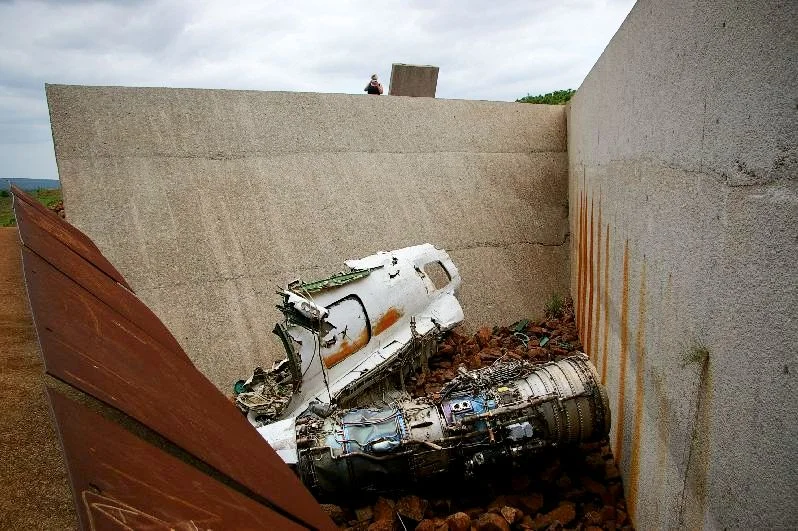

1986 Mozambican Tu-134 Crash
On the night of 19 October 1986, a Soviet-crewed jetliner was carrying Samora Machel home. The president of Mozambique - revolutionary, founding father, the voice of his young nation - was flying back to Maputo after a summit in Zambia, the lights of his own capital almost in reach. Instead the aircraft turned where it should have flown straight, descended where it should have climbed, and struck a low hill at Mbuzini, just inside South Africa. Machel died there, along with thirty-three others. Nine passengers and one crew member lived. Forty years later, what brought the plane down at Mbuzini remains contested - and for many across southern Africa, that uncertainty is itself part of the wound.
The Men Aboard
These were not novices, and the aircraft was not failing. The Tupolev Tu-134 had been maintained to standard, and its flight recorder later showed every system working normally. The captain, 48-year-old Yuri Novodran, had logged more than 13,000 hours; his crew of Soviet state employees flew this route regularly and knew the night approach into Maputo well. Beside Machel were people who had helped build modern Mozambique: the Marxist scholar and diplomat Aquino de Braganca; Fernando Honwana, a young aide some saw as a possible successor; the transport minister Alcantara Santos; the photojournalist Daniel Maquinasse; and others, ministers and officials whose names a grieving nation would soon learn. One survivor would die of his injuries months later.
Ninety-Six Kilometres From Home
The plane left Mbala in Zambia at 6:38 in the evening, due into Maputo by 9:25 under a favorable forecast. Then, roughly 96 kilometres out, it banked 37 degrees to the right - away from the runway, toward hilly ground. The crew, it appears, believed they were on course; they were in contact with Maputo's controller and configured for an ordinary approach. When the ground-proximity warning sounded in the final moments, they had reason to think the terrain below was low and flat, and the warning false. It was not. The first that Mozambique knew of disaster came the next morning, when Radio Mozambique fell silent and turned to funeral music, and a stunned country learned that the president's plane had not come home.
Three Countries, Three Conclusions
The investigation became a contest as much as an inquiry. South Africa, Mozambique, and the Soviet Union each examined the same evidence and disagreed sharply. The South African-led board of inquiry, the Margo Commission, blamed the crew - faulting the captain for ignoring the ground-proximity warning. Mozambique's team argued the deviation itself was unexplained and demanded the inquiry continue. The Soviets rejected the South African report outright, calling it "worthless," and offered a darker reading: that a false navigation beacon, placed deliberately, had lured the aircraft off course. They noted that a passing LAM Airlines Boeing 737 had picked up the Maputo signal impossibly early, which they argued was the decoy at work. No version persuaded the others, and the report's central question - why the plane turned - was never jointly resolved.
A Suspicion That Would Not Settle
Many never accepted that it was an accident. South Africa's apartheid government was openly hostile to Machel, and across the continent leaders said plainly what the cautious communiques would not. Yet no conclusive proof of foul play was ever produced. South Africa's own Truth and Reconciliation Commission revisited the case and, in its 1998 report, found the questions still open - the possibility of a false beacon, the absence of any warning as the plane strayed into restricted South African airspace - and called for further investigation that never fully came. Graca Machel, the president's widow, remained convinced apartheid agents were responsible and pressed the issue for years. Former foreign minister Pik Botha, among the first at the scene and called to identify Machel's body, maintained he knew only what the commission found.
Thirty-Five Pipes That Sing
What stands at Mbuzini now is grief turned to architecture. Designed by the Mozambican architect Jose Forjaz and unveiled in 1999 by Nelson Mandela, his wife Graca, and Mozambican president Joaquim Chissano, the Samora Machel Monument rises from the hillside as 35 steel pipes that catch the wind and whistle - one note for each life lost. Mandela had earlier called Machel a universal hero and promised that no stone would be left unturned to find the truth. The memorial was declared a national heritage site on the crash's twentieth anniversary. The pipes still sound on that exposed ground, an open-ended elegy on the spot where a president and his companions came down in the dark, and where the full answer, four decades on, has yet to arrive.
From the Air
The crash site and the Samora Machel Monument lie at Mbuzini, roughly 25.91 degrees south, 31.96 degrees east, in the border triangle where South Africa, Eswatini, and Mozambique meet - low hills of the Lebombo range rising from surrounding lowveld. From the air the area reads as broken, hilly ground near the international border, a stark contrast to the flats around it. The nearest airports are Kruger Mpumalanga International (ICAO: FAKN) to the west and Maputo International (FQMA) to the east. This is a place of memory; visitors come to the monument on the ground. Clearest views come in the dry winter months (May to October).
Nearby Stories
- Mbabane 21 km away
- Maputo–Katembe Bridge 22 km away
- Barberton Greenstone Belt 28 km away
- Eswatini 50 km away
- Sudwala Caves 68 km away
- Sabi Sand Game Reserve 89 km away
- Ponta d'Ouro 91 km away
- Zavora 315 km away