
Sudwala Caves
Somewhere deep inside the Sudwala Caves, fresh air is moving, and nobody knows where it comes from. That unseen draught is the strangest thing about a place already full of superlatives. The caves are carved into dolomite that was laid down some 2.8 billion years ago, and the chambers themselves began forming around 240 million years ago, making this one of the oldest cave systems on the planet. Step inside and the temperature settles to a constant seventeen degrees, the air stays clean, and the dripstone towers loom out of the dark with names like the Screaming Monster and the Lowveld Rocket.
Deep Time in Dolomite
To walk into Sudwala is to walk into a span of time the mind can barely hold. Groundwater laced with natural acid seeped through the joints and faults of the ancient Precambrian rock and dissolved out these halls over hundreds of millions of years. The speleothems, the stalactites and stalagmites and flowstones, grew drop by patient drop; some have been dated to around 200 million years old. Stranger still are the fossils locked in the stone itself: collenia, the layered remains of cyanobacteria that lived two billion years ago, among the oldest traces of life on Earth. The cave does not just shelter history. Its very walls are a record of the planet's deep past, written before anything resembling an animal existed.
The Prince Who Could Not Be Smoked Out
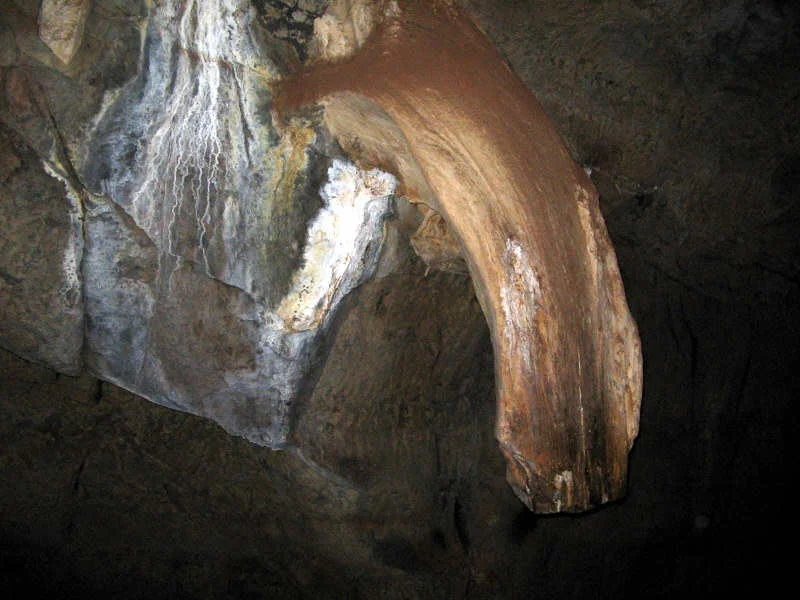
The caves owe their name to a nineteenth-century Swazi succession crisis. When King Sobhuza I died in 1836, his heir Mswati II was still a boy, and Mswati's brother Somquba made his own bid for the throne. Defeated and driven west, Somquba and his followers eventually found the caves in the early 1860s and turned them into a fortress, leading their prized Nguni cattle in single file through a mouth then so narrow the long horns barely cleared it. They stockpiled food, drew on plentiful water, and held out through repeated attacks. Once, Mswati's regiments lit an enormous bonfire at the entrance to suffocate everyone inside. The caves' mysterious airflow defeated them, and a Boer commando from Lydenburg arrived to drive the attackers off. Traces of that fire are still visible today.
The Guardian and the Gold
The man who watched over the entrance was Somquba's brother and chief councillor, Sudwala, whose name the caves carry to this day and whose spirit, legend says, lingers in the dark. Somquba was eventually killed in a surprise attack, and the survivors stayed on under Sudwala's leadership. The caves kept drawing soldiers. During the Second Boer War in 1900, retreating Boers stored ammunition here for their 94-pounder Long Tom guns, and a persistent legend holds that this was a hiding place for the "Kruger Millions," the gold bullion that supposedly vanished as President Paul Kruger fled toward Mozambique. The treasure has never been found. Whether it ever passed through Sudwala is exactly the kind of mystery a cave this old seems built to keep.
A Living Cave
Sudwala is no museum piece roped off behind glass; people still go in. Hour-long tours run through the day, and once a month the five-hour Crystal Tour pushes two thousand metres into the system to a chamber glittering with aragonite crystals and the formation known as the Sudwala Star. The acoustics are extraordinary, and the caves have doubled as a concert hall, hosting choirs and musicians from the Drakensberg Boys' Choir to local pipe bands marking World Bagpipe Day. Through all of it the cave does what it has always done: holds its temperature at a steady seventeen degrees and breathes that unexplained current of fresh air, the same draught that kept a hunted prince alive a century and a half ago.
From the Air
The Sudwala Caves lie at 25.37 degrees South, 30.70 degrees East, on the lowveld side of the Mpumalanga escarpment between Mashishing (Lydenburg) and Nelspruit, set into a dolomite ridge at roughly 900 metres elevation. The forested Mankelexele ridgeline and the nearby Crocodile River help mark the spot from the air. Nearest major airport is Nelspruit / Kruger Mpumalanga International (FAKN), about 35 km to the east. Recommended viewing altitude 2,000 to 4,000 feet AGL; the escarpment is clearest in the dry winter, with humid, cloud-building afternoons through the summer rains.
Nearby Stories
- Battle of Bergendal 16 km away
- Pilgrim's Rest 28 km away
- Sabi Sand Game Reserve 37 km away
- Barberton Greenstone Belt 43 km away
- 1986 Mozambican Tu-134 Crash 72 km away
- Bushveld Igneous Complex 111 km away
- Eswatini 121 km away
- Battle of Bronkhorstspruit 157 km away