
Bushveld Igneous Complex
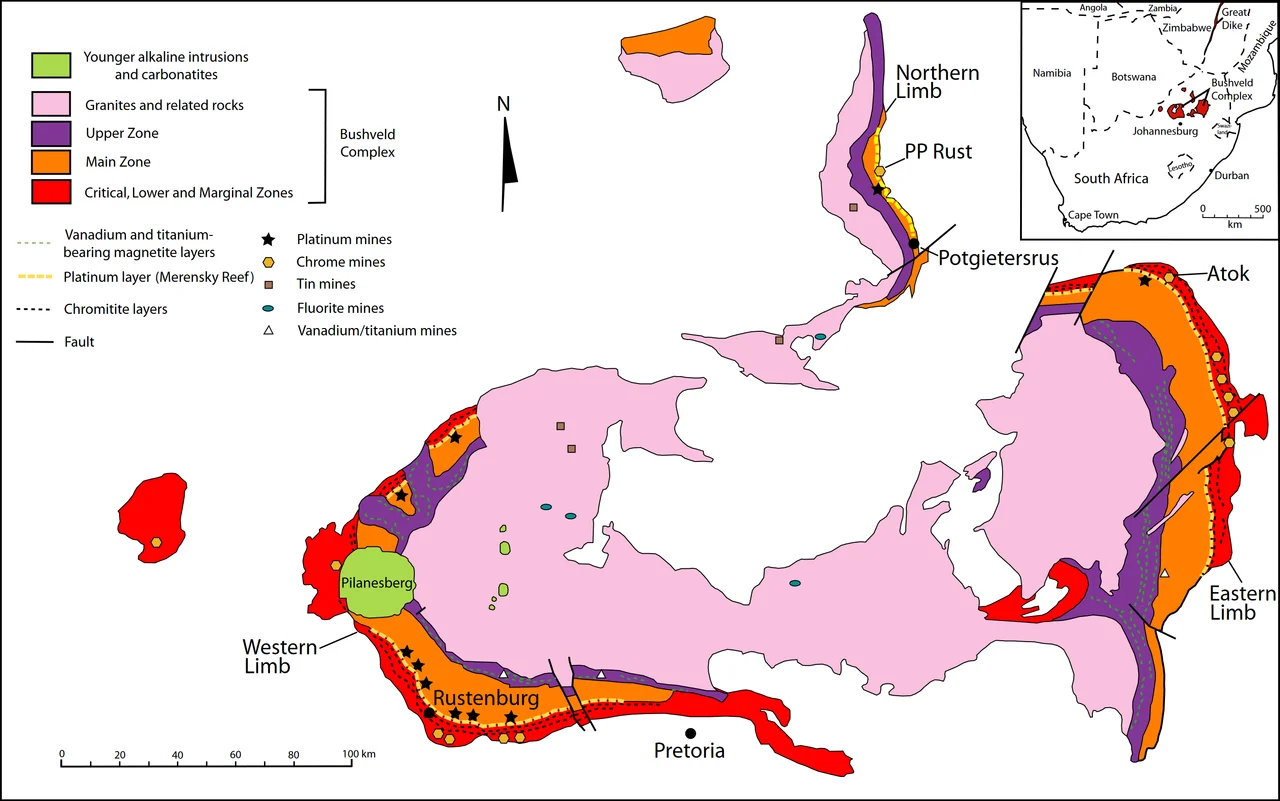
Look at the catalytic converter in a car, the wedding band on a finger, the contacts inside a hard drive, and there is a fair chance the platinum came from one place. Spread across the bushveld north of Pretoria, hidden beneath grass and granite and the towns of Rustenburg and Steelpoort, lies the largest layered igneous intrusion on Earth. It is a basin roughly the size of Ireland, and it holds something like three-quarters of the world's platinum. To understand how, you have to imagine the ground melting.
A Magma Chamber the Size of a Country
About 2.06 billion years ago, in the early Proterozoic, immense volumes of molten rock rose from the mantle through long cracks in the crust and pooled in a vast saucer-shaped chamber - a lopolith. It did not erupt. It sat, and it cooled, and it cooled slowly enough that the minerals had time to organize themselves. The Bushveld Igneous Complex now covers more than 66,000 square kilometers and reaches up to nine kilometers thick in places. Erosion has since tilted and stripped it, exposing its edges as four great limbs - northern, eastern, southern, and western - that ring what was once a single buried basin. Its intrusion predates the giant Vredefort meteorite impact to the south by some thirty million years, though the two are unrelated.
The Layered Cake
As the magma cooled, different minerals crystallized at different temperatures and settled out in sequence, building a structure geologists compare to a layered cake. Dense, magnesium-rich rocks settled toward the bottom; lighter ones formed above. The chamber was refilled again and again with fresh pulses of molten rock, and each surge left its signature in the strata, so that reading the layers from bottom to top is like reading the chamber's history in order. Threaded through this layering are thin, astonishingly rich seams the miners call reefs. The Merensky Reef - often less than a meter thick, a humble-looking band of norite laced with sulfides - was identified in 1924 by the geologist Hans Merensky, whose name it still carries. It and the UG2 chromitite reef together hold roughly 90 percent of the world's known platinum-group reserves. Together with the Platreef in the northern limb, they form a deposit that has no equal anywhere on the planet.
Six Precious Metals, One Reef
The platinum group is not one metal but six - platinum, palladium, osmium, iridium, rhodium, and ruthenium - and the Bushveld holds the world's largest reserves of all of them, alongside vast quantities of chromium, vanadium, titanium, iron, and tin. The numbers are staggering: roughly 75 percent of the world's platinum and about half its palladium trace to this single complex. The Merensky Reef alone averages around ten parts per million of platinum-group metals, which sounds like almost nothing until you realize how much rock has been moved to extract it. Even compared with the other great platinum deposits - the Sudbury Basin in Canada, Norilsk in Russia - the Bushveld stands apart as the prime source on Earth.
The Cost of the Reef
Wealth this concentrated comes with a human ledger. More than thirty mines work the complex, most of them underground, and the platinum towns around Rustenburg have been shaped by the migrant labor system - a 2016 study described an abnormal concentration of young men living far from their families, amid high poverty and a local economy where platinum mining accounts for more than 65 percent of GDP and most direct jobs. The history is written in strikes and tragedy: the 2014 platinum strike was among the longest in South African history, and the name Marikana, where police killed striking miners in 2012, has become shorthand for everything unresolved in the industry. The reef that supplies the world's clean-running engines has rarely run smoothly for the people who mine it.
From the Air
The Bushveld Igneous Complex is centered near 24.78°S, 29.20°E, north of Pretoria across South Africa's Limpopo and North West provinces. From cruising altitude the complex itself is subtle - it is a buried geological structure, not a mountain - but its surface signatures are not: the near-circular Pilanesberg Complex rising from the western limb, the long scars and tailings dams of the Rustenburg and Steelpoort mining belts, and the abrupt edge where the basin's tilted strata meet the surrounding highveld. Polokwane International Airport (ICAO: FAPP) lies to the northeast and Pretoria's airspace to the south. Best viewed from 10,000-20,000 ft on a clear, dry winter day (May-August) when the geology and the mine workings show plainly against the brown veld.
Nearby Stories
- Makapansgat 36 km away
- 2024 Mmamatlakala Bus Crash 59 km away
- Bokoni 68 km away
- Premier Mine 86 km away
- Pilgrim's Rest 90 km away
- Sunland Baobab 96 km away
- Tswaing crater 109 km away
- Battle of Bergendal 114 km away