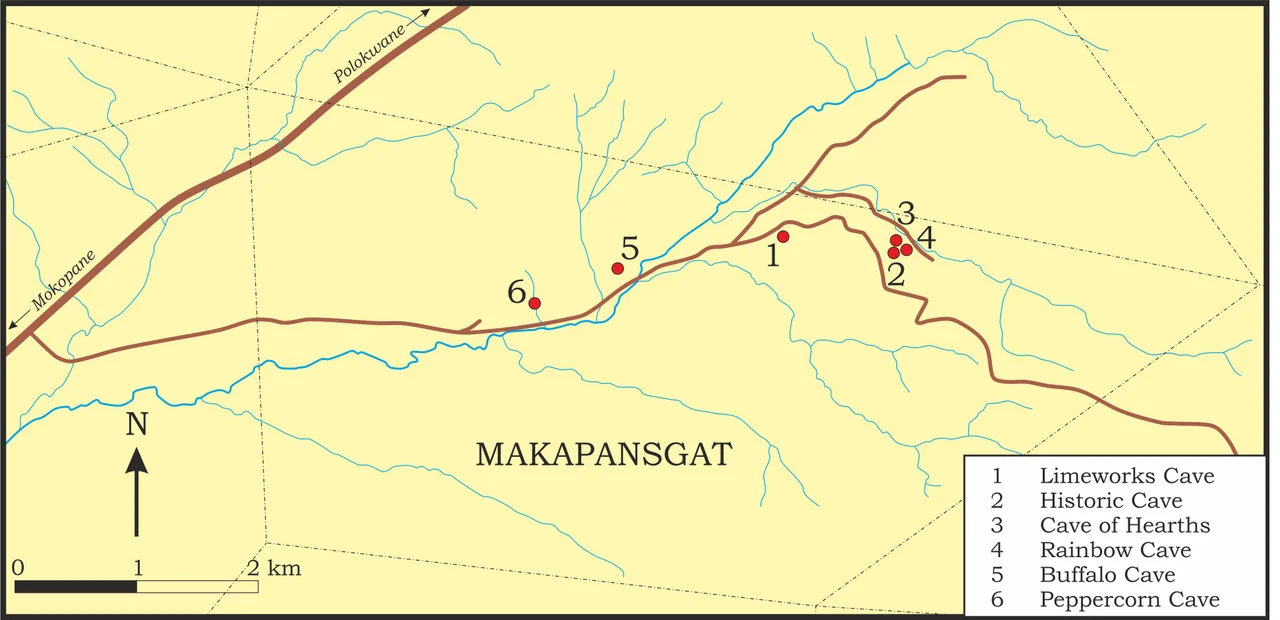

Makapansgat
A small reddish stone, no bigger than a fist, sits in a museum drawer in Pretoria. Water and weather shaped it, not hands - yet turn it in the light and a face stares back, with hollows where eyes and a mouth should be. It was found among the bones of Australopithecus africanus in a cave in the Makapan Valley, miles from any rock of its kind. Someone, nearly three million years ago, seems to have picked it up and carried it home. If they did, the Makapansgat pebble may be the oldest evidence we have that a mind looked at the world and saw something more than rock.
A Valley of Deep Time
Makapansgat is not one cave but a whole archive of them, carved into the limestone hills northeast of Mokopane in Limpopo. Together they preserve one of the richest records of human evolution anywhere on Earth, which is why the valley was added in 2005 to the Cradle of Humankind World Heritage Site. The oldest, the limeworks, spans from more than four million years ago to perhaps 1.6 million, and from its deposits have come many thousands of fossil bones - among them the gracile, small-brained australopithecines, dated by palaeomagnetism to between roughly 2.85 and 2.58 million years ago. These were upright walkers with apelike skulls, living in a world long before stone tools, leaving their remains in caves that would hold them for an almost unimaginable span of time.
The Man Who Saw Fire
The valley's modern story begins in 1925, when a local schoolteacher named Wilfred Eitzman, drawn by the limeworkers' blasting, started collecting fossils and sent some to the anatomist Raymond Dart in Johannesburg. Dart, who had already stunned the world with the Taung Child, found the Makapansgat bones blackened and concluded they had been burned in ancient fires. He named the creatures Australopithecus prometheus, after the Greek hero who stole fire from the gods, and built an elaborate theory that they had hunted with weapons of bone, tooth, and horn - the Osteodontokeratic culture. He was wrong on both counts. The black stains turned out to be manganese, not soot, and the bone tools dissolved under scrutiny; the fossils were simply Australopithecus africanus. But the romance of his error helped make Makapansgat famous.
A Record Without Gaps
What makes the valley extraordinary is its continuity. The Cave of Hearths preserves a nearly unbroken sequence of human occupation - from the hand-axe makers of the Early Stone Age, through the Middle and Later Stone Ages, into the Iron Age - and a jawbone recovered there may belong to one of the earliest representatives of our own species. Other caves hold their own chapters: Buffalo Cave, named for an extinct dwarf buffalo and dated to between roughly 990,000 and 780,000 years ago; Iron Age terraces littered with potsherds, grindstones, and the slag of ancient iron smelting; underground lakes; and colonies of migratory bats curtained behind the roots of a fig tree. Few places let you walk through so much of the human past in a single valley.
The Siege of the Historic Cave
The valley's recent history carries its own weight. In 1854, the Historic Cave became the site of a brutal confrontation between a Boer commando and the local Langa and Kekana people, following the killing of Voortrekkers nearby. Chief Mokopane and a large number of his people, along with their cattle, were besieged inside the cave for nearly a month, from late October into November. Many hundreds died of hunger and thirst before it ended. The nearby town that grew up afterward was named for a Boer commander killed in the fighting - and then, after apartheid gave way to majority rule, renamed Mokopane in honor of the chief. The valley that holds our most ancient ancestors also holds a far more recent and painful memory, and the act of renaming was, in its way, an act of return.
From the Air
The Makapan Valley lies at about 24.16°S, 29.18°E, in the limestone hills northeast of Mokopane (formerly Potgietersrus) in Limpopo, South Africa. From the air the area shows as a dissected dolomitic landscape of wooded ridges and steep-sided valleys at the western edge of the Springbok Flats, with the cave openings hidden in the hillsides rather than visible from altitude. It sits within the broader Waterberg region. Polokwane International Airport (ICAO: FAPP / IATA: PTG) is roughly 60 km to the northeast; smaller fields serve Mokopane itself. The site is a protected World Heritage area with controlled access on the ground. Best viewed in the clear, dry winter season (May-August); recommended altitude 4,000-7,000 ft over the valley.
Nearby Stories
- Bushveld Igneous Complex 44 km away
- Waterberg Biosphere 66 km away
- Sunland Baobab 75 km away
- Marakele National Park 90 km away
- Tswaing crater 116 km away
- Blyde River Canyon Nature Reserve 125 km away
- Soutpansberg 134 km away
- Pilgrim's Rest 147 km away