
Blyde River Canyon Nature Reserve
Most of the world's great canyons are the colour of dust. The Blyde is the colour of a forest. Cut into the Drakensberg escarpment in eastern Mpumalanga, this gorge plunges from cool, misty highlands at nearly 1,950 metres down to lowveld bushveld at 560 metres, and the whole drop is upholstered in living green, subtropical, dripping, riotous with orchids and tree ferns. It is widely called the third-largest canyon on Earth, and almost certainly the largest green one. From the rim, the cliffs fall away so far that on the clearest days, the Indian Ocean itself glints on the horizon.
The Chief and His Wives
The canyon's most famous landmark is a trio of conical peaks that rise from the far wall like enormous thatched huts. They are called the Three Rondavels, after the round dwellings they resemble, but the Sotho names that came first carry a story. The flat-topped peak beside them is Mapjaneng, "the chief", remembered for repelling an invading Swazi force in a battle that became legend. The three rondavels themselves are named for three of his wives, said to be his most troublesome: Magabolle, Mogoladikwe and Maseroto. Nearby stands an isolated hill the Sotho call "the mountain whose shadow moves", a natural sundial whose creeping shade was once read for the time of day.
Bourke's Long-Shot Luck
Where the Treur River drops into the Blyde, the water has drilled the rock into a gallery of smooth cylindrical wells, carved over ages by sand spinning in trapped vortices. They are called Bourke's Luck Potholes, after a prospector named Tom Bourke who was convinced gold lay here. He was right about the geology, in a sense, and wrong about his fortune: the gold was nearby, but Bourke himself never found any. The river that named the canyon carries a story too. Blyde means "glad" in Dutch, the relief of a Voortrekker party reunited with companions they had feared lost, while the Treur, just upstream, means "sorrow", named when those same companions seemed gone for good.
A Canyon That Breathes
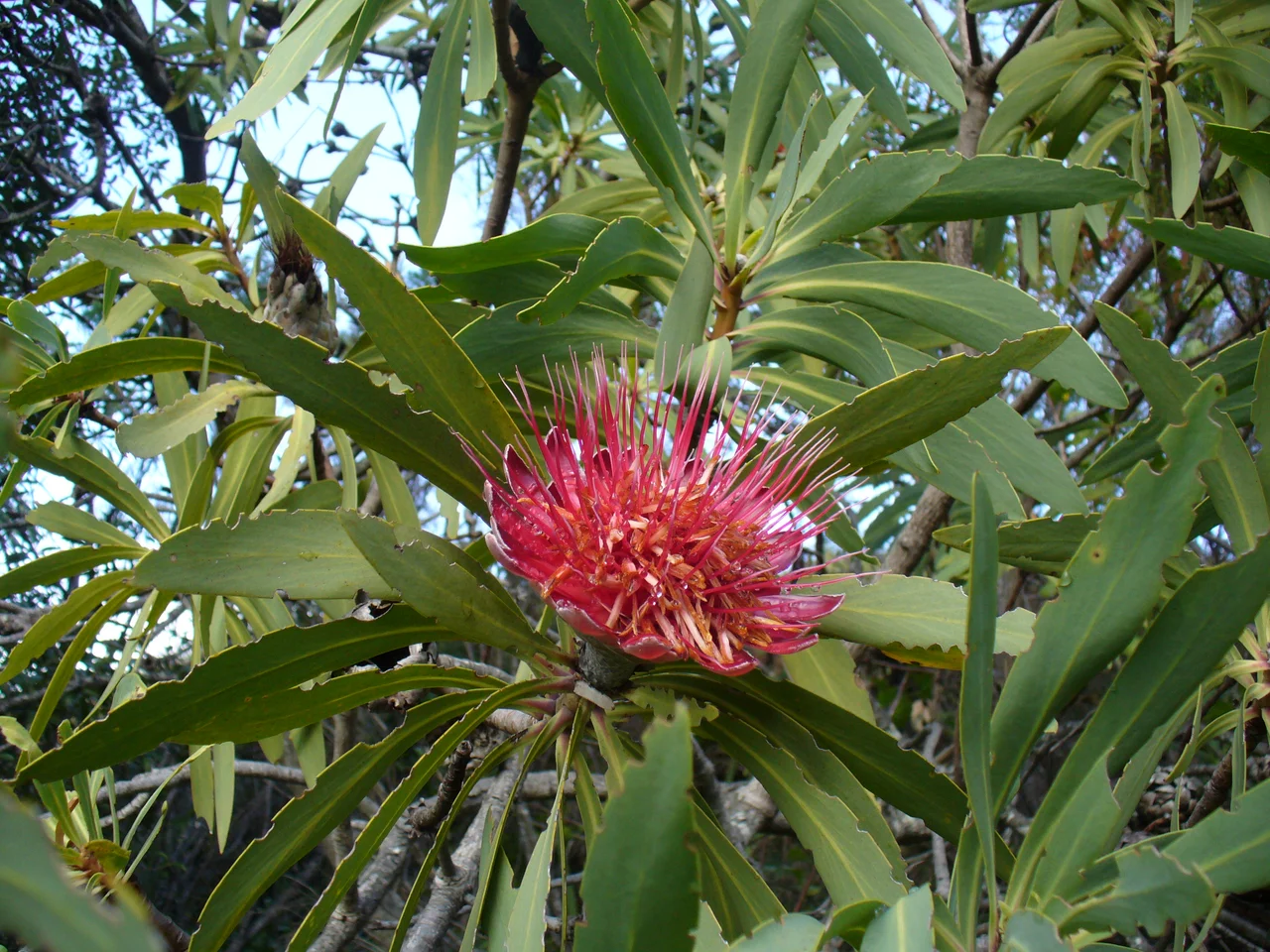
The Blyde's flora is staggering, the product of an altitude range that stacks several climates into one gorge and rainfall that swings from 540 to nearly 2,800 millimetres a year. Orchids, lilies and proteas grow here, including the Blyde River protea found nowhere else on Earth. Indigenous forest blankets a tenth of the reserve in sixty scattered patches. The wildlife shifts with the elevation: mountain reedbuck, baboons and rock hyraxes hold the high plateaus, while impala, kudu, zebra and wildebeest roam the warmer woodland below, and hippo and crocodile lurk in the Blyderivierpoort Dam at the canyon's heart. Even the lizards are endemic, including a flat gecko known only from the sheer cliff face of a single rondavel, undescribed by science until 2014. The rivers hold their own quiet survivor: the Treur River barb, a small fish once thought lost, rediscovered in the 1970s and now thriving again in the upper catchments where introduced trout and bass cannot reach it.
The Edge of the World
At the reserve's southern tip, the escarpment ends in a viewpoint called God's Window, where the land simply stops and the lowveld unrolls a thousand metres below. The 1980 film The Gods Must Be Crazy borrowed the spot for its ending, when the wandering San character Xi, played by the Namibian farmer N!xau, reaches the cliff edge through low cloud and decides he has found the edge of the Earth. The cloud helps. On a misty morning the platform floats above a white void, the world below erased. On a clear one, it stretches across the Kruger lowveld to the Lebombo Mountains on the Mozambique border, the full width of a continent's shoulder laid out beneath your feet.
From the Air
The Blyde River Canyon Nature Reserve centres near 24.49°S, 30.76°E along the Drakensberg escarpment in eastern Mpumalanga, South Africa. Elevation ranges dramatically from about 560 m at the Blyderivierpoort Dam to 1,944 m at Mariepskop. The Three Rondavels and the Blyde Dam mark the canyon's heart; God's Window anchors the southern rim, with the Kruger lowveld and distant Lebombo range to the east. Nearest airports are Hoedspruit Eastgate (ICAO FAHS) just east of the escarpment, and Kruger Mpumalanga International (FAKN) near Mbombela to the south. Expect strong orographic lift, rapid afternoon cloud build-up over the rim, and best visibility on clear winter mornings.
Nearby Stories
- Pilgrim's Rest 11 km away
- Sabi Sand Game Reserve 29 km away
- Kruger National Park 36 km away
- Sunland Baobab 71 km away
- 2010 FIFA World Cup 102 km away
- Battle of Bergendal 107 km away
- Makapansgat 161 km away
- 1986 Mozambican Tu-134 Crash 169 km away