
2010 FIFA World Cup
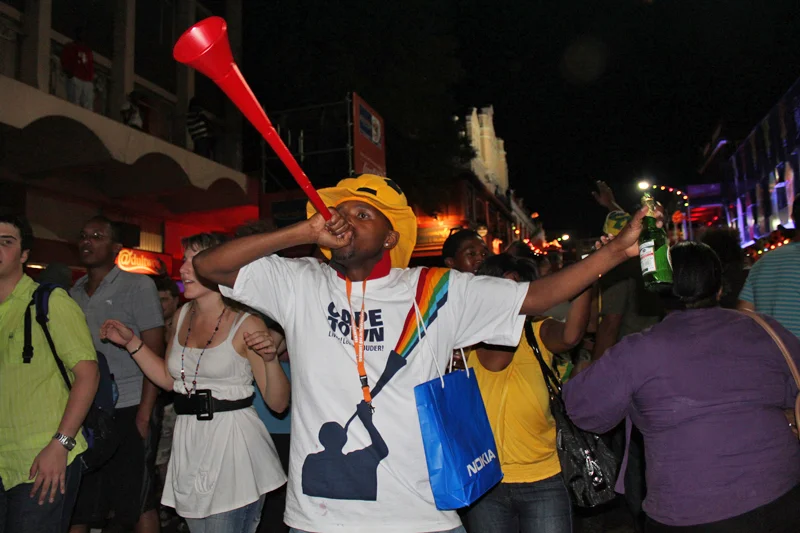
The sound came first. Long before the matches mattered, the world heard South Africa 2010 as a vast, droning hum, the noise of a million plastic vuvuzelas blown in stadiums from Cape Town to Johannesburg. Commentators complained; broadcasters tried to filter it out; nobody could stop it. It was the soundtrack of the first FIFA World Cup ever staged on the African continent, a tournament South Africa had been told, more than once, it could not pull off. From 11 June to 11 July 2010, across ten stadiums in nine cities, it pulled it off anyway.
Mandela's Bid
Hosting rights came down to a vote in Zürich on 15 May 2004, restricted that year to African nations as part of a short-lived policy to rotate the World Cup between continents. South Africa, which had narrowly lost the 2006 bid, won this time with 14 votes to Morocco's 10. The decisive figure was not a footballer but Nelson Mandela. He had spoken of how football sustained him during his long imprisonment on Robben Island, where, he said, the game "made us feel alive and triumphant despite the situation we found ourselves in." When the result was announced, the elderly former president lifted the World Cup trophy above his head, and a country that had emerged from apartheid barely a decade earlier had been handed the planet's largest sporting event.
Proving the Doubters Wrong
Confidence in South Africa was not universal. Through 2006 and 2007, rumours swirled that the tournament might be moved, and prominent voices in European football questioned whether the stadiums and infrastructure would be ready. They were. Five new stadiums were built and five more upgraded, at a cost of over a billion US dollars, and the country expanded its transport networks, including Johannesburg's new Gautrain. When 70,000 construction workers walked off the job in a pay dispute in July 2009, the strike was settled within a week and every venue was finished on time. At a ceremony marking 100 days to kickoff, even the skeptics conceded the country was ready. The crown jewel was Soccer City in Johannesburg, rebuilt in the shape of a calabash, the traditional African gourd, its earth-toned shell glowing as if lit from within.
Tshabalala's Goal
The opening match put South Africa against Mexico at Soccer City, and just after halftime it produced the moment the whole continent had been waiting for. In the 55th minute, the winger Siphiwe Tshabalala collected the ball, took aim from the left and drove a thunderous strike into the top corner. The stadium erupted; the vuvuzelas were, somehow, drowned out by a roar heard across the country. A nation still mending the wounds of apartheid danced together in the streets. South Africa's footballers, the team affectionately known as Bafana Bafana, could not sustain it, becoming the first host nation in World Cup history to be eliminated in the group stage, despite beating France along the way. But Tshabalala's goal had already done its work. For one afternoon, a divided country was simply, joyfully united.
A Final, and a Farewell
On the pitch, the tournament belonged to Europe. Spain, the reigning European champions, lost their opening match and then won everything that followed, beating the Netherlands 1-0 in the final at Soccer City on 11 July. The winning goal came in the 116th minute, an extra-time volley from Andrés Iniesta, the latest decisive strike in any World Cup final and Spain's first world title. Yet the image that endured belonged to South Africa. Before the match, at the closing ceremony, Nelson Mandela appeared on the field one last time, frail and smiling, wheeled around the turf to a roar of recognition. It was his final public appearance. The 91-year-old who had lifted the bid trophy six years earlier had lived to see his country deliver the tournament, and to wave goodbye from the centre of it.
From the Air
The final and opening match were held at Soccer City (FNB Stadium) near 26.23°S, 27.98°E in Johannesburg, South Africa, at roughly 1,750 m above sea level, high enough that the thin highveld air measurably affected the flight of the ball. The calabash-shaped stadium sits just south of central Johannesburg near Soweto; OR Tambo International (ICAO FAOR) lies about 25 km to the east, and Lanseria (FALA) to the northwest. The 2010 tournament spanned the country, from Cape Town (FACT) on the coast to Durban (FALE) on the Indian Ocean and Polokwane (FAPP) in the north. Winter daytime visibility on the highveld is typically excellent and dry, with cold, clear nights.
Nearby Stories
- 2024 Mmamatlakala Bus Crash 30 km away
- Sunland Baobab 34 km away
- Bushveld Igneous Complex 60 km away
- Blyde River Canyon Nature Reserve 93 km away
- Soutpansberg 97 km away
- Marakele National Park 124 km away
- Dzata Ruins 128 km away
- Matobo National Park 355 km away