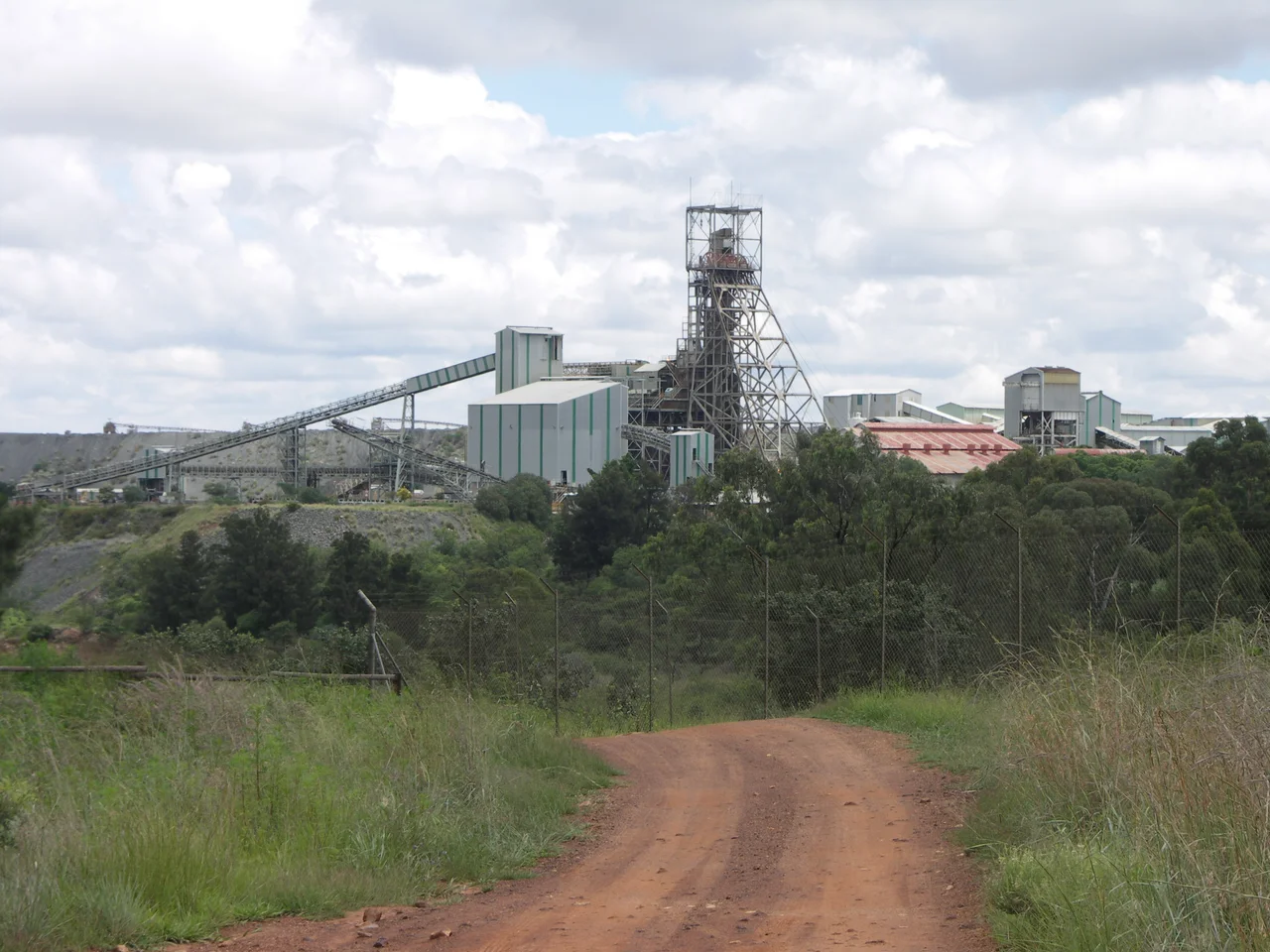

Premier Mine
In January 1905, a mine superintendent on an evening inspection noticed something glinting in the wall of the pit, just below the surface. He levered it out with a pocket knife, half-convinced it was a chunk of glass planted as a joke. It was not. It was the Cullinan - 3,106 carats of flawless blue-white crystal, the largest rough gem-quality diamond ever discovered, and it had come out of the ground here, at the Premier Mine near the town of Cullinan, some forty kilometres east of Pretoria.
A Pipe of Fire
The mine is not a tunnel chasing a vein but a hole bored straight down into a kimberlite pipe - a carrot-shaped throat of an ancient volcano that, more than a billion years ago, blasted up from the deep mantle carrying diamonds frozen inside it. The surface scar covers about thirty-two hectares, one of the largest such pipes ever worked. Sir Thomas Cullinan opened the operation in 1902 and gave it his name, though for a century it was simply the Premier. Petra Diamonds, which now owns it, renamed it the Cullinan Diamond Mine in 2003 to mark its hundredth year. The geology here is unusually generous: the pipe has yielded not only enormous stones but a colour almost no other mine produces in quantity - deep, rare blue diamonds that command record prices at auction.
The Great Star of Africa
The Cullinan was too valuable and too unprecedented to sell easily; it sat unsold in London for two years before the Transvaal government bought it and presented it to King Edward VII. The job of cleaving it fell to the celebrated cutter Joseph Asscher in Amsterdam, who studied the stone for months before striking it. From that single crystal came a constellation of finished gems. The largest, Cullinan I - the Great Star of Africa, 530 carats - remains the largest clear cut diamond on Earth and sits today in the head of the Sovereign's Sceptre with Cross. The second, Cullinan II at 317 carats, gleams in the band of the Imperial State Crown. Both are part of the Crown Jewels of the United Kingdom, which means a piece of this quiet Transvaal hillside is carried at every British coronation.
A Roll Call of Giants
The Cullinan was the most famous, but the mine kept producing marvels. The Golden Jubilee, 755 carats in the rough, became the largest faceted diamond in the world. The Niarchos came out at 426 carats, the Premier Rose at 353, the De Beers Centenary at 275 - each a small fortune of carbon. The records did not stop with history. In 2009 a 507-carat stone surfaced and sold for 35.3 million dollars, then the highest price ever paid for a rough diamond. The blues kept coming too: a 26-carat blue cut from rough found in 2009, a 29.6-carat blue in 2014 that the company's chief executive called its most significant ever, and a remarkable 122-carat blue later that same year. Few patches of earth anywhere have given up so much concentrated value.
A Mine, a Town, a Legacy
The story of the Premier is also a story of who profited and who labored, and how that balance shifted. For most of the twentieth century the mine and the global diamond trade were dominated by De Beers, and when De Beers sold Cullinan in 2007 for a billion rand, the buying consortium included a Black Economic Empowerment foundation holding a quarter of the operation, part of it through an employee share trust - a small marker of a country trying to redistribute the wealth dug from its own soil. The town of Cullinan, with its tin-roofed cottages and the great headframe looming over the main street, now welcomes visitors who descend into the workings to see where the giants were found. More than a century on, the pipe is still producing, still surprising, still pulling impossible blue fire out of the dark.
From the Air
The Premier (Cullinan) Mine lies at approximately 25.68°S, 28.51°E in the town of Cullinan, about 40 km east of Pretoria on the highveld (elevation roughly 1,500 m / 4,900 ft). From the air the mine is unmistakable: a vast open excavation and waste-rock dumps beside the compact grid of the town, with the tall steel headframe marking the shaft. The roughly oval surface footprint of the kimberlite pipe stands out against the surrounding farmland. The nearest major airport is Wonderboom Airport (FAWB) at Pretoria, about 35 km west; OR Tambo International (FAOR) lies around 55 km to the south-west. Dry winter air (May to August) gives the clearest views of the workings and dumps.
Nearby Stories
- Liliesleaf Farm 7.8 km away
- Tswaing crater 9.8 km away
- Vlakplaas 12 km away
- Boksburg explosion 47 km away
- Bushveld Igneous Complex 79 km away
- Battle of Bergendal 92 km away
- Makapansgat 157 km away
- Battle of Majuba Hill 175 km away