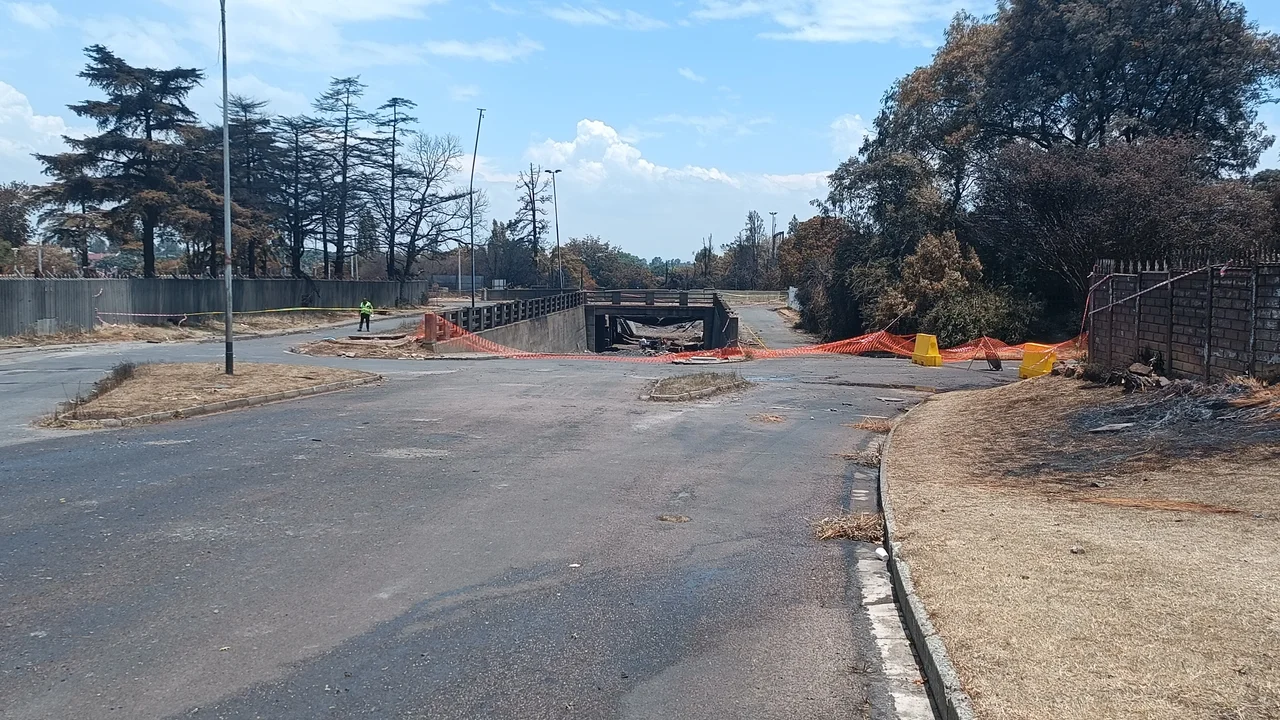

Boksburg explosion
It was Christmas Eve, and the tanker should never have been on that street. The driver had taken a wrong turn while hauling 60,000 liters of liquefied petroleum gas from Richards Bay toward Botswana, and the route he chose to correct it carried him under a low railway bridge on Hospital Street in Boksburg, barely a hundred meters from the Tambo Memorial Hospital. The truck stuck. Gas began to leak, then to burn. A crowd gathered to watch the spectacle of the fire, the way crowds do. At about half past seven that morning, the fourth and largest explosion tore through them. It was felt as a tremor four kilometers away. By the time the toll settled weeks later, 41 people were dead, and many of them had been doing nothing more than their jobs, or trying to move a car.
The Hospital Next Door
The cruelest detail of this disaster is who died and where. Tambo Memorial Hospital stood almost beside the bridge, and the people inside it had no warning that mattered. Eight hospital staff, seven nurses and a driver, were killed in the carpark. At least one of them died trying to move her own car away from the burning tanker. Inside, twenty-four patients and thirteen more staff in the emergency unit were caught by the blast, suffered severe burns, and had to be carried out to other hospitals. The ceiling of the emergency unit partly collapsed, forcing every patient to be moved to the theatre complex at the back. A hospital that should have been the first to help the injured was instead, for those terrible hours, unable to take anyone in at all.
Of the Forty-One
Of the dead, 23 were members of the public and 11 were health workers from the damaged hospital. Eight died immediately or before paramedics could reach them; the rest succumbed later in hospital beds. Two more people who had been near the blast were still listed as missing days afterward, their families left without even the certainty of a body. Among those killed were residents who had come into the area to help, neighbors drawn toward danger by the instinct to do something. These were not abstractions. They were Boksburg's nurses and its neighbors, people who on any other Christmas Eve would have been finishing shifts and heading home, and a single illegal turn down the wrong street ended their lives within minutes of each other.
The Response
Help came first from the people closest at hand: local security companies, the community policing forum, and volunteer groups. Investigators later found that early calls to emergency services went unanswered before the fire department finally picked up, and that police did not reach the scene until after the last explosion. Once mobilized, though, the response was enormous. Disaster-relief organizations including Gift of the Givers and Muslim Aid arrived through the day. The Gauteng Emergency Medical Services coordinated a frantic evacuation of critical patients from the wrecked hospital, using thirty state and private ambulances and several air-ambulance helicopters over a three-hour window. The blast had also destroyed the railway bridge itself, severing the Germiston-to-Springs line and adding a city's broken infrastructure to its grief.
No One to Blame, No One Accountable
The driver survived with only minor injuries. He was arrested the next day on charges including culpable homicide, but the deputy provincial police commissioner soon declared the arrest unlawful, since South African law required an investigation into intent before any arrest. The charges were dropped for lack of evidence, and six months on he remained uncharged. An external audit commissioned by the trucking company cleared it of wrongdoing, yet no comprehensive technical investigation was ever made public. The Citizen reported, from Google Street View imagery, that the height-restriction sign on the bridge had been illegible. As of late 2024, two years after that Christmas Eve, no one had been held legally responsible for the 41 deaths. For the families, the absence of accountability became its own lasting wound, a question that the bridge, now rebuilt, still cannot answer.
From the Air
The site lies at about 26.22 degrees south, 28.24 degrees east, in the Plantation suburb of Boksburg, within the City of Ekurhuleni on Johannesburg's East Rand in Gauteng. From the air this is dense urban and industrial terrain on the Highveld; the railway line and the rebuilt Hospital Street bridge near Tambo Memorial Hospital mark the spot. The nearest major airport is O. R. Tambo International (ICAO: FAOR), only a short distance west, with Rand Airport at Germiston (ICAO: FAGM) close by and Lanseria (ICAO: FALA) further north. Visibility over the East Rand is generally good, clearest in the dry winter months, though winter mornings can bring smog and haze. A respectful viewing altitude of 3,000 to 5,000 feet above ground takes in the rail corridor and the surrounding suburbs without lingering over a place of mourning.
Nearby Stories
- Cradle of Humankind 12 km away
- Kyalami Grand Prix Circuit 23 km away
- Rising Star Cave 30 km away
- Secunda CTL 34 km away
- Sharpeville Massacre 46 km away
- Vredefort Impact Structure 58 km away
- Battle of Bergendal 130 km away
- Battle of Majuba Hill 167 km away