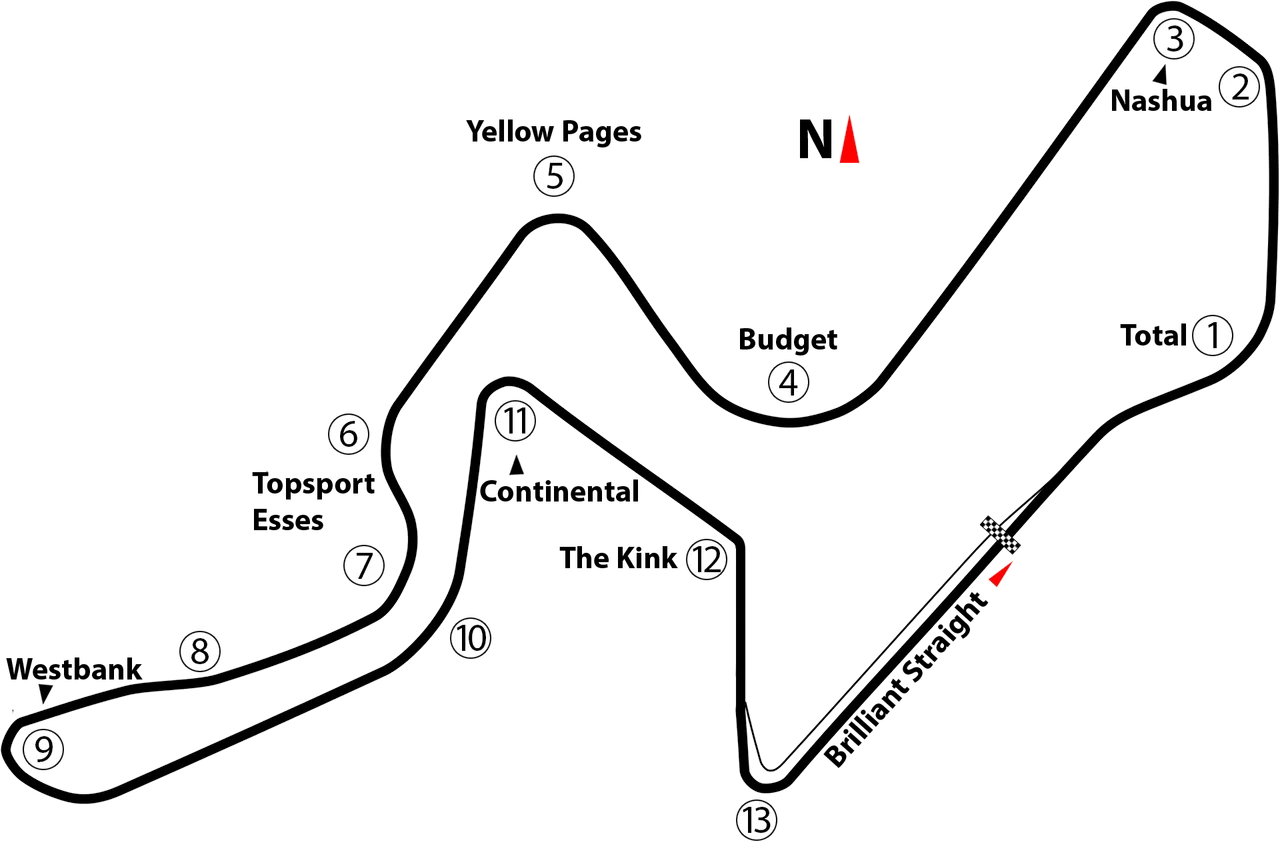

Kyalami Grand Prix Circuit
Its name means My home in Zulu - Khaya lami - and for the legends of motor racing, Kyalami became exactly that. Carved out of the high-veld grassland north of Johannesburg in the mid-1950s by Harry Pierce, Dick Bremner, and a handful of friends, the circuit grew into the fastest, most beloved racetrack on the African continent. Twenty editions of the South African Grand Prix were run here. Niki Lauda won three times; Ferrari and Williams claimed four victories each. At more than 1,500 metres above sea level, where the thin highveld air robbed engines of power and tested every driver's nerve, Kyalami earned a reputation as a circuit that gave nothing away for free.
A Circuit With Names Worth Knowing
The original Kyalami was a sweeping, fast layout, and its corners carried names that told you something about the place. Sunset Bend, a quick right-hander, was christened for the way it forced drivers to stare straight into the setting sun. Leeukop - Lion's Head - took its name from a nearby hill and the prison that stood behind it. The Kink split the long main straight in two, a deceptively casual flick at enormous speed. Clubhouse Bend honoured the motorsport clubhouse perched beside it. These were not abstract numbered turns but landmarks with stories, each one a test of commitment on a track that rewarded bravery and punished hesitation in equal measure.
The Day the Sport Stopped Cold
On 5 March 1977, Kyalami witnessed one of the most harrowing accidents in racing history - a tragedy that began with a small fire and ended with two lives lost. A stricken car had pulled off near the main straight, and two marshals ran across the track to reach it. One was Frederik Jansen van Vuuren, nineteen years old, carrying a fire extinguisher that weighed roughly 18 kilograms. He never saw the Welsh driver Tom Pryce coming over the crest at around 270 kilometres per hour, and Pryce, his view blocked, could not see him. The collision killed the young marshal instantly, and the extinguisher he carried struck Pryce in the head, killing the 27-year-old driver where he sat. Both men died doing their jobs. They are remembered together - a teenager who ran toward danger to help, and a gifted driver at the height of his career.
Silenced by the World
Kyalami's golden era could not survive the politics surrounding it. As international opposition to apartheid hardened, sporting sanctions closed in on South Africa, and Formula One left after the 1985 race; the last event on the original circuit ran in November 1988. The track had already seen its share of upheaval - in 1982 the Grand Prix drivers had staged a strike here, barricading themselves in a hotel to protest new licensing rules. But the sanctions were different. They were the world's verdict on a nation, and the empty grandstands of Kyalami became one small measure of South Africa's isolation. The engines that had defined the place fell quiet.
Rebuilt, Reborn, Still Racing
The circuit refused to die. Rebuilt in 1989 as part of a commercial development that swept away Leeukop, the Kink, and the old start-finish straight, Kyalami briefly welcomed Formula One back in 1992 and 1993 as a free South Africa rejoined the world. Hard years followed, and in July 2014 the track was auctioned without reserve, selling for 205 million rand to Toby Venter, the owner of Porsche South Africa. He poured another 100 million into upgrades, winning the circuit an FIA Grade 2 rating and bringing international endurance racing back with the Kyalami 9 Hours in 2019. Talk of a Formula One return still surfaces from time to time. For now the grandstands fill again each year, and the old highveld track lives up to its name - a home for racing in Africa.
From the Air
Kyalami sits at 26.00 degrees south, 28.07 degrees east, in Midrand, Gauteng, on the high plateau between Johannesburg and Pretoria at roughly 1,500 metres above sea level. From the air the circuit's distinctive looping ribbon of asphalt stands out against the surrounding suburban development. Lanseria International (ICAO: FALA) lies about 25 kilometres west, and O. R. Tambo International (FAOR), the region's main hub, is roughly 30 kilometres southeast - this is busy, controlled airspace, so expect heavy traffic and ATC coordination. Recommended viewing altitude is 4,000 to 6,000 feet AGL. The thin highveld air affects aircraft performance just as it once sapped racing engines; density altitude runs high on warm afternoons. Mornings are usually clear, with summer thunderstorms building by mid-afternoon.
Nearby Stories
- Witwatersrand Gold Rush 4.4 km away
- Royal Bafokeng Nation 25 km away
- TauTona Mine 26 km away
- Zonderwater POW camp 27 km away
- Tswaing crater 31 km away
- Sun City 73 km away
- Secunda CTL 80 km away
- Bushveld Igneous Complex 122 km away