.jpg)
Sun City
Forty-nine of the world's most famous musicians agreed on almost nothing in 1985 - Bruce Springsteen and Run-DMC, Miles Davis and Bono, Bob Dylan and Afrika Bambaataa - except this: they would not play Sun City. Their protest song named the resort directly, and it turned a luxury casino in the South African bushveld into shorthand for the whole machinery of apartheid. The irony is that Sun City was built to be the opposite of a battleground. It was meant to be an escape - a glittering pleasure palace dropped into the dry hills between the Elands River and the volcanic ring of the Pilanesberg, about 140 kilometres northwest of Johannesburg, where the rules that governed the rest of the country were quietly suspended.
A Loophole With Fountains
Sun City exists because of a line on a map. When the hotel magnate Sol Kerzner opened the resort on 7 December 1979, it stood inside Bophuthatswana, one of the bantustans the apartheid government had declared a separate "independent" state - a designation no other country in the world recognized. That fiction had a purpose. Gambling and topless revues were banned across South Africa, but in this nominally foreign territory they were legal. Kerzner built a casino, hotels, and a concert arena to fill the gap, and the white South Africans of nearby Pretoria and Johannesburg poured in for weekends of roulette and floor shows the law denied them at home. The resort was a playground for those the system favoured. Black South Africans, meanwhile, faced severe legal restrictions simply on entering the Sun City area - a reminder that the escape was never meant for everyone.
The Boycott Heard Around the World
The United Nations had called for a cultural boycott of South Africa, and Sun City became its sharpest test. Kerzner dangled enormous fees, and some performers took them - the Beach Boys, Linda Ronstadt, Queen, who played here in October 1984 and were fined by Britain's Musicians' Union and blacklisted by the UN for it. Queen defended themselves as apolitical entertainers, but the regret lingered; decades later, drummer Roger Taylor called the shows "kind of a mistake." Then Steven Van Zandt of the E Street Band turned the resort's name into a weapon. His 1985 single "Sun City," recorded by an extraordinary coalition called Artists United Against Apartheid, reached the Billboard charts that December and raised more than a million dollars for the anti-apartheid cause. Its refrain was a pledge and a dare: I ain't gonna play Sun City.
The Palace That Invented Its Own Legend
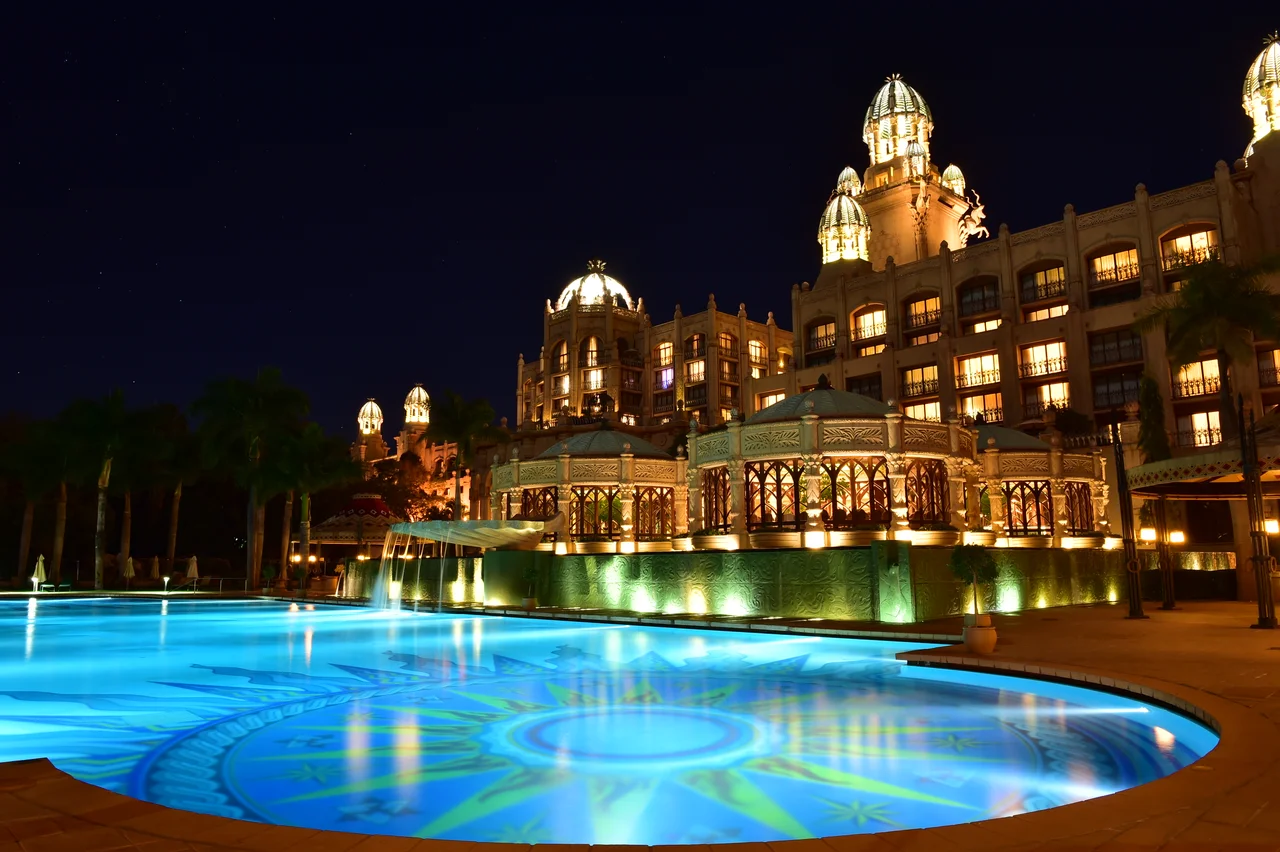
In 1992 Kerzner doubled down on fantasy with the Palace of the Lost City, a hotel built around a fairy tale he made up wholesale - the ruins of a vanished African kingdom, supposedly toppled by an earthquake, rebuilt in carved stone and gilded domes. Nearly ten thousand workers raised it in roughly 28 months, and it opened billed, with characteristic Kerzner audacity, as Africa's first seven-star hotel. Beside it, the Valley of Waves churns artificial surf onto a man-made beach, and two Gary Player-designed golf courses roll across the veld, one of them home to the Nedbank Golf Challenge. The whole place is a confection - palms and waterfalls and invented history layered over genuinely beautiful country.
After the Walls Came Down
When apartheid ended and Bophuthatswana was folded back into a democratic South Africa in 1994, Sun City lost the legal fiction that created it - but not its appeal. The casino still runs, the wave pool still breaks, and the resort has hosted Miss World pageants, world heavyweight title fights, and film premieres. What changed is who may walk through the gates. The resort that once enforced apartheid's exclusions now welcomes the citizens of the country it sits in. Sun City remains a strange and revealing monument: proof of how far a system will go to manufacture an escape, and how completely the world can refuse to look away.
From the Air
Sun City sits at 25.34 degrees south, 27.09 degrees east, in South Africa's North West Province, tucked against the southern rim of the Pilanesberg - an ancient, near-circular volcanic crater roughly 27 kilometres across that is unmistakable from altitude and makes an excellent navigational landmark. The nearest airport is Pilanesberg International (ICAO: FAPN), only a few minutes' flying time north. Lanseria International (FALA) lies about 100 kilometres southeast toward Johannesburg, and O. R. Tambo International (FAOR) is roughly 160 kilometres southeast. Recommended viewing altitude is 6,000 to 9,000 feet AGL, where the resort's hotels and golf courses read clearly against the surrounding bushveld. Highveld afternoons in summer bring sharp thunderstorms; mornings are typically clear with excellent visibility.
Nearby Stories
- Witwatersrand 16 km away
- Marikana Massacre 26 km away
- Oppikoppi 30 km away
- Tswaing crater 31 km away
- Matsieng Footprints 83 km away
- Siege of Mafeking 111 km away
- Gaborone 116 km away
- Bushveld Igneous Complex 149 km away