
Siege of Mafeking
When news reached London in May 1900 that the little South African town of Mafeking had been relieved after seven months under siege, the city lost its head. Crowds poured into the streets in such delirious celebration that the place-name itself became a verb: to maffick, meaning to rejoice loudly and publicly. The siege had no real military importance. But it had a hero, a plucky garrison, and a story Britain desperately wanted in a war going badly. The legend that emerged here would launch a worldwide youth movement. The reality, lived out in the dust by some nine thousand people, was harder and far less tidy.
A Stockpile on the Frontier
On the eve of the Second Boer War in 1899, Colonel Robert Baden-Powell was sent to raise mounted regiments on the frontier between the British Cape Colony and the Boer republics. He chose Mafeking as his supply base: it sat near the border, on the railway between Bulawayo and Kimberley, and held good stocks of food. It was also isolated and exposed. Ordered to keep a mobile cavalry force, Baden-Powell instead chose to tie down half his men defending the town. The Boers, under General Piet Cronje, cut the railway and telegraph and surrounded Mafeking from 13 October. The siege had begun, and it would last 217 days.
Improvise and Endure
What followed became the stuff of imperial folklore. The defenders dug a six-mile ring of trenches. They built a howitzer in the railway workshops and pressed an antique cannon from 1770 into service, the barrel happening to bear the initials B.P. Short of coins and banknotes, Baden-Powell printed his own siege money on woodcut presses, currency that today sells for far more than it was ever worth. Lord Edward Cecil, son of the British prime minister, organised local boys aged twelve to fifteen into a cadet corps that carried messages and freed men for the firing line, an arrangement Baden-Powell would later cite as a seed of Scouting. Lady Sarah Wilson, aunt of Winston Churchill, smuggled out dispatches and is remembered as one of the first women war correspondents.
The Other Mafeking
The legend has a shadow, and it lived in the stadt, the adjacent African township where the Barolong people made up most of Mafeking's population; roughly four in five residents of the town were Black. When food ran short from early 1900, the rationing was not shared equally. Black residents received less than white ones, and Baden-Powell eased the garrison's shortage in part by withholding rations from the Barolong town next door, leaving its people to face hunger and worse. Among those who lived through it was Sol Plaatje, a brilliant twenty-three-year-old court interpreter whose siege diary, published decades later, gives us the rarest thing from this war: an African account of it. His Mafeking is not the gallant adventure of the English memoirs. It is a place where the people who suffered most were the people the legend forgot.
Hero and Aftermath
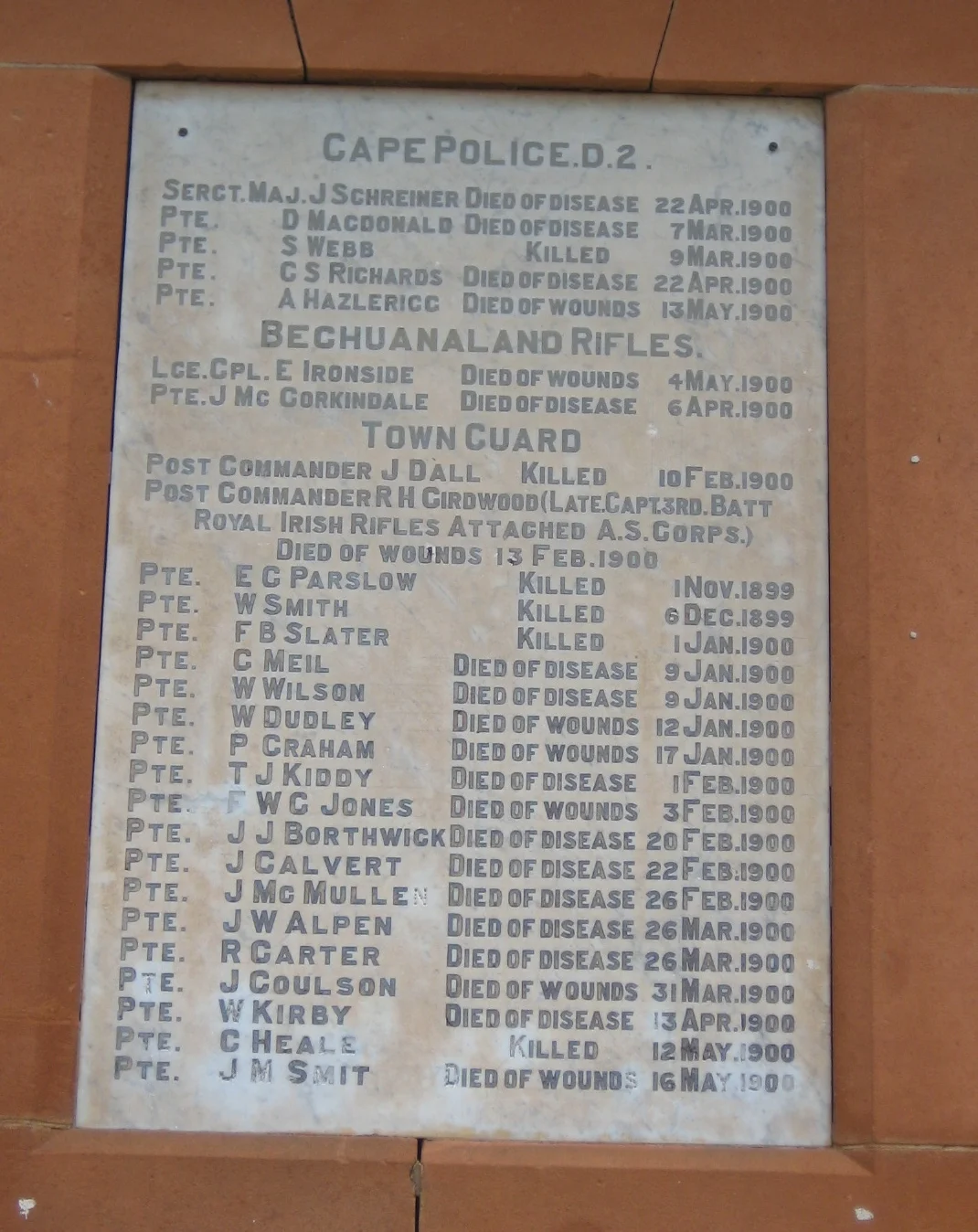
On 12 May, in the siege's final spasm, a Boer force under Field Cornet Sarel Eloff slipped through the defences before dawn, set fire to the stadt, and seized a police post, only to be cut off and beaten back by nightfall. Days later a relief column fought its way in. Mafeking had held. For no decisive military gain, the townspeople and garrison had suffered 212 killed and more than 600 wounded. Baden-Powell emerged the youngest major-general in the army and a household name, though sober military critics judged he had risked too much and tied down more of his own side than the enemy's. In 1908 he published Scouting for Boys, and his fame carried it: the Boy Scout movement spread across the world. The town, renamed Mahikeng, still stands, and so does the obelisk raised in 1904 to those who fell in its defence.
From the Air
Mahikeng (formerly Mafeking) lies at approximately 25.85 degrees south, 25.63 degrees east, in the far west of North West province near the Botswana border. From the air it is a compact town on the open, semi-arid plains of the Molopo River basin, the surrounding bushveld pale and dry for much of the year. Recommended viewing altitude is 5,000 to 9,000 feet. The Molopo River and the old railway line are the clearest landmarks. The town is served by Mahikeng (Mmabatho) Airport (FAMM) directly; the Botswana capital Gaborone and its airport (FBSK) lie roughly 50 km to the northwest across the border. Visibility is excellent through the dry winter months from May to September, when the bushveld turns golden-brown.
Nearby Stories
- Battle of Rooiwal 74 km away
- Battle of Dimawe 101 km away
- 2014 Orkney Earthquake 111 km away
- Sun City 114 km away
- Jwaneng diamond mine 130 km away
- Pilanesberg National Park 132 km away
- Kalahari Meerkat Project 207 km away
- Wonderwerk Cave 255 km away