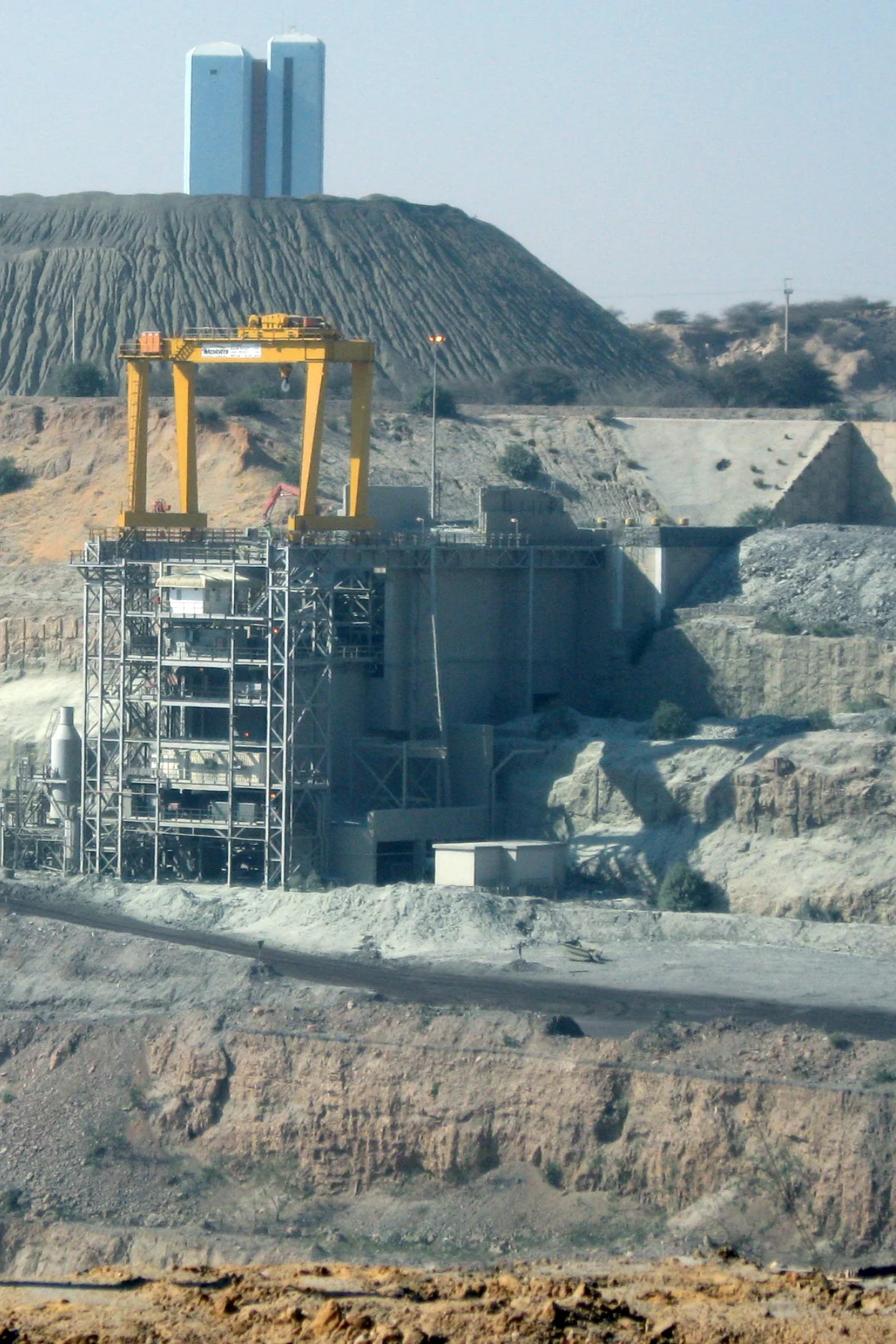

Jwaneng diamond mine
From the rim, the pit looks like an amphitheater built for giants: terraces of pale rock spiraling down hundreds of meters into the Kalahari, haul trucks the size of houses reduced to crawling specks at the bottom. This is Jwaneng, the richest diamond mine in the world by value, and the people who work it call it the Prince of Mines. The name comes from Setswana and means, fittingly, "a place where a small stone is found." The small stones found here, by the millions of carats each year, have done something almost no mineral wealth ever does for the country it comes from: they made it better off.
A Volcano's Buried Gift
The diamonds at Jwaneng rode to the surface inside a kimberlite pipe, the fossil throat of a volcanic eruption that tore up from deep in the Earth during the Permian period, well over 200 million years ago. As that magma blasted upward through the crust at tremendous speed, it carried with it crystals of carbon that had formed under crushing pressure far below, diamonds, frozen into the rock. The Jwaneng deposit is actually three such pipes merged together, part of the Orapa kimberlite field. For millions of years the gems lay hidden beneath the sands of south-central Botswana, until geologists came looking, guided in part by tiny telltale mineral grains scattered across the landscape.
The Stones in the Sand
Finding Jwaneng took patience and a touch of luck. In the early 1970s, De Beers exploration teams traced indicator minerals across the Kalahari, where windblown sand had buried any obvious sign of a pipe. In February 1973 the search paid off with the identification of the deposit. Then came nine more years of evaluation and construction before the mine opened fully in 1982. Today the operation digs on a scale that is hard to picture: in 2021 it moved roughly 107 million tonnes of rock, and in 2023 it produced about 13.3 million carats of diamonds. Year after year, Jwaneng alone generates the majority of the diamonds, and most of the revenue, of its parent company.
A Partnership, Not a Plunder
What sets Jwaneng apart is who shares in the wealth. The mine is run by Debswana, an equal joint venture between the diamond giant De Beers and the government of Botswana. When Botswana gained independence in 1966 it was among the poorest nations on Earth, with almost no paved roads. The decision to keep a half stake in its own diamonds, rather than hand the riches to foreign firms, helped fund schools, clinics, and infrastructure across the country. The mine itself runs a hospital, a primary school, and an airport, and in 2000 it became the first mine in Botswana to earn international certification for environmental management. The diamonds here are often called the gems that built a nation.
Digging Deeper
After four decades, Jwaneng's open pit is nearing the practical limits of how deep a hole this wide can safely go. Rather than close, its owners are reaching further down. A major expansion aims to push the workings well below their current depth of around 400 meters, extending the mine's life by years and adding thousands of jobs. The project is expected to pour more than 25 billion US dollars into Botswana's economy over its lifetime. Standing at the edge of that vast spiraling pit, watching the trucks grind up from the depths, you are looking at both an ancient eruption and a country's deliberate bet on its own future.
From the Air
Jwaneng lies in south-central Botswana at about 24.52 S, 24.70 E, roughly 170 kilometers southwest of the capital, Gaborone. From the air the mine is unmistakable: an enormous terraced open pit hundreds of meters deep, surrounded by the planned mining town and ringed by flat Kalahari bushveld. The mine operates its own Jwaneng Airport (FBJW) on site. Gaborone's Sir Seretse Khama International (FBSK) is the main gateway to the northeast. Recommended viewing altitude 3,000 to 5,000 feet AGL to take in the full scale of the pit; visibility is generally excellent over the dry Kalahari, though dust and heat haze build in the afternoons.
Nearby Stories
- Kolobeng Mission 39 km away
- Siege of Mafeking 123 km away
- Limpopo River 158 km away
- Battle of Rooiwal 233 km away
- Botswana 236 km away
- Central Kalahari Game Reserve 284 km away
- Kalahari Desert 285 km away
- Kalahari Meerkat Project 309 km away