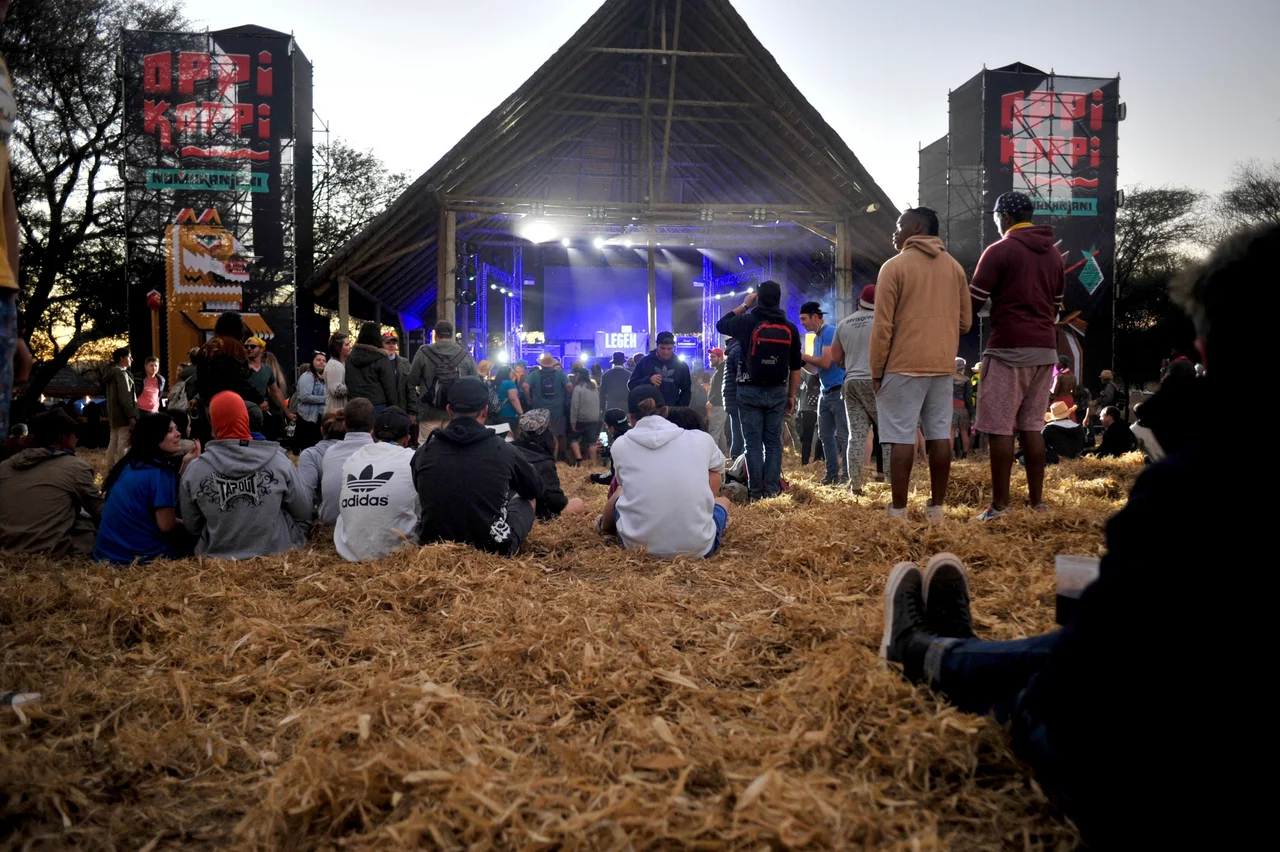

Oppikoppi
There is no obvious reason a thornveld farm outside a platinum-mining town should become sacred ground for a generation of South Africans. The dust gets into everything. The August nights turn cold enough to crack your lips. The nearest amenities are a long way down a dirt road. And yet, for more than twenty years, tens of thousands of people pointed their bakkies toward Northam every winter, pitched tents in the scrub, and gave themselves over to several days of music, heat and bushveld grit. They called it Oppikoppi, and for many it was the closest thing the country had to a rite of passage.
On the Little Hill
The name is a worn-down piece of Afrikaans. "Op die koppie" means "on the hill," and koppie — that small, flat-topped rise so common across the South African veld — got softened in everyday speech into "koppi." Say the whole phrase quickly enough and it collapses into a single affectionate word: Oppikoppi. The festival took its name from the land itself, a farm with a picturesque hill crowned by a humble bar and a small original stage. That little hill was the heart of the whole thing, the fixed point everyone climbed at least once. Each year crews built a temporary city at the foot of it, stages multiplying across the grounds while a second hill threw its weight behind the DJs and dance acts deep into the dark, and beyond both stretched the camping grounds where the real festival lived between sets.
Twenty-Seven Acts and a Crowd of Believers
It began modestly. A band weekend in 1994 gave way to the first proper festival in August 1995, when twenty-seven local acts played to a small crowd of enthusiasts who had no idea what they were starting. Through the late 1990s, as South Africa remade itself after apartheid, Oppikoppi became one of the engines of a reborn live-music scene — a place where Afrikaans rock, kwaito, hip hop, punk, jazz and metal could share a weekend and a dust cloud. The organisers wore their chaos as a badge of honour, boasting that they had "rolled bakkies, burnt tents, driven over knees, slept in jails, slept outside jails and turned over several stones" to make it happen.
A Whole Mixed Bag
What kept Oppikoppi alive was its refusal to stay one thing. The festival that started as a rock weekend kept widening its embrace until almost no genre was off the table — folk, drum 'n bass, big beat, ska, blues, funk, traditional music and comedy all found a stage somewhere on the grounds. Mostly the line-ups belonged to South African bands, though international acts were folded in to draw the curious. By 2008 the British tabloid the Daily Mirror ranked it the fourth-best music festival in the world. Crowds swelled past 16,000 by the start of the 2010s and pushed toward 20,000, with well over a hundred acts a year — 130 by 2012 alone. That same year the festival exported its spirit to the coast, launching a Cape Town offshoot called One Night in Cape Town that ran for years afterward, proof that a thing born in the Limpopo dust could travel.
The Gap Year That Lingered
Every institution built on dust and goodwill eventually meets its reckoning. After a poorly received 2018 edition, the organisers announced a "gap year" for 2019, the kind of pause that festivals rarely return from cleanly. For a movement that had defined winters for a generation of South Africans, the quiet was striking. But the legacy is real and difficult to overstate: a farm near a mining town became shorthand for a national coming-of-age, the place where countless people first slept under the open bushveld sky with a band playing somewhere in the distance and the cold coming down hard off the koppie.
From the Air
The Oppikoppi farm sits at 24.88°S, 27.14°E in Limpopo Province, near the platinum-mining town of Northam and the larger centre of Thabazimbi to the northwest. The terrain is classic bushveld — flat thornveld broken by isolated koppies — with the Waterberg massif rising to the north. Pilanesberg International Airport (ICAO: FAPN) lies to the south near Sun City, while Johannesburg's O.R. Tambo (FAOR) and Lanseria (FALA) serve the wider region. Recommended viewing altitude 3,000–6,000 ft AGL; visibility is typically excellent in the dry winter months, though dust and smoke haze are common in the surrounding farmland and mining country.
Nearby Stories
- Pilanesberg National Park 20 km away
- Tswaing crater 43 km away
- Marakele National Park 45 km away
- Matsieng Footprints 57 km away
- Gaborone 85 km away
- Waterberg Biosphere 96 km away
- Roodeplaat Research Laboratories 102 km away
- Siege of Mafeking 135 km away