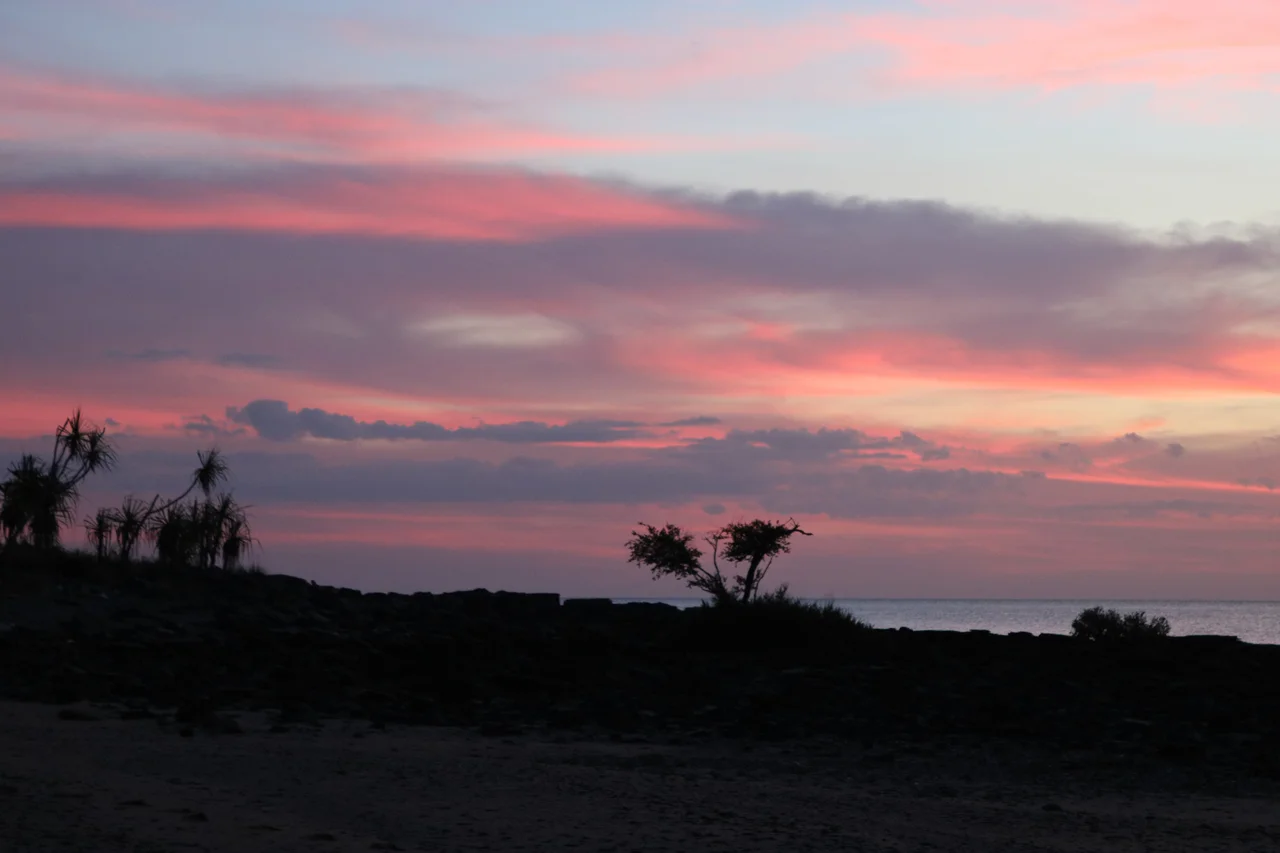

Elcho Island
His voice carried the island to the world. Dr G. Yunupingu - Geoffrey Gurrumul Yunupingu - was born blind here in 1971, in the Yolngu community of Galiwin'ku, and he sang in Yolngu Matha to audiences who could not understand a word and wept anyway. The island he sang about lies off the coast of Arnhem Land, in the far north of the Northern Territory, a long thin spine of land where the Arafura Sea meets the Cadell Strait. White maps call it Elcho Island, after a Scottish lord who never came near it. The people whose home it has always been call it Galiwin'ku, and they have been here far longer than any name.
Saltwater Country
Elcho Island runs roughly 60 kilometres from end to end and only six across at its widest, the largest of the Wessel Islands group at the eastern edge of Arnhem Land. Galiwin'ku, the main community, sits near the southern tip - 150 kilometres north-west of Nhulunbuy and some 550 kilometres from Darwin across open water and bush. Around 2,200 people live here, the overwhelming majority Yolngu, and this is the largest and most remote Aboriginal community in north-east Arnhem Land. The island holds extraordinary linguistic depth: dozens of hereditary clan groups, or mala, and more than a dozen languages still spoken, with Djambarrpuyngu serving as the lingua franca. This is saltwater country in the deepest sense - land and sea bound together in law, kinship, and song, knowledge carried unbroken across generations.
The Mission and the Adjustment
In 1942 the Methodist Overseas Mission established a settlement at Galiwin'ku, led by the lay missionary Harold Shepherdson - known to Yolngu as Bapa Sheppy. The mission ran the place until 1974, when it passed to Yolngu self-management. But the defining moment came in 1957, and it belonged entirely to the Yolngu. Feeling their law dismissed by the mission, senior leaders including David Burrumarra made an extraordinary decision: they would publicly reveal madayin, sacred objects ordinarily seen only by initiated men, displaying them in the open. The Adjustment Movement, as it became known, was both an act of diplomacy and a declaration. It asserted that Yolngu law was coherent, enduring, and the equal of anything the newcomers had brought - a sovereign people choosing, on their own terms, what to share.
Voice of the Island
Music runs through Galiwin'ku like a tide. Geoffrey Gurrumul Yunupingu left the band Yothu Yindi to return home to Elcho, co-founded the Saltwater Band, and then recorded solo albums that made him the most celebrated Aboriginal musician of his time before his death in 2017, aged just 46. He was not the island's only gift to the wider world. The island helped inspire 'My Island Home', written by Neil Murray for the Warumpi Band and later sung by Christine Anu at the closing of the Sydney Olympics. And the Djuki Mala dancers - the 'Chooky Dancers' - filmed themselves performing to Zorba the Greek in 2007; the clip drew hundreds of thousands of views in weeks and carried them onto stages across Australia.
Both Ways
At Shepherdson College, around 700 students from birth to year 12 learn in both Djambarrpuyngu and English - an approach Yolngu call 'both-ways', balancing their own knowledge with Balanda, the white world's. Down at Elcho Island Arts, community-run since 1992, senior artists like fibre weaver Mavis Warrngilna Ganambarr and Morning Star Pole custodian Gali Yalkarriwuy Gurruwiwi turn ancestral knowledge into work that sells worldwide. The island guards its own threshold: visitors need a permit through the Northern Land Council, alcohol is restricted, and there is no ordinary petrol. None of this is quaintness. It is a living culture deciding, as it did in 1957, exactly how it meets the outside world.
Echoes From the Sea
The sea here has always carried strangers as well as song. For generations before any European arrived, Makassan sailors from the islands of what is now Indonesia came each year on the monsoon to harvest trepang, the sea cucumber prized in Chinese kitchens, trading and intermarrying with Yolngu and leaving words behind in the languages still spoken today. In 2018 a small copper coin turned up on an Elcho beach, possibly minted by the medieval Kilwa Sultanate of East Africa - an echo, however faint, of how far the currents of the Arafura Sea once reached. Long before the world arrived by ship or screen, Galiwin'ku was already connected to it.
From the Air
Elcho Island lies at approximately 11.92 degrees south, 135.8 degrees east, a long narrow island at the southern end of the Wessel Islands, separated from the Arnhem Land mainland by the Cadell Strait. From altitude it reads as a distinct sliver of land between the Arafura Sea to the west and the strait to the east; Galiwin'ku sits near the southern tip. The community is served by Elcho Island Airport (ICAO YGAL). Milingimbi Airport (YMGB) lies to the west, and Gove Airport / Nhulunbuy (YPGV) is roughly 150 km to the south-east on the Gove Peninsula. Best viewed under the clear, high-visibility skies of the dry season (May to October); the wet season brings monsoon cloud and storms. Note that Galiwin'ku is a restricted-access Aboriginal community - permits are required to land or visit.
Nearby Stories
- Wessel Islands 11 km away
- Crocodile Islands 31 km away
- Nhulunbuy 41 km away
- Gapuwiyak 42 km away
- Bremer Island 52 km away
- Marchinbar Island 91 km away
- Roper River 287 km away
- Fort Dundas 538 km away