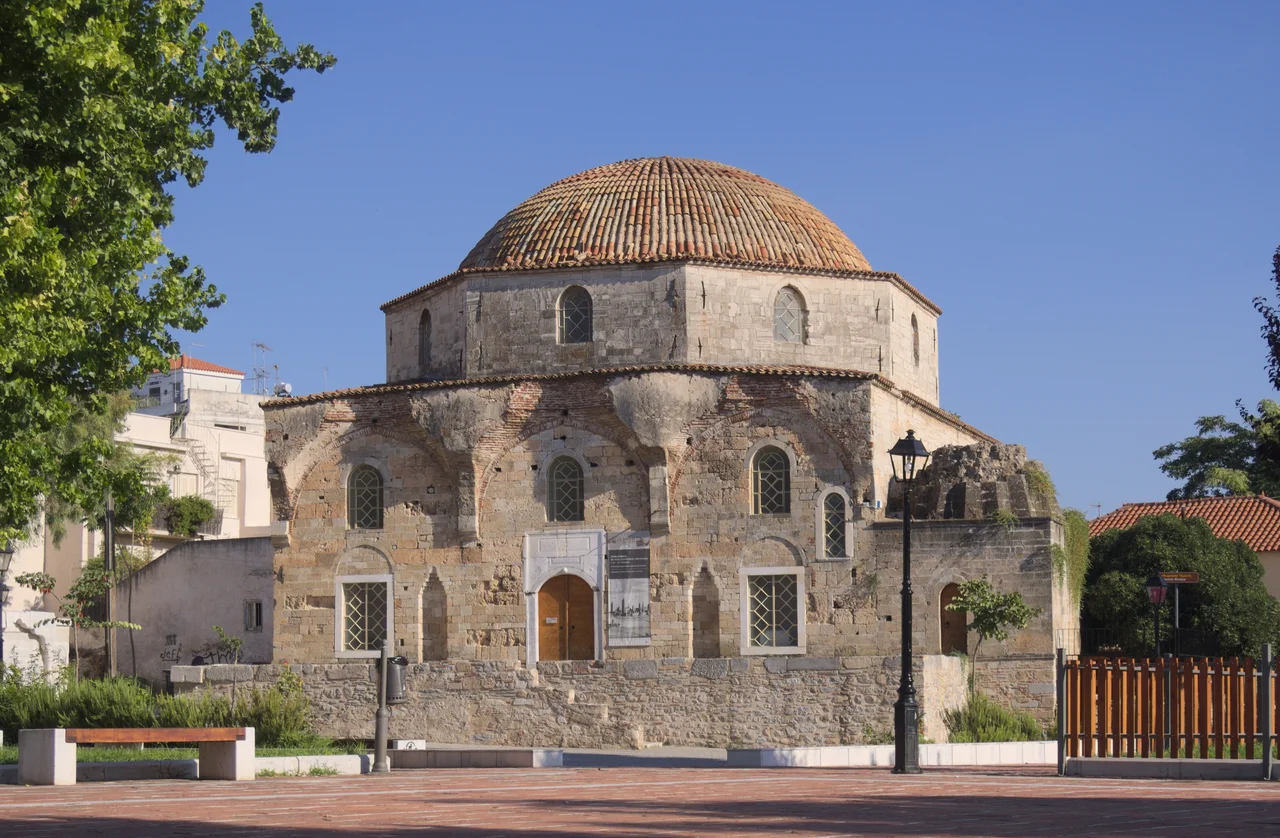

Emir Zade Mosque
Carved into the marble frame of its doorway is an Arabic invitation: "enter here in peace and be immortal in the name of all-merciful God." Almost no one reads it from inside. The Emir Zade Mosque has stood in the heart of Chalcis for more than five centuries, but for most of living memory its doors have been closed to the public. It holds part of the city's medieval treasures and one of the last whole pieces of Ottoman Euboea, and it keeps them to itself.
After the Fall of the Island
The mosque went up in the 1480s, in the first generation of Ottoman rule over Euboea. The island had fallen to the Ottomans only a few years earlier, wrested from the Venetians, and the new rulers set about marking Chalcis as their own. The Emir Zade was one of three mosques raised inside the walled city. It did not rise on empty ground. Outside its walls lie the remains of an earlier Christian church, and the mosque itself stands on that converted ground, a building layered onto faith that came before it. Scattered around the site are fragments of something older still: ancient column drums and carved capitals, reused as casually as fieldstone, the recycled bones of classical Euboea worked into an Ottoman foundation.
A Single Dome
There is nothing grandiose about the design, and that is true to its kind. The Emir Zade is a single-domed mosque, the plain and common form found across Greece and the wider Balkans. A rectangular prayer hall is crowned by a dome that is rounded as a hemisphere on the inside but eight-sided when seen from without, carried on four half-conical squinches at the corners. Along the west side ran a columned porch, the revak, roofed with small domical vaults. The interior was lit by two stacked rows of windows, and in the east wall sat the mihrab, the prayer niche pointing the faithful toward Mecca, where traces of the original color and decoration still cling to the plaster. Two marble plaques carved with verses from the Quran crown the arch above it.
The Things That Were Lost
We know roughly when the building began to come apart because an artist recorded it before it did. A watercolor painted in 1843 by Andre Couchaud shows the minaret and the porch still standing, and a gravure by Antoine-Marie Chenavard in 1858 captures the mosque in similar condition. Sometime around the middle of the nineteenth century, both were lost. Today only the square stub of the minaret's base survives on the southwest corner, the tower that once rose from it gone entirely. The porch has vanished too. Yet apart from those losses the structure is remarkably intact, far more complete than the long centuries and the abandonment of 1821, when the Greek War of Independence drove the Ottomans out, might lead you to expect.
The Fountain in the Yard
One of the most beautiful survivors stands in the open air. In the mosque's courtyard sits a fountain built in 1655, its surfaces worked in finely embossed Arabic ornament and lettered with inscriptions, a small masterpiece of Ottoman craft that has weathered nearly four centuries. It is a reminder that this was not only a place of prayer but a place of daily life, where people stopped to wash and to drink. The fountain, the carved doorway, and the painted mihrab together hold the memory of the Muslim community that once worshipped here, a chapter of Euboea's history that the modern Greek town has largely moved past.
A Closed Museum
The building's later life is a quiet one. Declared a historical monument in 1937, it was gradually restored from the late 1950s onward, with major conservation work carried out between 1970 and 1973. Since then it has housed part of the medieval archaeological collection of Chalcis, which makes it, on paper, a museum. In practice it is a museum almost no one visits, kept shut to the public, its treasures and its own carved walls visible mainly to specialists. So the Emir Zade endures in a strange middle state, neither a working mosque nor an open exhibit, a sealed survivor in the center of a busy town, still offering its marble invitation to a peace that very few people pass through the door to find.
From the Air
The Emir Zade Mosque stands in central Chalcis on Euboea at 38.46°N, 23.59°E, only a short distance from the Euripus Strait and its bridges. From the air it is a small landmark, best identified by its single octagonal dome amid the dense rooftops of the old walled town near the waterfront. The nearest major airport is Athens International (LGAV), about 60 km to the south; Nea Anchialos (LGBL) lies to the northwest. Best appreciated on the ground or at very low altitude, with the strait and the sliding bridge nearby.
Nearby Stories
- Hellenic Police 2.9 km away
- Tower of Aliartos 8.5 km away
- Great Sand Beach 13 km away
- John the Russian 22 km away
- Saint George Monastery, Aidipsos 23 km away
- Sousaki Volcano 25 km away
- Skyros 32 km away
- Carystus 46 km away