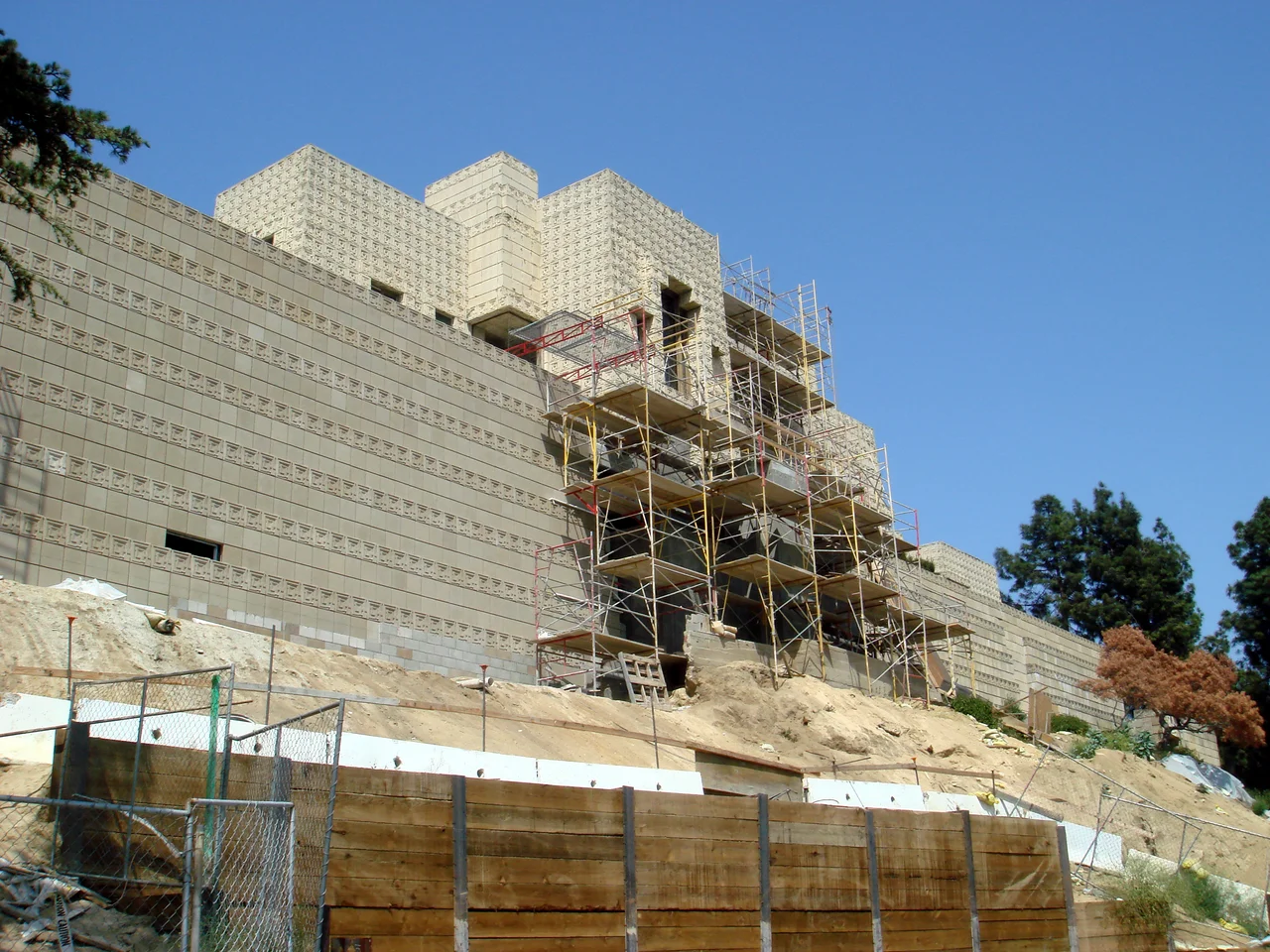

Ennis House
The house looks like it was excavated rather than built. Sitting on a hill above Los Feliz, its massive concrete walls rise in terraces of engraved textile blocks — over 27,000 of them, each stamped with an interlocking geometric pattern — and the ziggurat rooflines push skyward against the San Gabriel Mountains behind. When Ridley Scott needed a location that looked like the far future in Blade Runner, he chose the Ennis House. It had looked like the far future since 1925.
Wright in Transition
Frank Lloyd Wright designed the Ennis House in 1923 and 1924 for Charles and Mabel Ennis, a retired couple who had commissioned him after seeing his other work in Los Angeles. The house was completed in August 1925 and is the largest of four concrete textile block houses Wright designed in the Los Angeles area during the 1920s. The others — La Miniatura, the Storer House, and the Freeman House — are smaller and less theatrical. The Ennis House is the one that looks like a temple.
Wright was between phases when he designed it: moving away from the Prairie Style that had made his reputation and toward the more experimental Usonian designs of his later career. The textile block system was his response to the problem of low-cost construction with character — precast concrete blocks with decorative surfaces, interlocked with steel reinforcement. In theory, the system was economical. In practice, the Ennis House required over 27,000 individual blocks. The project was expensive and technically demanding, and the results look nothing like any economy measure.
A House That Endures
The Ennis family lived here only until 1936. After that, the house passed through seven owners in 44 years — among them the actor John Nesbitt, who bought it in 1940 and commissioned Wright himself to add a swimming pool, billiard room, and heating system. In 1968 it was purchased by Augustus Brown, who renovated it and eventually donated it to the Trust for Preservation of Cultural Heritage. The 1994 Northridge earthquake damaged it. Heavy rains in 2005 did further harm. A foundation managed restoration until 2011, when businessman Ronald Burkle bought the house and made additional repairs.
In 2019, Burkle sold the Ennis House to cannabis executives Robert Rosenheck and Cindy Capobianco for $18 million — at the time, the highest price ever paid for a Frank Lloyd Wright building. The house sits at 2607 Glendower Avenue; the only approach is via a narrow road that winds through Los Feliz and surrounds the building on three sides, reinforcing what one writer called its quality of being "seemingly impenetrable from the street."
On Screen, Always the Future
The Ennis House has appeared in films when directors needed a building that looked ancient, alien, or apocalyptic. Its Mayan Revival design — a style Wright developed partly from his study of pre-Columbian architecture — reads on camera as something from outside the western tradition, something that predates or transcends ordinary domesticity. Blade Runner used it as the apartment of the replicant hunter Deckard, its engraved blocks suggesting both antiquity and decay. The house also appeared in The Rocketeer, Buffy the Vampire Slayer, and numerous other productions.
A writer for Contemporary Literature noted in 1997 that the house signified Wright's ethos of "extreme individualism" and his distaste for urbanism. Seen from Glendower Avenue, with its retaining walls and terraced masses pushing upward, the house seems to make good on that description. It does not look like anywhere a person would simply live. It looks like a statement.
Inside the Blocks
The main house interior spans approximately 6,000 square feet and contains three bedrooms and three and a half bathrooms. The entrance hall is unexpectedly beneath the main floor — an inversion of Wright's usual approach. Above it, the rooms are decorated with chandeliers, marble floors, mosaic tiles, exposed ceiling beams, and wrought iron details. The garage wing, connected to the main house by a footbridge over an enclosed motor court, contains an additional bedroom.
Stained glass windows filter the California light into colored patterns on the concrete floors. The blocks, from outside, look severe; inside, the same patterns create something warmer. This is the characteristic Wright paradox: a building that challenges from the exterior and rewards from within. The Ennis House is listed on the National Register of Historic Places, is a Los Angeles Historic-Cultural Monument, and carries designation as a California Historical Landmark.
From the Air
Located at 34.12°N, 118.29°W in the Los Feliz hills, the Ennis House sits on a prominent ridgeline east of Griffith Park. Its terraced concrete walls are visible from low altitudes on east-west approaches. Nearest airports: Burbank (KBUR, 4 miles NW), Hollywood Burbank is the primary option; Van Nuys (KVNY, 10 miles W). Best viewed at 1,500–2,500 ft AGL.
Nearby Stories
- Amgen 4.9 km away
- Compton, California 8 km away
- Silverado Fire 21 km away
- War Eagle Field 28 km away
- San Bernardino Train Disaster 40 km away
- Santa Barbara Island 54 km away
- Calico: The Ghost Town Walter Knott Saved 99 km away
- The San Andreas Fault at Carrizo Plain 101 km away