
Compton, California
They called it the Hub City because it sat at the center of everything: highways, rail lines, the industrial spine of Southern California radiating outward in every direction. Compton was platted in 1867 by Griffith Dickenson Compton and a wagon train of Midwestern settlers seeking California's promise, incorporated as a city in 1888, and spent the next century becoming something its founders could not have imagined and would not have recognized. By 1988, when N.W.A. released Straight Outta Compton, the city's name had traveled farther than anyone who had ever lived there.
The Founders and the Wagon Train
Griffith Dickenson Compton was a farmer from Indiana who led a group of settlers westward in 1867, looking for agricultural land in Southern California. They found the coastal plain south of Los Angeles — flat, fertile, close to water — and bought acreage that would become the city bearing Compton's name. The early settlement was agricultural and predominantly white: wheat, then dairy, then truck farms. The town incorporated on May 11, 1888, making it one of the oldest cities in Los Angeles County. For its first decades, Compton was the kind of small California town that didn't make history: church picnics, county fairs, the quiet accumulation of families putting down roots.
Redlining and the Great Migration
What transformed Compton was the collision of the Great Migration and the instruments of American housing discrimination. Black families moving west from the South in the 1940s found Los Angeles's better neighborhoods closed to them by restrictive covenants — legal agreements between white property owners not to sell to Black buyers. Compton, as a working-class community with slightly less rigid enforcement, became one of the few places where Black families could actually buy homes. The demographic shift was rapid and contested. White residents fled. Real estate agents practiced blockbusting — stoking racial fear to accelerate white flight and profit from the turnover. By the 1960s, Compton had become a majority-Black city, a transformation that took less than two decades.
The Japanese Americans Who Were Erased
Before the great demographic transformation of the postwar years, Compton had another chapter that is easily forgotten. A significant Japanese American community had put down roots in the city and surrounding area, farming the truck garden plots and operating small businesses. After the attack on Pearl Harbor in December 1941, Executive Order 9066 authorized the forced removal of Japanese Americans from the West Coast. Compton's Japanese American residents were among the first uprooted, their property sold for pennies on the dollar or simply abandoned, their community dissolved by government order. They were sent to internment camps in the desert. Most did not return to Compton. The history of that community — its erasure and its absence — is part of what the city is.
The Sound That Named a City
In the 1980s, a group of young men from Compton and the surrounding South Central area — Dr. Dre, Ice Cube, Eazy-E, MC Ren, DJ Yella — formed N.W.A. and made music that described the city they knew: police harassment, gang violence, poverty, the specific texture of Black life in Reagan-era California. Straight Outta Compton, released in 1988, was raw, confrontational, and furiously specific about place. It was also heard everywhere. Kendrick Lamar, born in Compton in 1987, would carry that tradition forward into the twenty-first century, winning Pulitzer Prizes and selling out stadiums while continuing to name and claim the city he grew up in. Compton's name became, through music, a kind of shorthand for something larger — a whole American experience of marginalization and defiance.
The Hub City
Compton today is a city of about 95,000 people, working-class and predominantly Latino and Black, situated at the intersection of multiple freeways and rail corridors exactly as it always was. The industries that once employed its residents — manufacturing, warehousing, the port economy — have shifted and contracted. The city has struggled with debt and political corruption and the chronic underfunding that afflicts poor cities in California. It has also produced doctors, lawyers, artists, and athletes whose success rarely attaches to the city's name the way its rappers' success does. The Hub City keeps moving, as it always has, at the center of things.
From the Air
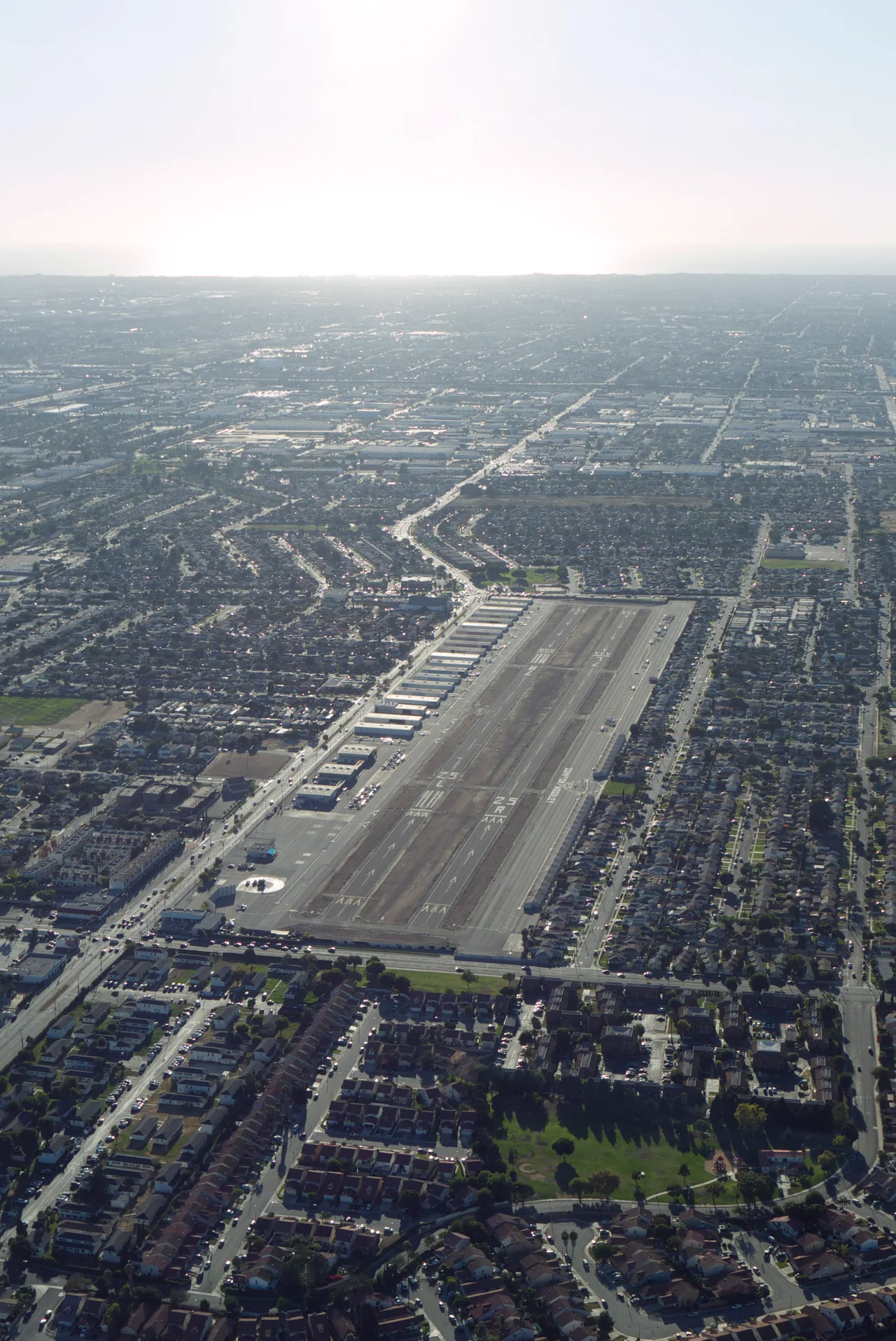
Located at approximately 33.90°N, 118.22°W in the south-central Los Angeles Basin, Compton is bounded by Long Beach to the south and Watts to the north. The I-710, I-105, and I-91 freeways intersect near the city, making it identifiable from altitude by its freeway grid. Compton/Woodley Airport (KCPM) is a small general aviation field within the city limits. Long Beach Airport (KLGB) is approximately 5 miles south. Approach from the south along the I-710 corridor for best orientation.
Nearby Stories
- Ennis House 1.8 km away
- Aliso and Wood Canyons Wilderness Park 5 km away
- Amgen 9.9 km away
- Silverado Fire 12 km away
- Catalina Airport 22 km away
- Santa Barbara Island 22 km away
- Stagecoach Inn (California) 39 km away
- San Bernardino Train Disaster 40 km away