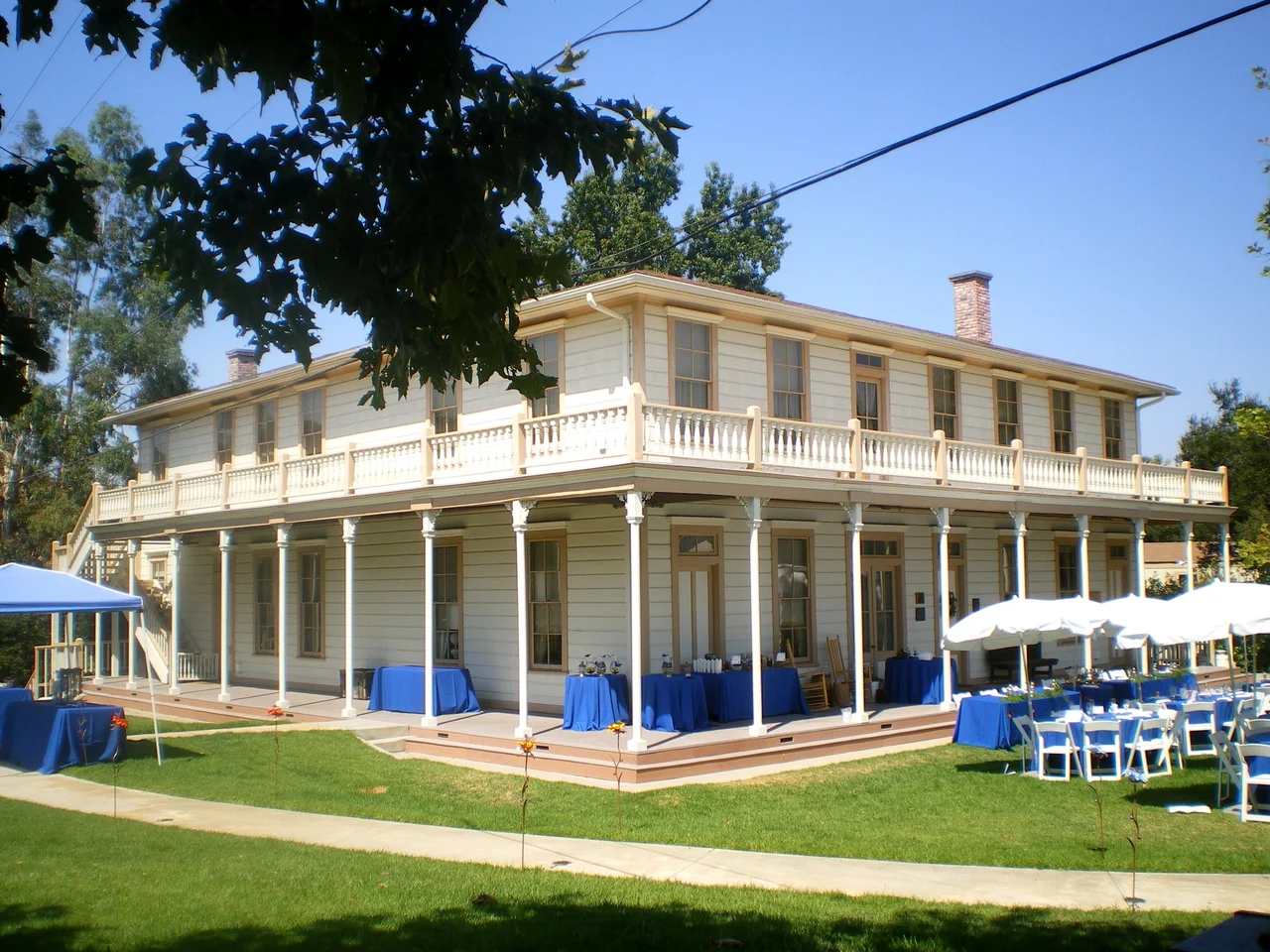

Stagecoach Inn (California)
One month before the Grand Union Hotel was scheduled to open on July 4, 1876, the Coast Line Stage Company rerouted its line and cut the Conejo Valley out entirely. The hotel's owner, James Hammell, had built the place to serve travelers on the Los Angeles-to-Santa Barbara route. He opened anyway, in August, advertising it as a 'health and pleasure resort.' A countywide newspaper enthused about the shooting, fishing, bathing, and first-rate table. This was the first business venture in the Conejo Valley, and it was launched into a market that had just disappeared.
A Hotel Built to Last
The building itself was impressive for 1876. Hammell constructed it from redwood shipped by sea from Northern California, which was then hauled by teams of horses up the Conejo Grade from Port Hueneme. The architecture was Monterey-style, two stories, designed for the kind of tourist trade that would never quite materialize. After Hammell lost the hotel following the drought of 1877–78, the property passed through several owners. In 1885, an Englishman named Cecil Haigh purchased it and settled in for the long run. His family held it until 1926. Simon and Ethel Hays owned it from 1926 to 1957. The building cycled through at least half a dozen names across its history.
The Sycamore and General Frémont
On the museum grounds stands a sycamore tree more than 250 years old. It was designated Ventura County Landmark No. 44 in June 1978 for its 'great age, size, and formation.' The Chumash people are said to have bent its lower branches to mark the location of underground water — a form of landscape annotation practiced for generations before European contact. General John C. Frémont passed by this same tree in 1846, on his way to sign a treaty with General Andrés Pico that secured California's annexation to the United States. Three different historical narratives — Chumash, Mexican, American — converge at this one tree.
Saved, Burned, Rebuilt
By the 1960s, the old hotel faced demolition from the expansion of the Ventura Freeway. The Conejo Valley Historical Society was founded on October 9, 1964, specifically to save it. They succeeded, and in 1966 the building was moved to its current location and declared California Historical Landmark No. 659. Then, on April 25, 1970, a fire destroyed the museum and all its contents. The community rebuilt it — the reconstructed museum dedicated July 4, 1976, a century after Hammell's original opening — and completed the second floor in 1980. It was placed on the National Register of Historic Places in 1975.
What the Museum Holds
The Stagecoach Inn Museum today includes the reconstructed 1876 hotel, a carriage house with an authentic 19th-century stagecoach, a blacksmith shop, and the Tri-Village complex — three structures representing the Chumash, Mexican vaquero, and early American pioneer eras in the Conejo Valley. A reproduction of the 1889 Timber School sits on the grounds. The museum also holds Chumash pictographs, fossils, and Victorian-era artifacts. And there is the matter of the ghost: the Stagecoach Inn is considered one of California's most famous allegedly haunted places, a claim that appears in Los Angeles Times coverage dating to at least 1990.
From the Air
The Stagecoach Inn Museum sits at approximately 34.18°N, 118.91°W in Newbury Park, within the Conejo Valley of Ventura County. The complex is adjacent to the Santa Monica Mountains foothills. Nearest airports: Camarillo Airport (CMA) about 10 miles west, Van Nuys Airport (VNY) about 15 miles east.
Nearby Stories
- Sound City Studios 3.1 km away
- Bruce's Beach 6.6 km away
- Santa Barbara: The American Riviera 30 km away
- Antelope Valley California Poppy Reserve 31 km away
- Santa Barbara Island 50 km away
- San Nicolas Island 74 km away
- The San Andreas Fault at Carrizo Plain 74 km away
- War Eagle Field 76 km away