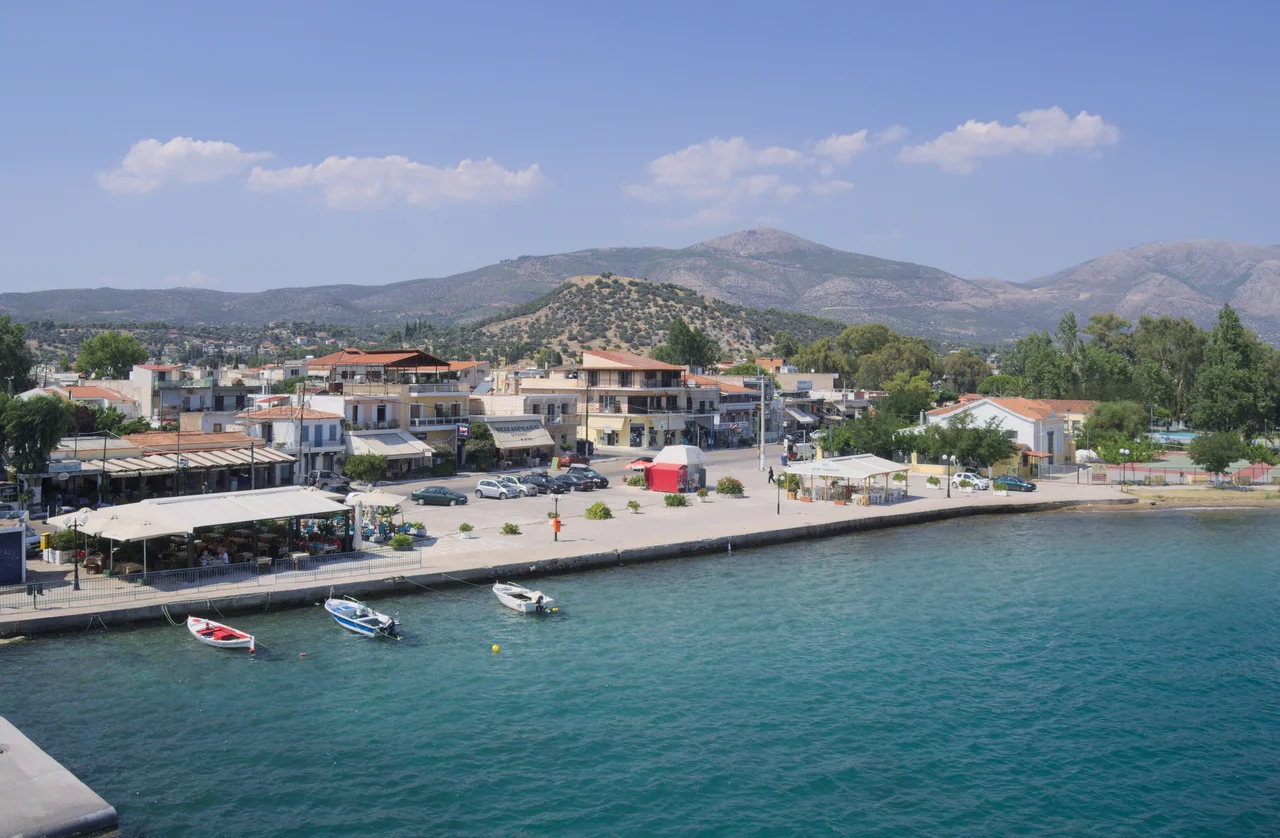

Eretria
On the seventh day of the siege, the gates opened from the inside. For nearly a week in the late summer of 490 BC, Eretria had held against the army of the Persian king Darius. Then two of the city's own nobles betrayed it, and the soldiers of the admiral Datis poured through. They burned the sanctuaries, killed the men, and marched the women and children barefoot toward Persia. The Persians then sailed on to a beach called Marathon, where a far more famous fight was waiting. But Eretria's fall came first, and the city never truly recovered from it.
City of the Rowers
The name Eretria means "city of the rowers," and the sea was always its livelihood. By the eighth century BC, this town on the western coast of Euboea was one of the great trading powers of the Greek world, controlling the Aegean islands of Andros, Tenos, and Ceos and reaching as far as Italy, where its sailors helped found the colonies of Pithekoussai and Cumae. Homer had already named Eretria in the Iliad as one of the cities that sent ships to Troy. Across a narrow plain lay its mirror image and bitter rival, Chalcis. The two cities looked alike, traded alike, and eventually went to war with each other over the fertile fields between them.
The Lelantine War
That conflict, the Lelantine War, takes its name from the Lelantine plain the two cities both wanted. It was one of the earliest wars in Greek history about which anything is recorded, mentioned by the historian Thucydides, and the details are frustratingly thin. What is clear is the outcome: Eretria lost. The city was damaged, stripped of its holdings in Boeotia and its island dependencies, and humbled. Neither Eretria nor Chalcis ever again held the weight in Greek affairs they once had. But defeat redirected Eretria outward. Cut off from expansion at home, it sent colonists north toward Macedon and west toward Italy and Sicily, planting its name across the Mediterranean even as it shrank at home.
The Price of Defiance
The Eretrians were Ionians, which made them natural allies of Athens and natural enemies of Persia. When the Ionian Greeks of Asia Minor rose against Persian rule in 499 BC, Eretria sent ships to help, repaying an old debt to the city of Miletus. The rebels burned the Persian regional capital of Sardis before being crushed, and the Eretrian general Eualcides was killed. Darius did not forget. When his fleet came west in 490 BC, punishing Eretria was a deliberate objective, not an afterthought. The city that resisted was made an example. Its temple of Apollo, barely a generation old, was thrown down, and most of its surviving people ended their days enslaved at Ardericca, deep in Persian territory.
What the Ground Remembers
Eretria refused to stay dead. Rebuilt within a few years, it sent six hundred armored hoplites to the Battle of Plataea in 479 BC, where the Greeks finally broke the Persian invasion. What survives today is a remarkable open-air record of that resilience. There is the temple of Apollo Daphnephoros, whose pediment sculptures of fighting Amazons were so advanced that art historians still study them. There is a theatre carved not into a hillside but built up on an artificial mound, seating 6,300 people, with a vaulted underground passage that once let actors playing the dead rise into the orchestra. There is even a temple to the Egyptian goddess Isis, raised by merchants who brought her cult home from Alexandria. Excavated by Greek and Swiss archaeologists since the 1890s, the ruins sit at the northern edge of a quiet beach town.
Nea Psara
The modern town has its own story of exile and return. After the Greek War of Independence, refugees from the island of Psara, whose home had been destroyed by Ottoman forces in 1824, settled here and called their new home Nea Psara, "New Psara." Only later was the ancient name revived. Today Eretria is a relaxed resort of taverns and a long beach promenade, reachable by ferry from the Attic mainland. Walk a few minutes north of the cafes and you step from one refuge of the displaced into the bones of another, a city that was sacked, scattered, and stubbornly rebuilt.
From the Air
Eretria lies on the southwestern coast of Euboea at 38.40°N, 23.80°E, facing Attica across the South Euboean Gulf. From the air the modern town reads as a compact grid against the water, with the archaeological zone and acropolis hill on its northern edge. The nearest major airport is Athens International (LGAV), roughly 50 km south across the gulf; Nea Anchialos (LGBL) lies farther to the northwest. Best viewed at lower altitude in the clear light typical of the Greek summer, with the rival ancient city of Chalcis visible up the coast to the north.
Nearby Stories
- Hellenic Police 2.9 km away
- Tower of Aliartos 8.5 km away
- Great Sand Beach 13 km away
- John the Russian 22 km away
- Saint George Monastery, Aidipsos 23 km away
- Sousaki Volcano 25 km away
- Skyros 32 km away
- Carystus 46 km away