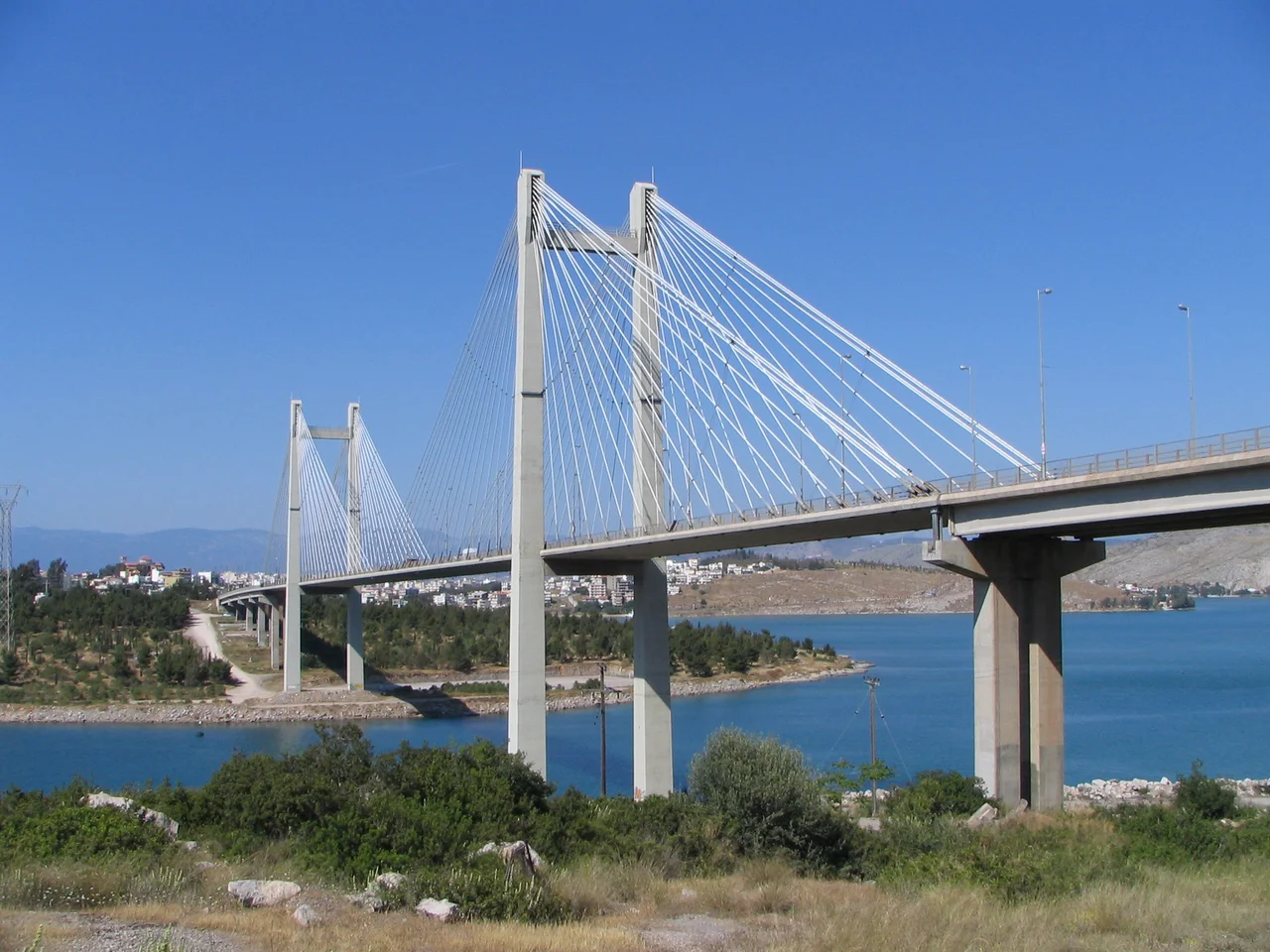

Euripus Bridge
The deck is forty-five centimeters thick. That is less than the length of a forearm, a ribbon of pre-stressed concrete stretched 395 meters across one of the most restless stretches of water in Greece. When the Euripus Bridge opened above the strait at Chalcis in 1993, it was the first cable-stayed bridge the country had ever built, and almost everything about it was an exercise in doing more with less.
Two Bridges, Two Problems
Chalcis has long needed a way across the Euripus Strait, and for centuries it solved the problem at the water's edge. The old crossing in the middle of town sits at the narrowest point, where the channel is only thirty-eight meters wide, and it is a sliding bridge: the deck draws aside to let ships through. That low bridge has been rebuilt again and again, from a retractable span in 1858 to a rotating one in 1896 to the structure standing today. But a town cannot run all its traffic through a bridge that keeps opening for boats. The answer was to build a second crossing south of the center, high enough to clear shipping entirely, spanning the strait where it widens to around 160 meters. That high bridge is the Euripus Bridge.
The Discipline of Thinness
Cable-stayed bridges hang their deck from cables that run straight down to towers, and the great temptation in such designs is to let the deck grow heavy and stiff. The engineers at Chalcis went the opposite way. They built a deck of extraordinary slenderness, just forty-five centimeters of constant-thickness concrete, pre-stressed in two directions so it could carry its load without the deep longitudinal beams most bridges rely on. To hold a deck that thin, the cables had to be spaced closely, roughly every five meters, fanning down at a minimum angle of about twenty-three degrees. Those same cables did double duty during construction, propping up the moving formwork as the deck was cast outward in cantilevered sections from the towers. The result reads almost like a drawn line in the air, a span that seems too light for its length.
Built to Move
A slender bridge over a strait in an earthquake-prone country has to be designed for forces that never stop shifting. Rather than fighting movement, the Euripus Bridge was engineered to absorb it. The thin concrete deck is locked monolithically to the towers, and the towers themselves are slim enough to flex, so that when the structure expands and contracts with the heat of the day, the slender towers and the soft deck simply take up the strain instead of cracking under it. At the ends of the bridge, where the deck meets its transition piers, hinged pendulum members hang ready to catch the upward forces that try to lift the span and pass them safely down into the foundations. It is a structure that holds itself together by giving a little.
A Span and Its Strait
The numbers stay modest by the standards of the world's giant bridges, and that is the point. Two towers rise about ninety meters, roughly half above the deck and half below. The carriageway is 13.5 meters wide, room for two lanes of traffic and two pedestrian walkways, covering some 5,390 square meters of deck. What gives the bridge its drama is not size but setting. It hangs over the Euripus, the channel whose current famously reverses several times a day, fast enough to spin small boats at the turn of the tide. Below the slim white span the water keeps changing its mind, while above it the cables hold their quiet, precise geometry. Lit at night, mirrored in the moving strait, the Euripus Bridge has become the signature image of Chalcis, an engineer's restraint set against the water's old refusal to stay still.
From the Air
The Euripus Bridge crosses the strait just south of central Chalcis at 38.445°N, 23.591°E, where the channel widens to about 160 meters. From the air, look for the slender cable-stayed span and its twin towers set apart from the older sliding bridge in the town center to the north. The nearest major airport is Athens International (LGAV), roughly 60 km to the south; Nea Anchialos (LGBL) lies to the northwest. Best viewed at low altitude in clear conditions; the bridge is most striking near sunset or after dark, when it is floodlit above the dark, shifting water of the strait.
Nearby Stories
- Hellenic Police 2.9 km away
- Tower of Aliartos 8.5 km away
- Great Sand Beach 13 km away
- John the Russian 22 km away
- Saint George Monastery, Aidipsos 23 km away
- Sousaki Volcano 25 km away
- Skyros 32 km away
- Carystus 46 km away