
Fulong
The box lunch came first. Long before Fulong acquired its reputation as a beach town, travellers on the old northeast railway line knew the village for what vendors sold on the platform: a bento packed with braised pork, pickled vegetables, seasoned tofu, and rice — the kind of meal that made a long train journey worth anticipating. The tradition has outlasted the steam engines that inspired the shop sign, and today the original biandang restaurant — marked by its locomotive logo — still sits just to the left of the station exit, selling the same lunch for around NT$60 to NT$80. The beach came after, and the rock festival after that, but the bento remains the clearest signal that Fulong understands what travellers actually need.
The Beach at the River Mouth
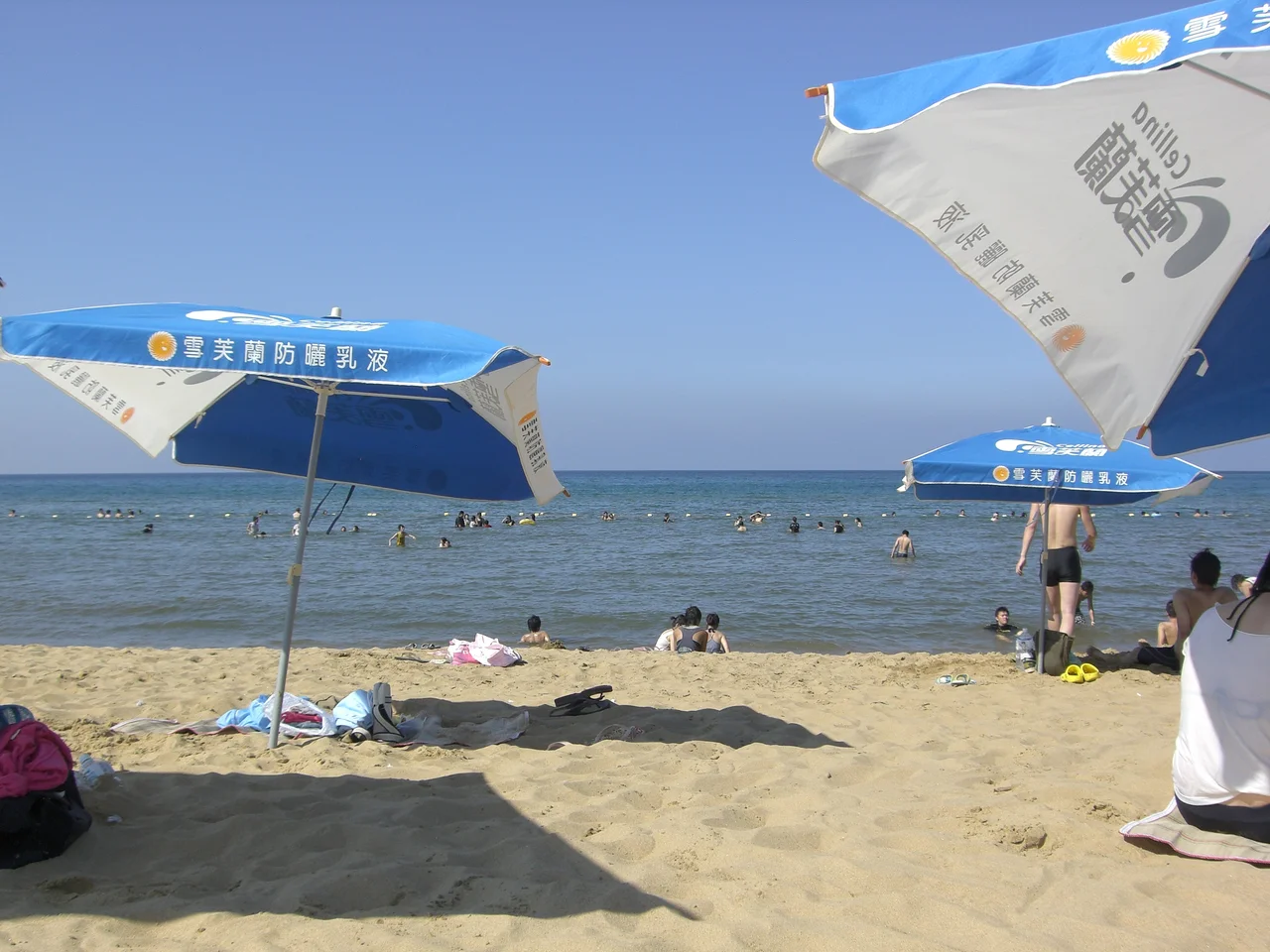
Fulong Beach occupies a double geography. The main paid area sits on one side of the Shuangxi River, enclosed by a low dune line that keeps the Pacific waves at a useful height for swimming and surfing. On the other side of the river mouth, accessible by footbridge, a free beach extends southeast toward a small temple and a quieter stretch of coast where the water is calm and warm, protected by the headland. The sand at Fulong is fine and pale, the kind that heats fiercely under a summer sun — visitors who sprint across it barefoot at midday understand why beach sandals are sold at every shop in town. The paid section offers umbrella and chair rentals; the free section asks nothing except the walk.
Hohaiyan: Three Days in July
Every July, Fulong hosts the Hohaiyan Rock Festival — 貢寮國際海洋音樂祭 — a three-day event that transforms the beach into an outdoor concert venue. The festival draws bands from across Taiwan and internationally, and the audience camps at the Longmen Campground or arrives by the trainload from Taipei. The name Hohaiyan comes from the Taiwanese phrase for the sea, and the festival's original impulse — bringing live music to an outdoor coastal venue — has remained consistent since the event began in the early 2000s. During festival weekend, the train from Taipei runs crowded; outside of festival season, the same train deposits visitors into a village that moves at the pace of a beach town in the off-season, which is a different kind of pleasure.
Through the Mountain Darkness
The Old Caoling Railway Tunnel offers one of the stranger recreational experiences on the northeast coast. The tunnel once carried the rail line before track realignment rerouted trains elsewhere, and it has since been converted into a cycling path. From the Fulong side, a ten-minute bike ride from the station brings you to the entrance; the ride through — ten to fifteen minutes of dimly lit passage through the mountain — emerges on the east coast to a view of Turtle Island rising from the Pacific. The island's volcanic profile, unmistakable from sea level, frames a view that rewards the tunnel passage entirely. Bikes are available for rent near the station, with the Giant shop offering day rates that make a self-guided circuit — tunnel, coast road, and back — the obvious way to spend a morning.
A Village Built for Arrivals
Fulong's layout reflects its history as a train-stop destination: the station anchors one end of a short commercial strip, and almost everything a visitor needs sits within easy walking distance. The bike rental shops cluster near the station exit. The biandang restaurants line the first block. The campground at Longmen, a ten-minute walk north, accommodates larger groups with excellent facilities — though at NT$800 per site plus NT$70 per person, it prices itself above the budget campgrounds further inland. The highway running north and south carries buses that connect Fulong to the coastal towns in both directions, and for those continuing the northeast coast circuit, the road south toward Fulong's neighboring bays offers increasingly empty beaches as the summer crowds thin. What Fulong offers, essentially, is a well-organized point of entry to a stretch of coast that rewards slow exploration.
From the Air
Fulong sits at approximately 25.02°N, 121.94°E on the northeast coast of Taiwan, at the mouth of the Shuangxi River where it meets the Pacific. From the air approaching Taipei Songshan (RCSS), the Fulong coastline is visible as a series of sandy coves and headlands on the eastern side of the island, roughly 60 km northeast of Songshan. Turtle Island (Guishan Island) appears clearly offshore at 3,000–5,000 feet AGL in clear weather, its volcanic cone rising to about 400 meters above sea level and providing a distinctive navigation landmark along the northeast coast. The beach itself is visible as a pale crescent between the river mouth and the dune line. Nearest major airport: Taipei Songshan (RCSS), approximately 60 km west-northwest.
Nearby Stories
- Taoyuan Air Base 4.7 km away
- Min Ping Yu No. 5540 Incident 6.9 km away
- Neiwan 14 km away
- North Jiangsu Main Irrigation Canal 982 km away
- Sinking of MV Sewol 1049 km away
- General Cliff Rock Paintings 1058 km away
- Yellow Sea 1108 km away
- Sibuyan Island 1376 km away