
Taoyuan Air Base
Thirty hours. That is how long it took American mechanics to transform a pile of disassembled parts, delivered by lumbering C-124 Globemaster cargo planes, into an operational F-104A Starfighter on the tarmac at Taoyuan Air Base. It was September 1958, the Taiwan Strait was on the brink of war, and the United States was racing to put its fastest interceptor within striking distance of mainland China. The base in Taoyuan City, southeast of what is now Taoyuan International Airport, would spend decades at the intersection of Cold War espionage, cross-strait tension, and the kind of stories that read like thriller novels.
Operation Jonah Able
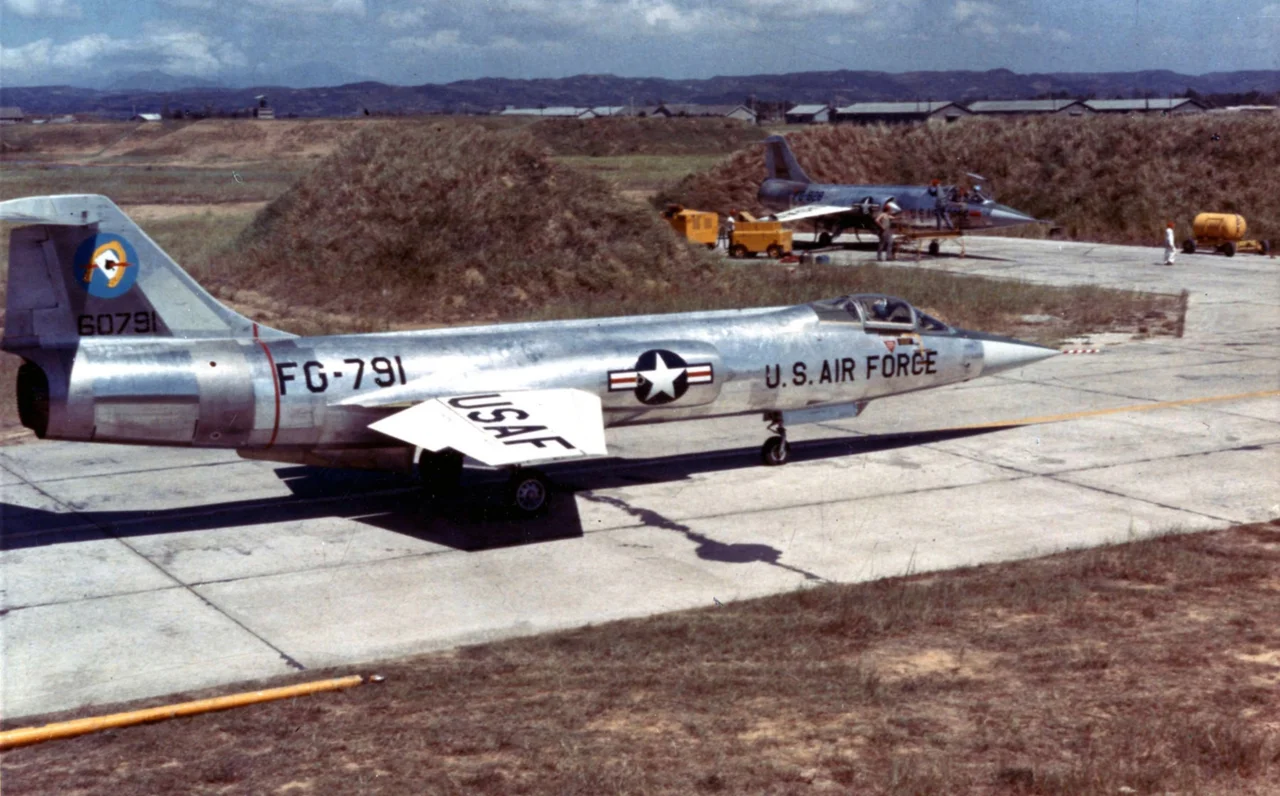
The 1958 Quemoy Crisis brought Taoyuan Air Base its most dramatic chapter. When the People's Republic of China began shelling the offshore islands of Quemoy and Matsu, the United States responded by airlifting the 83rd Fighter-Interceptor Squadron's F-104A Starfighters to Taiwan in pieces. The operation, code-named Jonah Able, was a logistical sprint. C-124 Globemasters hauled the disassembled jets across the Pacific, and ground crews reassembled them on Taoyuan's flight line. By September 19, the entire squadron was operational. The Starfighters never fired a shot in combat, but their presence sent a clear message across the strait. In December, the 337th Fighter-Interceptor Squadron under Colonel James Jabara, America's first jet-to-jet ace from the Korean War, relieved the 83rd. By March 1959, the F-104s were disassembled again, loaded back into C-124s, and flown home to McClellan Air Force Base.
Spies in the Sky
Before the Starfighters arrived, Taoyuan had already earned its place in the shadow world of Cold War reconnaissance. In 1957, two RB-57A aircraft from the 6021st Reconnaissance Squadron were stationed at the base to fly Project Heartthrob missions over the People's Republic of China. These were later replaced by RB-57Ds operating under the equally evocative code name Project Diamond Lil. The base also hosted U-2 spy planes, the same type that would make international headlines when Francis Gary Powers was shot down over the Soviet Union. Taoyuan's U-2 operations were less famous but no less dangerous. On March 19, 1961, a Lockheed U-2C crashed during a training mission, killing pilot Chih Yao Hua. Nearly a decade later, on November 24, 1970, another U-2 went down at the base under similar circumstances.
The Defector's Landing
Perhaps the most extraordinary single event at Taoyuan occurred in November 1965, when Chinese pilot Li Xianbin flew his IL-28 bomber across the strait and landed at the base. It was a defection, but not a unanimous one. Li's navigator, Li Caiwang, and tail gunner, Lian Baosheng, had not agreed to flee. Lian Baosheng took his own life upon landing in Taiwan. The incident captured the brutal human calculus of Cold War defections: one man's flight to freedom was another's unbearable betrayal. The Republic of China government celebrated Li Xianbin as a hero. The story of his crewmates received far less attention.
From Fighters to Frigates
The Republic of China Air Force operated Taoyuan for decades, hosting American F-86 Sabres as early as 1955 alongside its own squadrons. But by 2007, the base's mission had changed. The site was transferred to the Republic of China Navy and renamed Taoyuan Naval Base. When the nearby Chung Cheng Aviation Museum closed in 2014 to make room for Taoyuan International Airport's expansion, 18 retired military aircraft were relocated to the naval base grounds, giving the former air base a second life as an open-air museum of sorts. The fighters that once scrambled from these runways now sit in quiet rows, their cockpits empty, their engines cold, monuments to an era when this patch of Taiwanese coastline was one of the most strategically watched airfields in Asia.
From the Air
Coordinates: 25.055N, 121.243E. The former air base sits southeast of Taoyuan International Airport (ICAO: RCTP) in Taoyuan City. Now operating as Taoyuan Naval Base, the facility is visible from standard approach patterns into RCTP. The Taiwan Strait lies to the northwest. Taipei Songshan Airport (RCSS) is approximately 30 km to the northeast.
Nearby Stories
- Jingtong Mining Industry Museum 8.9 km away
- Kavalan Distillery 9.5 km away
- Hsinchu Science Park 10 km away
- 2022 Chinese Military Exercises Around Taiwan 25 km away
- Gaomei Lighthouse 53 km away
- North Jiangsu Main Irrigation Canal 978 km away
- General Cliff Rock Paintings 1043 km away
- Sinking of MV Sewol 1073 km away