
Six Blocks That Bet on Walking
More than fifty cities sent official delegations to Fresno to see it. That sentence alone should tell you how different America's expectations were in 1964, when a Central Valley farming town closed six blocks of its main commercial street to cars and declared the future had arrived. The Fulton Mall was not just a pedestrian corridor -- it was an argument, made in stained concrete, curvilinear walkways, and nineteen free-standing sculptures, that downtowns could thrive without automobiles. The argument was designed by Victor Gruen, the Austrian-born architect who had essentially invented the indoor shopping mall, and landscaped by Garrett Eckbo, one of the most influential landscape architects of the twentieth century. Only Kalamazoo, Michigan, had tried anything like it before. Fresno's version was grander, more ambitious, and ultimately more tragic.
Gruen's Gamble
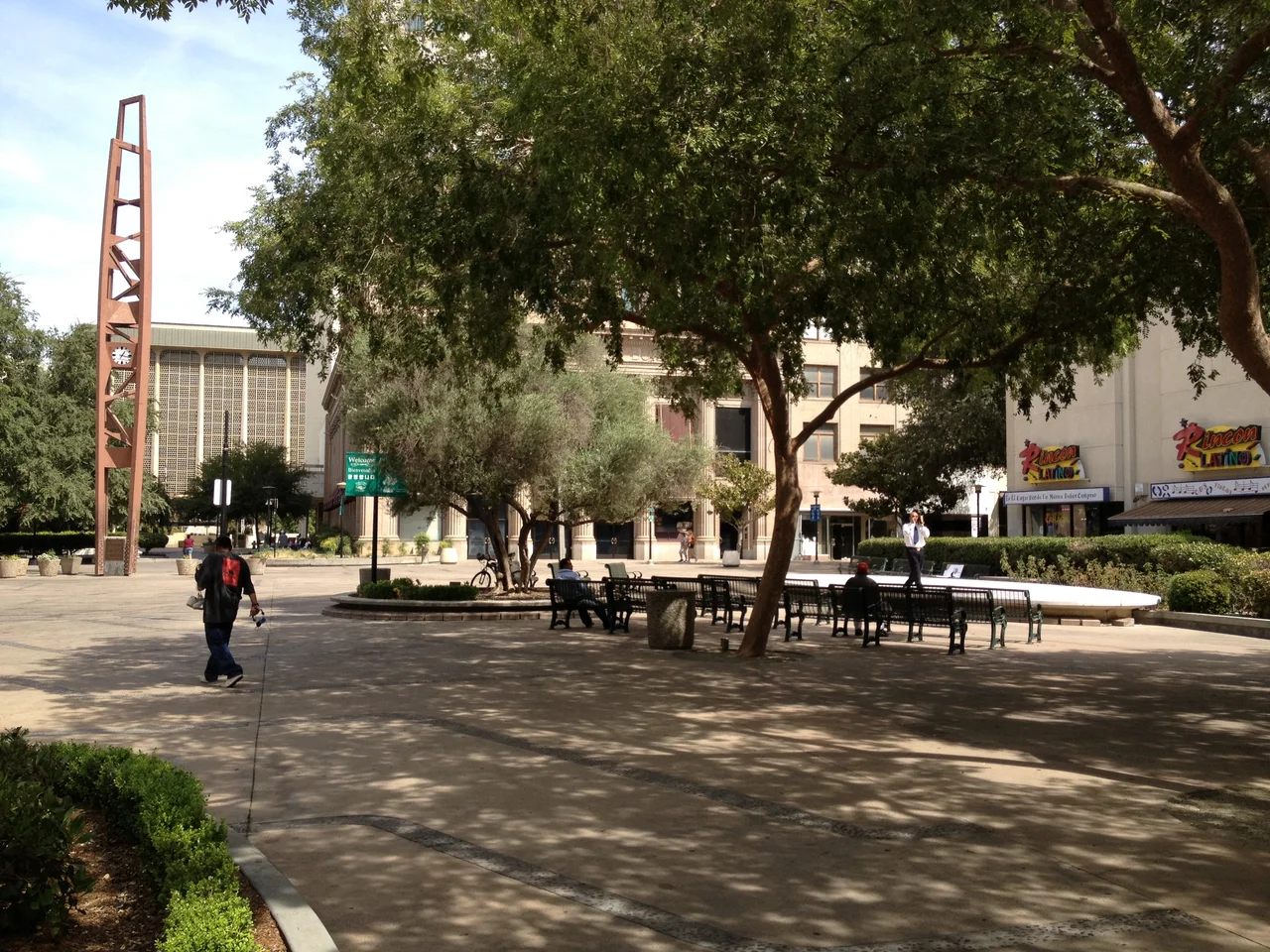
Victor Gruen had a theory about American cities: they were dying because they had surrendered their streets to cars. The solution, he believed, was to reclaim public space for people. He had already tested the idea in Kalamazoo and proposed it for Fort Worth, but Fresno gave him his most complete canvas. Fulton Street -- originally called J Street -- had been Fresno's main commercial corridor since the city's founding. On September 1, 1964, six blocks of it were closed to traffic and transformed into an 80-foot-wide pedestrian promenade. Eckbo's landscape design filled the space with nearly 200 trees and shrubs in planting beds of varying sizes and elevations, brightly colored seating areas, play spaces, pools, and fountains. The mall opened with Gottschalks, Montgomery Ward, Woolworth, and JCPenney anchoring the retail. For a few years, the experiment seemed to be working.
An Outdoor Gallery
What set Fulton Mall apart from other pedestrian experiments was its commitment to public art. Private donors funded nineteen sculptures and installations scattered across the six blocks, turning a commercial street into an open-air gallery. Clement Renzi's bronze sculpture "The Visit" greeted walkers at the north end near Tuolumne Street. Bruno Groth's "Rite of the Crane," a six-foot bronze, stood nearby. George Tsutakawa, the Japanese-American sculptor known for his fountain works, contributed the "Obos" fountain near Kern Street. The art was not decorative afterthought -- it was integral to Eckbo's design, which treated the entire mall as a unified landscape composition. The Cultural Landscape Foundation would later call the mall one of the most significant examples of modernist landscape architecture in the United States.
The Slow Emptying
Fresno's problem was the same problem that afflicted almost every American pedestrian mall: the suburbs kept growing. Fashion Fair Mall opened six miles to the north in 1970, pulling shoppers away from downtown. Fresno's population was expanding northward, and the commercial center of gravity followed. In 1988, Gottschalks -- which had anchored Fulton Street since 1914 -- relocated to the Woodward Park area, a departure that felt less like a business decision than a eulogy. By the 1980s, most storefronts on the mall stood empty. Fresno poet Gary Soto memorialized the street scene in a 2001 poem, capturing a place that had become more memory than marketplace. The mall that fifty cities had traveled to see had become a cautionary tale about the limits of urban design in a car-dependent region.
The Battle Over Cars
In 2002, a city redevelopment agency proposed the obvious solution: let the cars back in. The Downtown Fresno Coalition fought back, and the debate became one of the most contentious civic arguments in the city's history. In 2008, preservationists nominated the Fulton Mall for the National Register of Historic Places, hoping that federal recognition would block or complicate the road's reopening. The mall was deemed eligible, but the nomination was never completed -- the city administration and a majority of property owners objected. The preservationists lost. Groundbreaking for the $20 million reconstruction began on March 3, 2016. The art was carefully relocated from the center of the former mall to widened sidewalk areas, and George Tsutakawa's son Gerard restored both the "Obos" fountain and "Aquarius Ovoid" as part of the project. On October 21, 2017, Fulton Street reopened to traffic.
What Remains
The sculptures are still there, lined along the sidewalks of what is now a conventional downtown street. The trees Eckbo planted have matured. The stained concrete walkways are gone, replaced by asphalt and lane markings. Whether the reopening saved downtown Fresno or simply acknowledged a defeat that happened decades earlier depends on whom you ask. What is harder to argue is the historical significance of what was attempted. Fulton Mall represented a moment when American cities believed they could be redesigned around human beings rather than automobiles -- a belief that has, ironically, come back into fashion in urbanist circles, decades after Fresno gave up on it.
From the Air
Located at 36.7373°N, 119.814°W in downtown Fresno. The former mall runs along Fulton Street between Tuolumne and Inyo Streets -- look for the tree-lined corridor in the downtown grid. Nearest airports: Fresno Yosemite International (KFAT), approximately 6 nm northeast; Fresno Chandler Executive (KFCH), approximately 3 nm south-southeast. The San Joaquin Valley floor is flat and offers wide visibility, though winter tule fog can reduce ceilings dramatically.
Nearby Stories
- Alkali Sink Ecological Reserve: Holding Ground for a Ghost 9.3 km away
- The Lifeline of Madera County 9.6 km away
- California Central Valley Grasslands 11 km away
- Sequoia: Standing Among the Largest Living Things on Earth 58 km away
- The Bristlecone Pines: The Oldest Living Things on Earth 103 km away
- Great Bakersfield Fire of 1889 113 km away
- Hearst Castle 115 km away
- Bakersfield: The Oil Town Where Country Music Got Its Sound 129 km away