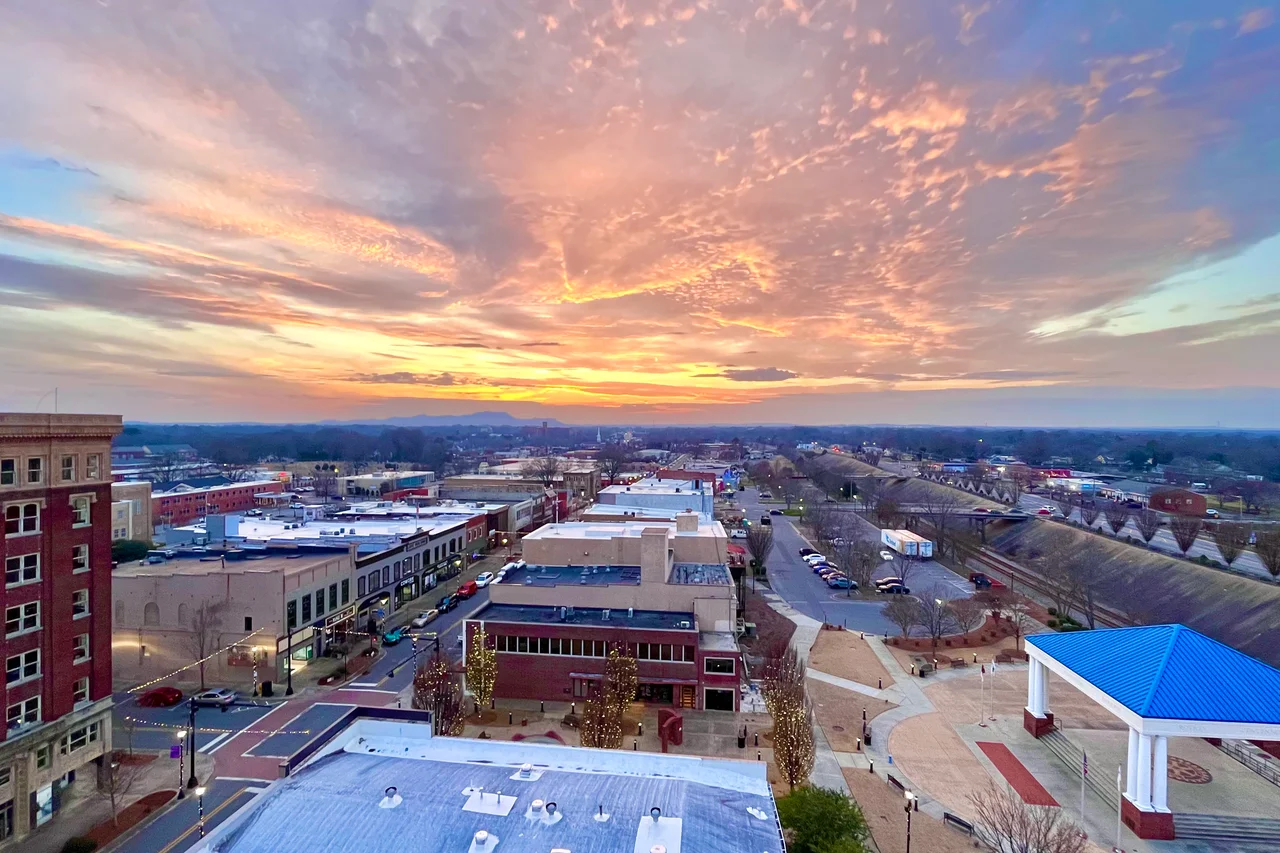

Gastonia, North Carolina
Ella May Wiggins was 28 years old, a widowed mother of five surviving children, and a balladeer when an armed mob shot her dead near Gastonia on September 14, 1929. She was riding in the back of a truck on her way to a strike rally at the Loray Mill. The bullet that killed her went through her chest. The men who fired the shots were acquitted. Her songs about mill life and child mortality - she had buried four of her nine children - outlived her killers and the strike itself. The Loray Mill still stands at the western edge of Gastonia, converted now to lofts. Her grave is in Bessemer City. Gastonia, the largest city in Gaston County, has been quieter in the century since, but the events of that summer still sit just beneath the surface of any honest history of the place.
The Spun-Yarn Capital
Long before and long after the strike, Gastonia was a textile town. Parkdale Mills - the largest manufacturer of spun yarn in the world - is still headquartered here. The company has closed plants and shifted production overseas like most of its competitors, but the corporate brain of global yarn still operates from a Carolina Piedmont city most Americans could not find on a map. Around it, the industry has thinned: Wix Filtration, Freightliner Trucks, Stabilus, Curtiss-Wright, the Italian-owned Radici Group. The mills that once employed entire neighborhoods now employ smaller, more specialized workforces. The 2020 census counted 80,411 people, up from 71,741 a decade earlier - the city is growing again, partly on its own merits and partly as a Charlotte exurb 18 miles east on I-85.
Schiele and the Stowe
The Schiele Museum of Natural History keeps the area's deep history visible - the Hall of North Carolina Natural History, the Henry Hall of the American Indian, and the James H. Lynn Planetarium, the only one in the Charlotte region. Just southeast in Belmont, the Daniel Stowe Botanical Garden spreads over hundreds of acres of cultivated landscape. To the west, Crowders Mountain State Park offers granite-faced summits and rock-climbing routes; to the east, the U.S. National Whitewater Center pumps Olympic-grade rapids through its artificial channels. None of this was here when the mills ran 24 hours. Most of it grew up in the four decades since the textile industry's slow collapse forced the region to imagine itself differently.
The Ghost Peppers Move In
Downtown has been quietly working its way back. The historic district has filled in with locally owned businesses again. The newest civic landmark, CaroMont Health Park, opened in 2021 as part of the Franklin Urban Sports and Entertainment District. The Gastonia Honey Hunters played there until 2023; in 2024 they became the Gastonia Ghost Peppers, still in the Atlantic League of Professional Baseball, still independent, still drawing crowds to a stadium two blocks from the old courthouse. Roller derby bouts run at Kate's Skating Rink. The Gastonia Gargoyles play rugby. Sister-city ties go to Gotha, Germany and Santiago de Surco, Peru. None of it makes national news. All of it is what a recovering mill town looks like when it gets serious about being a city again.
The Names That Left
Gastonia's notable-people roll is long and improbable. Thomas Sowell, the economist and political commentator, was born here. James Worthy of the Lakers and the Hall of Fame grew up here. Fred Durst of Limp Bizkit. R. Gregg Cherry, governor of North Carolina from 1945 to 1949. The novelist Lionel Shriver, the painter John T. Biggers, the swimmer Melvin Stewart with his Olympic medals, the golfer Harold Varner III, the basketball coach Sylvia Hatchell. A textile town three decades into deindustrialization, raising children who left and made names that the town then claims back. It is one of the quieter American patterns, and Gastonia is one of its truer examples.
From the Air
Gastonia sits at 35.255 N, 81.180 W, on the Piedmont about 18 miles west of Charlotte. Field elevation around 825 feet. Gastonia Municipal Airport (KAKH) handles general aviation southeast of the city center. Charlotte Douglas International (KCLT) is the commercial gateway 18 miles east. Interstate 85 cuts the city east to west - visible as a clear linear scar from cruising altitude. The Loray Mill complex on the west edge of downtown is a substantial brick footprint, and the small CaroMont Health Park stadium downtown is a recognizable green oval near the city center.
Nearby Stories
- Winthrop University 4.4 km away
- Reed Gold Mine 5.7 km away
- Grace Evangelical and Reformed Church 8 km away
- Gardner-Webb University 9.8 km away
- 2025 North Carolina Cessna Citation II Crash 30 km away
- Spartanburg 34 km away
- Joara 38 km away
- Cheraw, South Carolina 64 km away