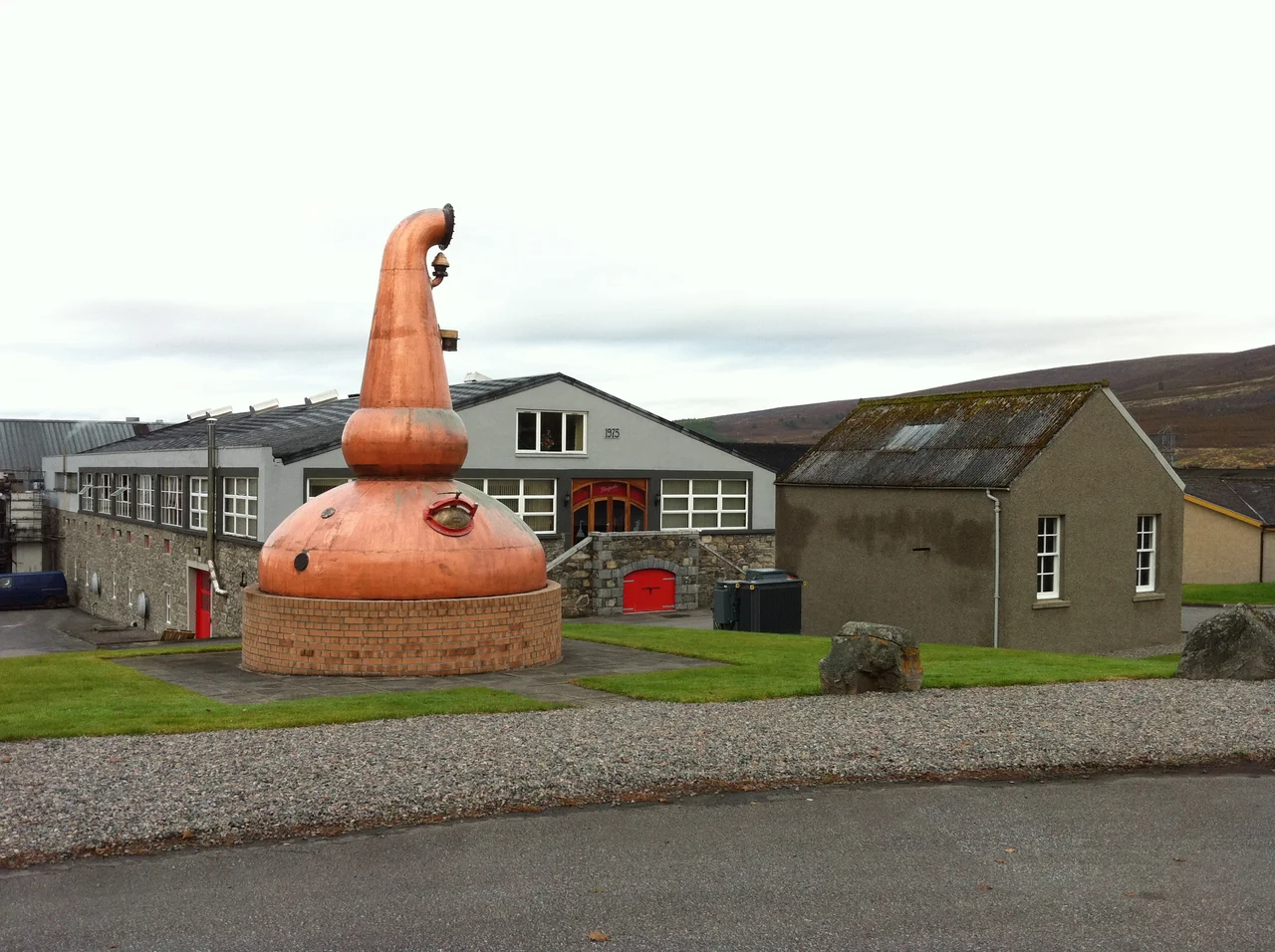

Glenfarclas Distillery
John Grant paid 511 pounds, 19 shillings and 0 pence for Glenfarclas distillery on 8 June 1865. The bill of sale survives. In 2015, six generations later, the same family released a limited bottling named after that exact price - the 511 Pounds Family Reserve - to mark 150 years of unbroken Grant ownership. Each bottle came with a copy of the original receipt. In an industry that has been swallowed by multinationals, where Macallan belongs to Edrington and Glenlivet to Pernod Ricard and Talisker to Diageo, Glenfarclas is something nearly extinct: a Speyside distillery still run by the family who bought it before Queen Victoria had finished her first Highland summer.
Six Generations of Grants
Glenfarclas had existed before John Grant arrived - there is evidence of distilling on the site before 1791, and the first formal licence was issued in 1836 to Robert Hay. But it is the Grant family's tenure that has defined the distillery's identity. John Grant bought it in 1865 and sent his son George G. Grant to run operations. When George G. died in 1890, his widow Elsie took over the licence and continued the family management. The pattern has continued through six generations. The current chairman, John L.S. Grant, signs the label of every bottle of Glenfarclas 105, the cask-strength expression - a small mark of personal continuity in an industry that mostly outgrew that sort of thing in the 1980s. Pol Roger Ltd has distributed Glenfarclas in the UK since 2006, but the distillery itself remains independent.
The Biggest Stills on Speyside
Glenfarclas runs six stills - the largest on Speyside - and unusually for the region, they are heated directly by gas burners rather than by steam coils. The combination produces a heavier, more robust spirit than the typical Speyside style. Total production capacity sits around 4 million litres per year, though normally only four of the six stills run at any one time, with two kept in reserve. Maturing on site are approximately 68,000 casks, stored in traditional dunnage warehouses - low buildings with earthen floors that maintain even temperature and humidity, the way Speyside distilleries have always stored their stock. The standing inventory holds a cask from every year from 1953 to the current bottling - a six-decade family savings account in oak.
The Family Casks
The depth of that inventory makes possible something almost no other distillery can offer. In 2007 Glenfarclas launched The Family Casks - a collection of single-cask bottlings, one from every year from 1952 to 1994. The range later extended to 2007. Stock from 1952 and 1953 has since been exhausted. To buy a 1952 bottle while it lasted was to taste whisky that had been laid down the year Elizabeth II ascended the throne - a continuous line from Coronation Year to your glass. The standard Glenfarclas range covers everything from the 8-year-old at 40 percent ABV to the 40-year-old at 46 percent. In 2015, the distillery released a limited 60-year-old - only 360 bottles, globally. The 40-year-old expression was named Scotch Whisky Single Malt of the Year at the 2011 Malt Advocate Whisky Awards. In May 2022, thieves broke into the visitor centre and took more than 100,000 pounds of whisky in a single raid.
The Ship's Room
Glenfarclas opened a visitor centre in 1973 - one of the first distilleries to do so, at a time when the industry was just beginning to treat tourists as customers rather than nuisances. The centre includes a tasting room called the Ship's Room. Its panelling came from the RMS Empress of Australia. The ship had carried the last British troops home from Bombay - now Mumbai - after they had symbolically passed through the Gateway of India, ending more than two centuries of British imperial rule in the subcontinent. The panelling found its way to a Speyside whisky tasting room by routes the original shipwrights would not have predicted. To drink a Glenfarclas there is to taste a heavily sherried Highland malt in a room made of the wood that watched an empire end. Few distillery tours offer a more eccentric piece of historical resonance, and none do it on a Speyside afternoon with the Spey running cold past the door.
From the Air
Coordinates 57.4272N, 3.31821W. Elevation approximately 220 m (720 ft) in Ballindalloch, Banffshire, on the slopes below Ben Rinnes (840 m). Recommended viewing altitude 3,500-5,500 ft AGL. From the air, look for the distillery cluster south of the Spey valley with its dunnage warehouses and pagoda kiln roof. Ben Rinnes makes an unmistakable conical landmark to the east. Ballindalloch Castle and the preserved Strathspey Railway sit nearby in the valley floor. Nearest ICAO: Inverness (EGPE) 35 nm west; Aberdeen (EGPD) 55 nm east; Lossiemouth (EGQS) 30 nm north. Speyside microclimate can produce valley fog at dawn, especially in autumn; orographic cloud builds rapidly on Ben Rinnes in moist westerlies.
Nearby Stories
- Spynie Palace 3.6 km away
- Findlater Castle 4.7 km away
- Battle of Slioch 6.6 km away
- Battle of Lumphanan 6.6 km away
- Tomatin distillery 9.8 km away
- Nigg Stone 11 km away
- Balmoral Castle 12 km away
- Highland Folk Museum 16 km away