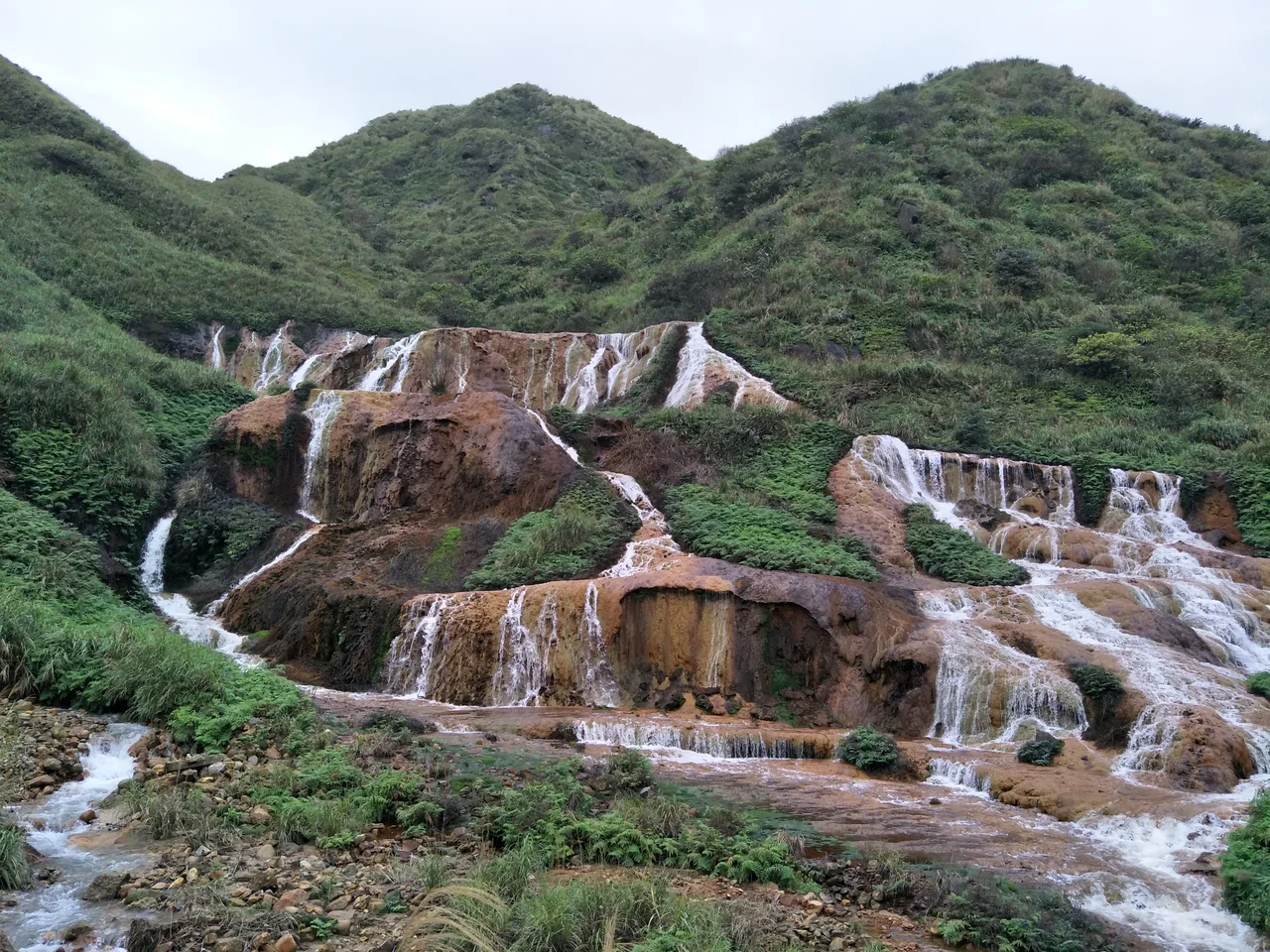

Golden Waterfall
The water is the color of honey held up to sunlight. It pours down a steep hillside in Ruifang District, northeast of Taipei, glowing amber against the dark volcanic rock - a waterfall that looks like liquid gold and is, in fact, something close to it. For decades, locals assumed the Golden Waterfall's extraordinary color was pollution. An abandoned Japanese-era gold mining factory sits just uphill, and the logical conclusion was that a century of mining had poisoned the runoff. The logic was wrong. Scientists eventually determined that the water's golden hue is a natural geological phenomenon, produced by the same underground chemistry that attracted miners here in the first place. The minerals were always in the mountain. The mines just opened new channels for the water to find them.
Chemistry in Amber
The Golden Waterfall's color comes from the geology beneath it. The mountains above Ruifang District are rich in sulfur, arsenic, and copper ore - a mineral cocktail that formed over millions of years of volcanic and hydrothermal activity. Rainwater seeps through cracks in the surface rock, percolates down into abandoned mine tunnels and natural fissures, and interacts with these mineral deposits along the way. The result is water saturated with dissolved metals, particularly iron in its ferric form. When this mineral-laden water emerges at the surface where the terrain drops sharply, it cascades down the hillside as a golden stream. Over time, the arsenic and other minerals in the water have stained the rocks themselves a deep ochre yellow, making the entire waterfall site look as though it has been dipped in gilt. The beauty comes with a warning: the water is genuinely toxic. The concentration of heavy metals makes it dangerous to touch, and visitors are advised to admire the falls from a distance rather than wade into the stream.
The Mining Legacy
Near the waterfall stand the remains of an old gold mining factory dating to the Japanese occupation of Taiwan, which lasted from 1895 to 1945. The Japanese industrialized gold extraction across this mountainous region, building smelters and processing facilities that transformed quiet hillside villages into bustling mining towns. Jinguashi and the neighboring town of Jiufen became synonymous with gold, attracting thousands of workers and their families. When the mines eventually closed, the infrastructure remained - concrete foundations, rusting machinery, empty tunnels boring deep into the mountains. It was the presence of this abandoned factory, so visibly connected to the waterfall's source, that led generations of locals to assume the golden color was an industrial byproduct. The assumption was understandable but backwards. The mines were built here because the minerals were already present. The waterfall's color predates the mining by geological ages. The Japanese found gold because the mountain had been advertising it, in liquid form, for millennia.
Where the Sea Splits in Two
The Golden Waterfall does not simply disappear after its descent. Its mineral-rich water flows downhill into Shuinandong Bay, where it meets the Pacific Ocean in a phenomenon the locals call the Yin-Yang Sea. Viewed from the coastal road above, the bay presents a striking visual: half the water is the normal deep blue of the open Pacific, and half is a milky ochre yellow, stained by the ferric iron particles carried down from the mountains. The two colors meet in a wavering, shifting line that never quite resolves. The name draws on the Taoist concept of complementary duality - two opposite forces forming a single whole. The yellow is not pollution overcoming the blue. The blue is not cleanliness resisting the yellow. They coexist, each defined by the other, in a bay that has looked this way for far longer than anyone has been watching. On clear days, when the sun catches the contrast between the warm gold of the runoff and the cold blue of the Pacific current, the effect is less like looking at water and more like looking at a painting that someone left unfinished on purpose.
Gold Above, Gold Below
The Golden Waterfall sits in a landscape saturated with the legacy of extraction. Jiufen, the famous hillside tourist village, lies a few kilometers to the south. Jinguashi, with its ruined thirteen-story smelter and Gold Museum, is even closer. The entire Ruifang District mountainside is threaded with abandoned mine shafts, some reaching hundreds of meters below sea level, all of them slowly filling with the same mineral-rich groundwater that feeds the waterfall. From the road that winds along the coast between Jiufen and the waterfall, the terrain tells a single continuous story: people came for the gold, built an industry on the mountain's mineral wealth, extracted what they could, and left. The mountain continued doing what it had always done - pushing mineral-laden water through its cracks and fissures, painting its own rocks, feeding its golden stream to the sea. The waterfall is not a remnant of mining. It is what was here before the mining started, and what will be here long after the last factory wall crumbles into the hillside.
From the Air
Located at 25.12°N, 121.86°E on the mountainous northeast coast of Taiwan, near the village of Jiufen in Ruifang District. The waterfall is visible from low altitude as a golden-amber streak on the dark hillside above the coastal road. The most striking aerial feature is the Yin-Yang Sea at Shuinandong Bay, where the waterfall's mineral runoff creates a visible two-tone yellow-and-blue pattern in the ocean. The ruins of the Shuinandong Smelter (the 13-story structure) are nearby on the hillside. Taipei Songshan Airport (RCSS/TSA) is approximately 30km to the west. Taiwan Taoyuan International Airport (RCTP/TPE) is about 65km to the west-southwest. The coastal road and the mountain terrain above it show clear evidence of former mining activity. Weather is frequently wet and overcast along this stretch of coast.
Nearby Stories
- Taoyuan Air Base 4.7 km away
- Min Ping Yu No. 5540 Incident 6.9 km away
- Neiwan 14 km away
- North Jiangsu Main Irrigation Canal 982 km away
- Sinking of MV Sewol 1049 km away
- General Cliff Rock Paintings 1058 km away
- Yellow Sea 1108 km away
- Sibuyan Island 1376 km away