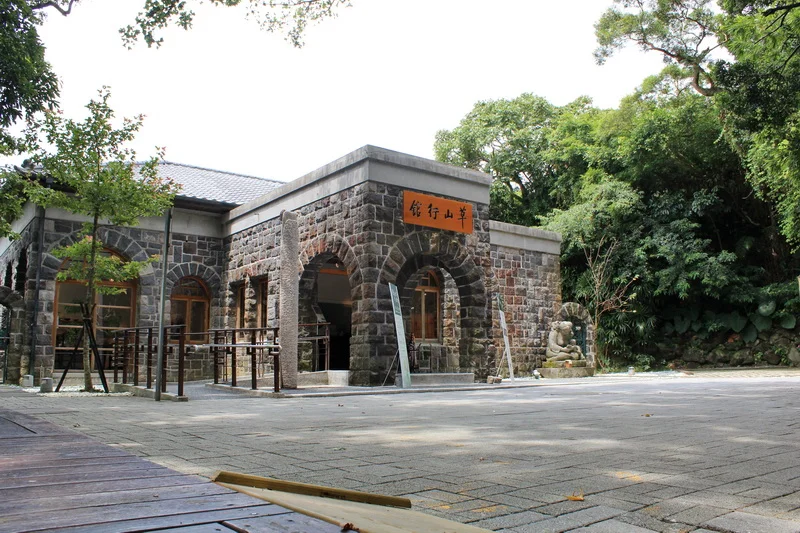

Grass Mountain Chateau
In December 1949, one of the most consequential retreats in modern Asian history deposited Chiang Kai-shek on an island he had never intended to govern permanently. The Kuomintang government had fled Nanjing, then Canton, then Chengdu, and at last crossed the Taiwan Strait with the remnants of its army and bureaucracy. Chiang needed a residence immediately. On the forested slopes of Yangmingshan, a modest chateau built by Taiwan Sugar Corporation in 1920 would have to do. That building — originally a colonial recreational retreat, later a stop for Japanese royalty — became the unlikely first presidential home of the Republic of China on Taiwan.
A Sugar Company's Mountain Lodge
The chateau was not built for presidents. Taiwan Sugar Corporation erected it in 1920 as a recreational facility for employees — a cool-air escape from the subtropical heat of the Taipei Basin below. The site covers a partially landscaped 7,200 square meters on the Yangmingshan slopes, the volcanic hills that ring the northern edge of the city. What the sugar company built was gracious but functional: a retreat that could accommodate the sort of guests a major colonial enterprise needed to impress.
Impressive guests did come. Emperor Hirohito of Japan visited personally, staying for 1 hour and 50 minutes according to historical records — a precise accounting that suggests the visit was logged with the attention any imperial movement commanded. That the future emperor of wartime Japan stopped here, briefly, in a sugar company's mountain lodge is one of those small historical ironies that a building accumulates over a century.
First Address of a Displaced Republic
When Chiang Kai-shek arrived in Taiwan in December 1949, he claimed the Grass Mountain Chateau as his first official residence on the island. The choice was practical more than symbolic: there were few structures of suitable size and privacy available immediately, and the Yangmingshan location offered both cooler temperatures and the kind of strategic remove from the city center that a leader in uncertain circumstances might want.
Chiang occupied the chateau for roughly a year. During that time, a new mansion closer to central Taipei was completed — the residence that would become his long-term home. But the chateau served its purpose as a transitional seat of government, the place where the displaced Republic of China began to reorganize itself in exile. Decisions made within those walls shaped Taiwan's trajectory for decades. What had been a colonial amenity quietly absorbed the weight of history.
Fire, Abandonment, and Return
Decades passed. Taiwan changed — from martial law to democratic reform, from a government that called itself a government-in-waiting to one rooted in the island it actually governed. As the political landscape shifted through the 1990s, the chateau's role shifted with it. The building was opened to the public as a historical museum and art exhibition center, its colonial architecture repurposed for cultural programming.
In April 2001, fire struck the property — an act of arson, according to Taipei City officials. The damage was significant, and the building closed. Reconstruction plans were announced and debated. After years of restoration work, the chateau reopened on December 29, 2011. Today it stands in Beitou District within Yangmingshan National Park, accessible to visitors who want to walk through a building that watched Taiwan's twentieth century unfold — from Japanese colonial modernity to wartime imperialism to Cold War exile to democratic revival.
Yangmingshan's Layered Landscape
The chateau does not stand in isolation. Yangmingshan National Park surrounds it — a volcanic landscape of hot springs, sulfur vents, cherry blossoms in spring, and rolling grasslands that gave the mountain its name (grass mountain, literally). The park's calderas and fumaroles are evidence that the geology here remains active at depth, even if the surface has long since quieted into meadows and hiking trails.
The combination makes Yangmingshan an unusual place: a national park within easy reach of a city of millions, layered with volcanic geology, colonial history, and the particular weight of mid-century political drama. The chateau sits at the intersection of those layers — a building that was recreational, then imperial, then presidential, then cultural, and is now simply historical. Some buildings accumulate so much history they become almost archeological in character. This is one of them.
From the Air
The Grass Mountain Chateau sits at approximately 25.1545°N, 121.5380°E on the forested slopes of Yangmingshan, about 300–400 meters above the Taipei Basin. Approaching from Taipei Songshan Airport (RCSS), head north-northwest; the volcanic highlands of Yangmingshan National Park form a distinctive dark-green ridge line above the urban grid. Taoyuan International Airport (RCTP) lies roughly 40 km to the southwest. The chateau itself is tucked into forested terrain and difficult to identify from the air, but the surrounding Yangmingshan caldera landscape — open grasslands, volcanic craters, and steam vents — is visible on clear days at low altitudes. Recommend 1,500–2,000 ft AGL for terrain clearance over the Yangmingshan hills.
Nearby Stories
- Sanxia Car Attack 9.6 km away
- Dapu Incident 28 km away
- 2022 Chinese Military Exercises Around Taiwan 45 km away
- North Jiangsu Main Irrigation Canal 960 km away
- General Cliff Rock Paintings 1031 km away
- Sinking of MV Sewol 1042 km away
- Yellow Sea 1091 km away
- Twin Forts of Romblon 1377 km away