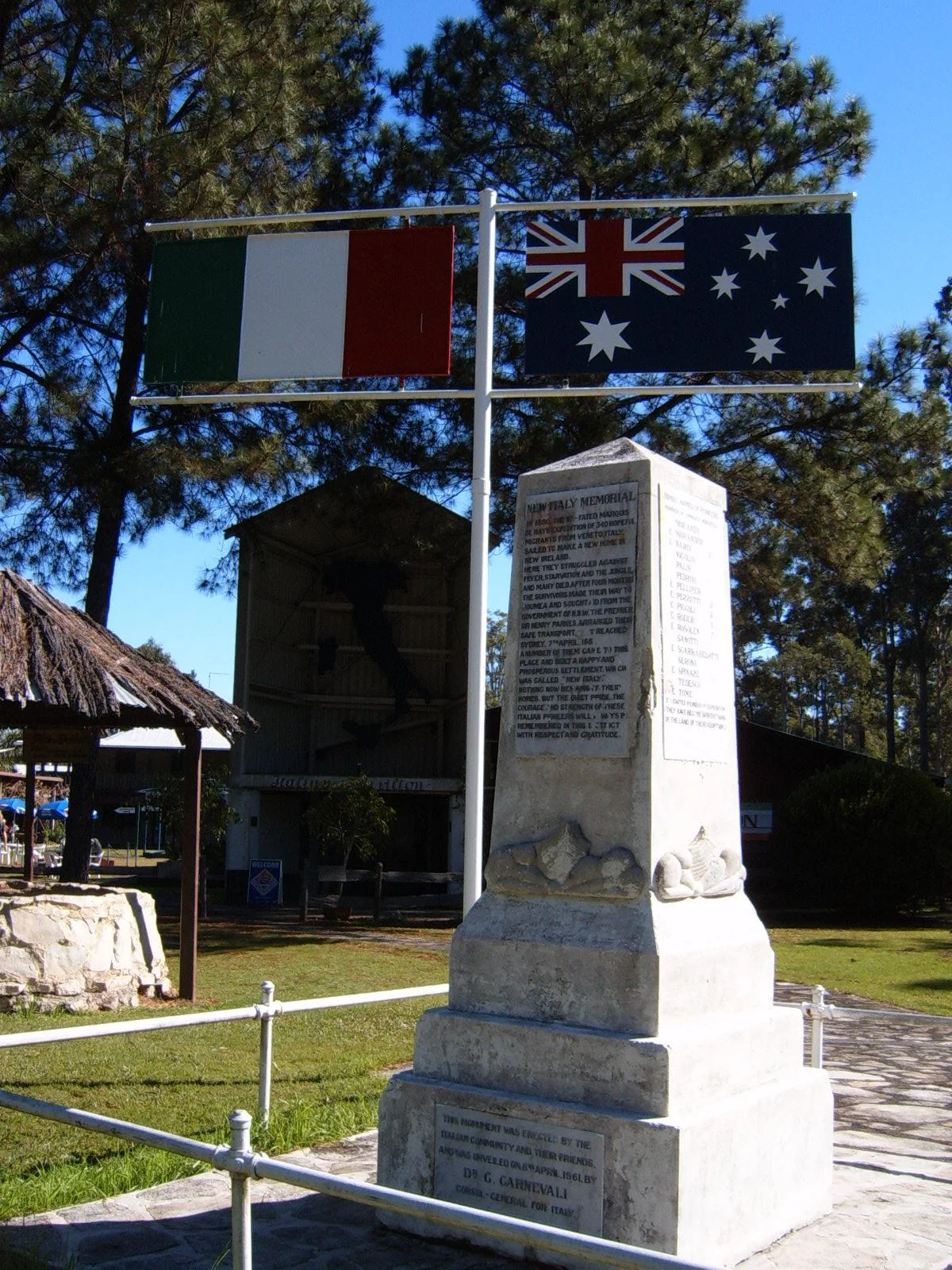

History of New Italy, New South Wales
They had been promised paradise and given a death trap. In 1880, poor farming families from the Veneto region of northern Italy sold what little they had and sailed for a Pacific colony called La Nouvelle France, conjured by a French aristocrat, the Marquis de Rays, who had never set foot there. The land he sold them - on New Ireland, near New Guinea - was uninhabitable. Dozens died of disease and starvation before the survivors were carried, half-broken, to Sydney. What happened next is one of the most quietly remarkable immigrant stories in Australia: turned loose with nothing, these families found a patch of poor scrub on the road between the Clarence and Richmond rivers, and on it built a settlement they called New Italy.
The Swindle
The Marquis de Rays never sailed with his colonists. From Europe he advertised a paradise in the western Pacific - East New Guinea, New Britain, New Ireland - to be called La Nouvelle France, with its capital at Port Breton. Word reached the Veneto through an agent in Milan, and to families living close to starvation, with no future to offer their children, the promise of land was irresistible. Some paid in francs; others signed away five years of labour for the right to eventually own a house and plot. The French government tried to forbid the recruiting, and authorities in Milan refused to issue passports, but roughly 340 hopeful migrants pressed on, departing from Barcelona. When they reached Port Breton they found no settlement at all - only harsh, unprepared land. More than eighty would die before the ordeal ended.
The Long Way to Sydney
The survivors aboard the ship India were eventually carried to Noumea in New Caledonia, where the colony's officials offered them shelter, rations and gifts. The Italians refused to leave the ship. They wanted Sydney, and they would not be turned aside. A deputation reached the British Consul, who passed their plea to Sir Henry Parkes, the powerful Colonial Secretary of New South Wales. Parkes agreed to bring them in as shipwrecked mariners. On 7 April 1881, 217 Italian survivors finally stepped ashore in Sydney aboard the James Patterson - skilled in vines and olives, fluent in hardship, and almost entirely without money. The press, the public and Sydney's Italians rallied around them. King Umberto I of Italy later honoured the men who had helped them; Parkes was made a Commander of the Crown of Italy.
The Venetian Cell
Parkes wanted the families scattered across the colony to learn English and assimilate. They refused to be parted. In 1882 one of them, Rocco Caminotti, found land still open for selection in the northern rivers district and realised it might let them stay together. The first seven families arrived that year, nineteen more the next. They lived at Swan Bay at first, walking each day to their selections to build homes of clay, bark and wattle-and-daub. With no natural water, they dug wells eight to twelve feet deep by hand; the men felled trees while the women dug drainage trenches. The first child was born on 29 July 1882. They named their settlement La Cella Venezia - the Venetian Cell - a symbol of how tightly they held together. Within seven years it was a community of some 250 people, growing grapes, melons, lemons and pumpkins where a visiting reporter found them hospitable and quietly thriving.
Silk, Wine and Stubborn Hope
The scrub was poor and the water scarce, so the settlers improvised. They cut timber, worked the district's cane fields, and made wine that drew crowds to Louie Antoniolli's shop on Saturday afternoons for singing and dancing on the lawn. When the government floated silk-making - an old craft of their Venetian homeland - they seized it, clearing land and breeding silkworms with such success that their silk won a gold medal at the 1893 World's Columbian Exposition in Chicago, with skeins sent on to Queen Victoria. When officials would not buy them a reeling machine, two settlers simply built one. Depression and fire in 1893 ended silk as a large industry, but the families recovered through dairying, timber and cane. From 1936 the settler Giacomo Piccoli planted a tree every 7 April to mark the day they reached Sydney - a Park of Peace that survives in the New Italy Museum, a living monument to people who were handed nothing and made a future anyway.
From the Air
New Italy lies inland at 29.15 degrees S, 153.30 degrees E, in the Richmond Valley, at the junction of the Pacific Highway and the Swan Bay - New Italy Road - roughly midway between the Clarence and Richmond river systems. There is no town to spot from altitude; the site is a small heritage complex and Park of Peace set amid cleared scrub and farmland north of Woodburn, marked by the highway junction itself. Nearest airports are Lismore (YLIS), about 35 km northwest, and Ballina Byron Gateway (YBNA), about 40 km northeast. Recommended viewing altitude 2,500 to 4,500 ft for the patchwork of coastal scrub and cane country. Generally clear subtropical weather, with summer afternoon storms common over the ranges to the west.
Nearby Stories
- Iluka, New South Wales 12 km away
- Lennox Head 13 km away
- Susan Island Nature Reserve 36 km away
- Washpool National Park 65 km away
- Spicers Gap Road 97 km away
- HMS Porpoise (1799) 750 km away
- Wreck Reefs 780 km away
- SS Elingamite: Gold, Fog, and a Captain Wrongly Blamed 1786 km away