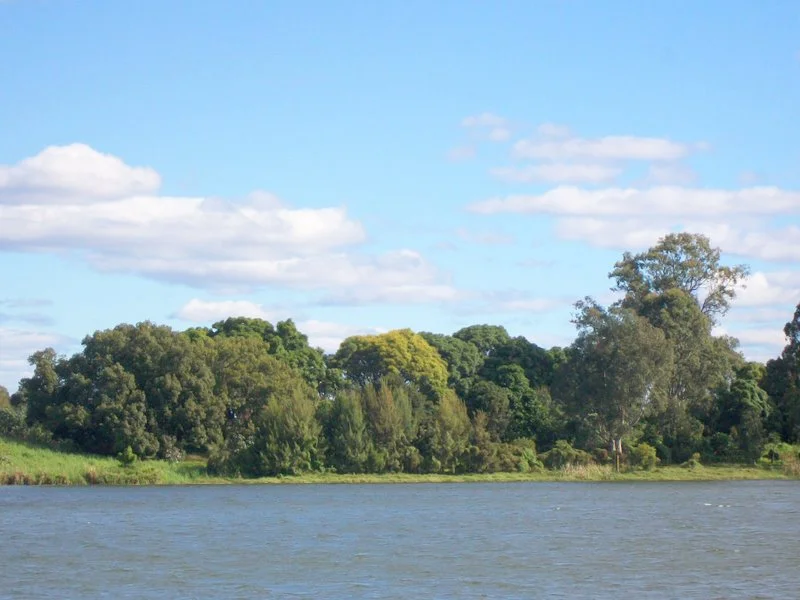

Susan Island Nature Reserve
At dusk in high summer the sky over Grafton darkens twice. First the sun goes down; then the bats rise. From a wooded island in the middle of the Clarence River, tens of thousands of grey-headed flying foxes lift off at once and pour outward to feed on the flowering forests beyond town - a living cloud that has launched from this same spot since before Europeans ever named the place. The island is Susan Island, three kilometres long and barely 400 metres wide, and its upstream third holds something the surrounding valley has almost entirely lost.
The Last Rainforest of the Valley
Most of Susan Island was cleared long ago - logged for timber, grazed, even used for Grafton's first rifle range. What survived, on the western end, is the largest remnant of lowland subtropical rainforest left in the entire Clarence Valley, a rare patch of an ecosystem now listed as endangered. It is an unlikely survivor. Built on alluvial soil laid down by the river's floods, it gets only about 1,080 millimetres of rain a year - marginal for rainforest, which is why botanists describe it as a "dry" form of the type. Inside grow more than ninety species of rainforest trees: huge Moreton Bay figs, the fearsome Giant Stinging Tree, tulipwood and black bean. Red cedar, logged to exhaustion by the 1920s, was reintroduced in 2001 and is now quietly thriving and reseeding itself.
When the Sky Fills with Wings
The island's great spectacle is its flying foxes. Grey-headed flying foxes use it year-round as a roost and, crucially, as a maternity camp - a nursery where mothers carry and raise their young. In a normal summer the colony numbers in the thousands; when the nearby eucalyptus forests burst into blossom, it can swell past 100,000, and in exceptional years beyond 300,000, swollen by waves of little red flying foxes chasing the flowering hardwoods. These are not vermin but pollinators and seed-carriers, stitching the region's forests together on their nightly flights. Above them wheel other rarities: white-bellied sea eagles, ospreys, the jewel-bright wompoo fruit-dove and the shy noisy pitta that hunts snails on the forest floor.
A Women's Place
Long before any of this was mapped or protected, Aboriginal people came to the island to fish, to gather food and medicine from the forest, and to collect fibre for nets and bags. To the Gumbaynggirr, Susan Island carries a deeper meaning still: it is a women's site, a place of ongoing cultural significance to the Aboriginal women of the Clarence Valley, who are recognised as its cultural custodians. That standing is not merely informal - the island is officially acknowledged as an Aboriginal Place under New South Wales law. Custodial women still make trips here, where the bats, the rainforest and the women's heritage are bound together as one living landscape.
A Reserve Worth Saving
Keeping the remnant alive has been a long, patient fight against weeds rather than chainsaws. From the late 1980s, parks staff and volunteers began clearing the invaders that smother northern rivers rainforest - camphor laurel, broad-leaved privet, and the curtain-forming exotic vines like cat's claw creeper and Dutchman's pipe that blanket the canopy until it sags and collapses, dragging the trees down with it. Early on, crews had to hack through dense prickly pear just to reach the forest at all. Decades of steady regeneration have slowly expanded the rainforest and let the natives recover, the reintroduced red cedar now reseeding itself among figs that predate the town. The reward is an island that still works as nature intended: a rare endangered ecological community, a wildlife nursery, and a place of deep cultural meaning, all within sight of a country town's main street.
From the Air
Susan Island lies in the Clarence River at Grafton, near 29.68 degrees south, 152.91 degrees east. From the air it reads as a long, narrow, densely wooded island splitting the river just upstream of the city centre, the forested western third standing out darker than the cleared eastern end. The Grafton Bridge and the city's grid sit immediately east. The nearest field is Grafton Airport (ICAO YGFN); Coffs Harbour Airport (ICAO YCFS) lies to the southeast. Best viewed at low altitude in clear conditions - and at dusk in summer, the flying-fox fly-out is visible as a moving haze rising off the island.
Nearby Stories
- Angourie, New South Wales 17 km away
- History of New Italy, New South Wales 23 km away
- Tenterfield School of Arts 39 km away
- Guy Fawkes River National Park 47 km away
- Glen Innes Showground 49 km away
- Casino, New South Wales 62 km away
- Guyra, New South Wales 64 km away
- SS Elingamite: Gold, Fog, and a Captain Wrongly Blamed 1828 km away