.jpg)
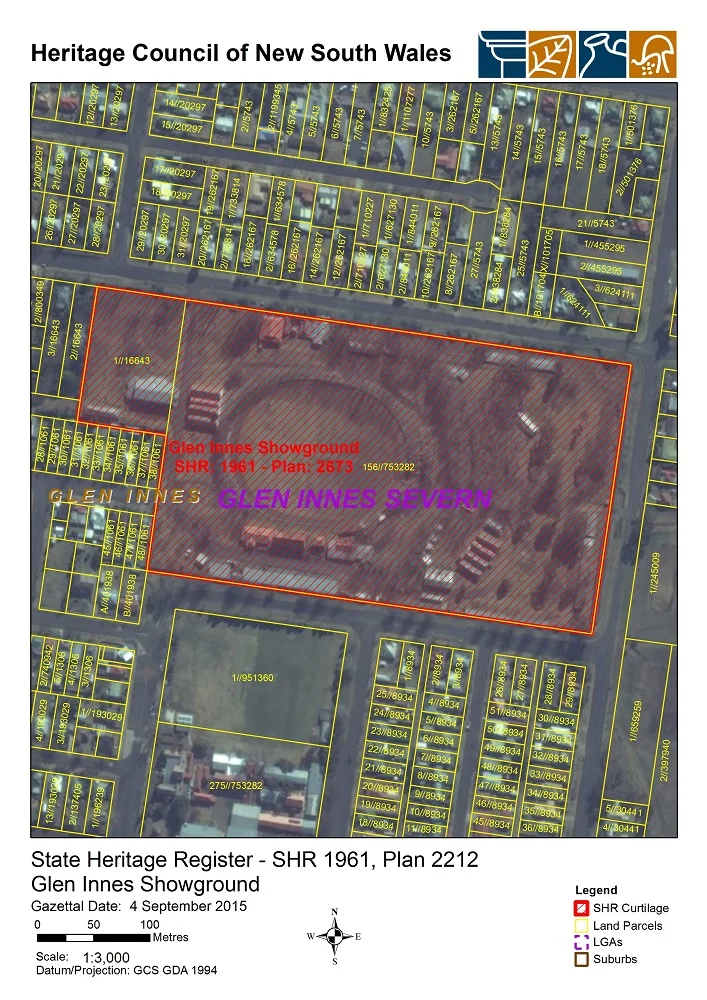
Glen Innes Showground
Walk through the gates on show day and the past is still doing its job. Elms throw shade across a central arena ringed by timber pavilions, their classical detailing softened by terracotta tile and a century of weather. The sheep have been judged from this octagonal stand since 1928; the main pavilion has held prize jams and fleeces and woodwork since before Federation. Most country towns have lost their old show buildings to fire, demolition, or simple neglect. Glen Innes kept nearly all of them. The result, listed on the New South Wales State Heritage Register in 2015, is one of the most complete suites of nineteenth and early-twentieth-century showground architecture left standing in the state, and it still does exactly what it was built to do.
Before the Pavilions
Long before the first grandstand rose, this high tableland belonged to the Ngarabal people, whose totem was the koala. Their country reached out to take in Glencoe, Wellingrove, and the Beardy Plains, and their year moved with the brutal local winters. When cold thinned the food supply, the Ngarabal travelled to warmer ground along the tributaries of the Clarence River and the Mole district. In the warmer months they returned to the plateau to harvest its plenty, hunting wallaby, possum, bandicoot, and lizard, and gathering wild raspberry, native yam, and bracken root for food and medicine. Those too old or frail to make the journey stayed on the tablelands through the cold, wrapped in possum and kangaroo-skin cloaks and tending fires beside their bark shelters. The seasonal rhythm of this country is far older than any show schedule.
One Hundred and Fifty Shows
The first Glen Innes Show was held in 1869, and the show moved to this ground in 1874, where it has run every year since. That makes it one of the earliest regional shows in New South Wales, in a tradition that began in metropolitan Sydney and spread out through Maitland, Singleton, Bathurst, and Armidale. For a stretch in the late nineteenth and early twentieth centuries, the Glen Innes Show was reckoned among the very best in the colony, judged by the crowds it drew, the gate takings, and above all the number and quality of its exhibits. A regional show was no small thing in a pastoral district. It was the year's great gathering, the place where a farmer's reputation, and a prize ewe's bloodline, were made or unmade in public.
A Stand for the Sheep
The jewel of the ground is the Cadell Memorial sheep-judging stand, built in 1928 and named for W. T. Cadell, the pastoralist who developed nearby Deepwater Station into one of the leading merino studs in the state and who bankrolled the show for two decades until his death in 1922. The stand is a small marvel of country carpentry: octagonal, some 27 feet across at its widest, raised on hardwood posts set in concrete, and crowned with a domed ceiling and a lantern roof whose glass louvres funnel daylight down onto the animals below. Around it stand the other Federation-era timber pavilions, post-and-rail yards, stables, and a refreshment room, the full working anatomy of a show, arranged with an eye for symmetry around the arena.
Why It Still Matters
Heritage assessors call Glen Innes Showground an 'ideal' regional showground, and the phrase is earned. Most NSW showgrounds saved a grandstand or a pavilion or two; Glen Innes preserved a coherent, architect-designed ensemble in a deliberately planted, park-like landscape of elms, yellow box, and white gum, some of it sown back in 1897 for Queen Victoria's Jubilee. The buildings carry real research value, offering a rare window into the bushcraft and country architecture of their era, and several have needed urgent conservation work to survive. But the deepest argument for the place is simpler. It has done one job, in one spot, for more than 150 years, and the community has chosen, again and again, to keep it whole rather than start over.
From the Air
The showground occupies a block on Bourke Street at roughly 29.74 degrees S, 151.74 degrees E, on the northern side of central Glen Innes, on the Northern Tablelands. From above, pick it out by the oval arena ringed with mature elms and the cluster of pale timber pavilions, just off the town grid near the New England Highway. Glen Innes Airport (YGLI / GLI) lies about 9 km northwest at around 1,046 m elevation; Armidale Regional (YARM / ARM) is roughly 95 km south. The tableland sits near 1,050 m, so expect cold, frost-prone mornings and crisp high-visibility air after a front; spring can bring sudden heavy storms as moist air lifts over the ranges.
Nearby Stories
- Inverell Post Office 6 km away
- Guyra, New South Wales 16 km away
- Washpool National Park 21 km away
- Guy Fawkes River National Park 27 km away
- Ebor Falls 40 km away
- Tenterfield, New South Wales 61 km away
- Parramatta Female Factory and Institutions Precinct 416 km away
- Hornet Bank Massacre 455 km away