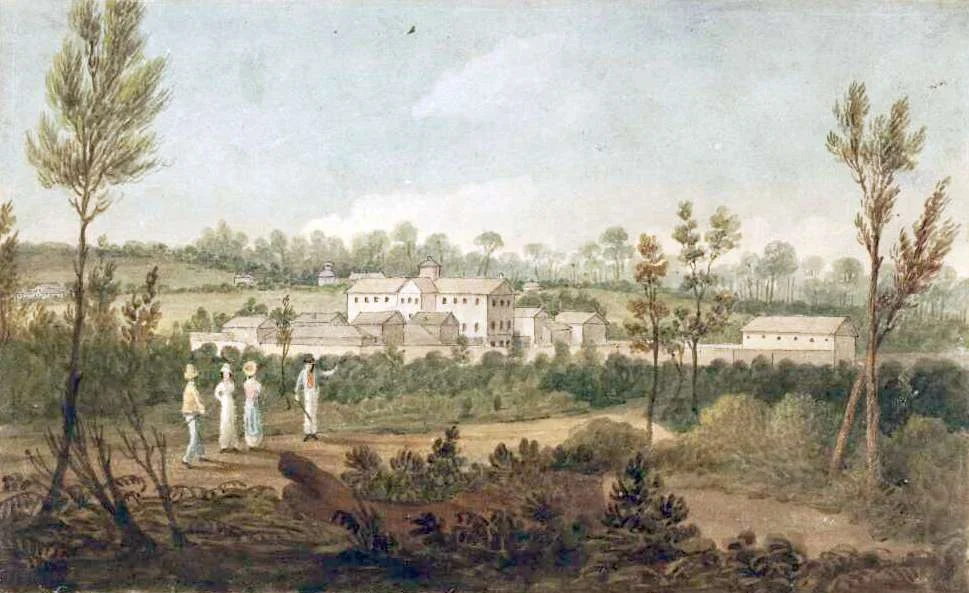

Parramatta Female Factory and Institutions Precinct
On a Wednesday night in October 1827, the women of the Parramatta Female Factory had had enough. The matron had cut their tea and sugar, and word ran through the cells. By morning they had seized the workmen's hammers and sledges, broken down the gates, and poured into the streets of Parramatta — a crowd one shocked journalist called 'Amazonian banditti.' Soldiers were called. The rations were the spark, but the fuel had been building for years: hunger, crowding, and the daily indignity of being confined for the crime of being a poor woman alone in a young colony. That riot was only the first of many on this ground beside the Parramatta River, where the same buildings would govern the unwanted for the next century and a half.
Stone Laid for Punishment
Governor Macquarie laid the foundation stone in July 1818, and after nearly three years of labour by convict stonemasons the Female Factory opened its doors in February 1821. It was designed by Francis Greenway, himself an emancipated convict, into elegant sandstone — but elegance was never the point. The factory was workhouse, prison, hospital, and marriage bureau in one. Women earned their way through a system of classes: First Class women could take wages, attend church, receive visitors, and marry their way out, with suitors given three days to choose a bride. Pragmatism, the records suggest, usually beat romance, and husbands sometimes returned wives they found disagreeable. Second and Third Class women got less food, less clothing, and harder treatment. When Governor Gipps later modernised the punishment cells, he ordered windows cut into the ground floor and the cells shrunk — changes so severe they horrified the British architects who had drawn the original plans.
The Children Behind the Wall
Hundreds of children lived inside the factory walls alongside their mothers, and the colony's answer to convict motherhood was to separate the two. In 1844 a Roman Catholic Orphan School was moved next door — close enough that many of its children had mothers in the factory, a great number of them Irish. The reasoning was blunt: convict mothers were deemed unfit, their children better raised toward usefulness than left to 'poor choices.' The reality was bleak. A government report in 1855 found the place starved of food, utensils, clothing, and teaching, the children locked in at night and put to laundry and heavy labour instead of lessons. Inspectors noted the absence of the ordinary noise of children — no games, no spirit, just listless boys 'basking in the sun.' One visiting governor said the buildings looked like a place 'half-gaol, half-lunatic asylum.' The school limped on, chronically underfunded, until it closed in 1886.
Parramatta Girls
From 1887 the ground took on its longest and darkest role as the Parramatta Girls Industrial School, holding girls labelled 'neglected,' 'wayward,' or 'uncontrollable' — including Aboriginal girls taken as part of the Stolen Generations. Many had absconded from violent homes, foster placements, or abuse, and were treated as delinquents for the very harm done to them. They were trained for domestic service and punished for the smallest infraction with beatings, isolation, and a cruelty called 'standing out,' where a girl held attention for hours. The testimony later given to a Senate inquiry is hard to read: a girl made to scrub concrete with a toothbrush in midwinter until her knees bled, staff who bashed and molested children. Riots flared again and again, as they had under the convict women, until a sustained campaign by the women's movement forced the school's closure in the mid-1970s. The full weight of what these girls carried into adulthood has only recently been believed.
A Place to Witness
What survives here is rare. Of the twelve female factories that once existed in colonial Australia, nine are gone entirely, which makes the convict-era ranges and walls at Parramatta a national rarity — among the only physical traces of how the colony chose to manage its women. After the factory closed it became the Parramatta Lunatic Asylum, later the Cumberland Hospital, and ran as a mental institution for over a century; one superintendent, Dr Richard Greenup, was stabbed to death by a patient in 1866 despite having pushed to ease the very confinements that defined the place. In 2017 the precinct was added to the Australian National Heritage List. The 2009 national Apology to the Forgotten Australians named the trauma carried out of institutions like this one. Historians now describe the site as a bridge — a shared space where a nation can finally witness experiences that thousands of women and children were once told no one would believe.
From the Air
The precinct sits on the north bank of the Parramatta River in North Parramatta at approximately 33.80 degrees south, 151.00 degrees east, about 24 kilometres west of central Sydney. From the air, look for the bend of the river and the cluster of sandstone ranges and walls within the grounds of the former Cumberland Hospital off Fleet Street, set among unusually mature conifers and fig trees. Sydney's Kingsford Smith Airport (ICAO YSSY) lies to the east-southeast; Bankstown Airport (YSBK) is the nearest general-aviation field, southwest of the site. Western Sydney is prone to summer heat haze, so cooler, clearer mornings render the river corridor and the precinct's geometry most distinctly.
Nearby Stories
- Royal National Park 6.1 km away
- Australian War Memorial 178 km away
- Canberra 203 km away
- Apsley Falls 282 km away
- Walcha, New South Wales 294 km away
- Smoky Cape Lighthouse 356 km away
- Mount Hope, New South Wales 431 km away
- 2003 Fiordland Earthquake 1796 km away