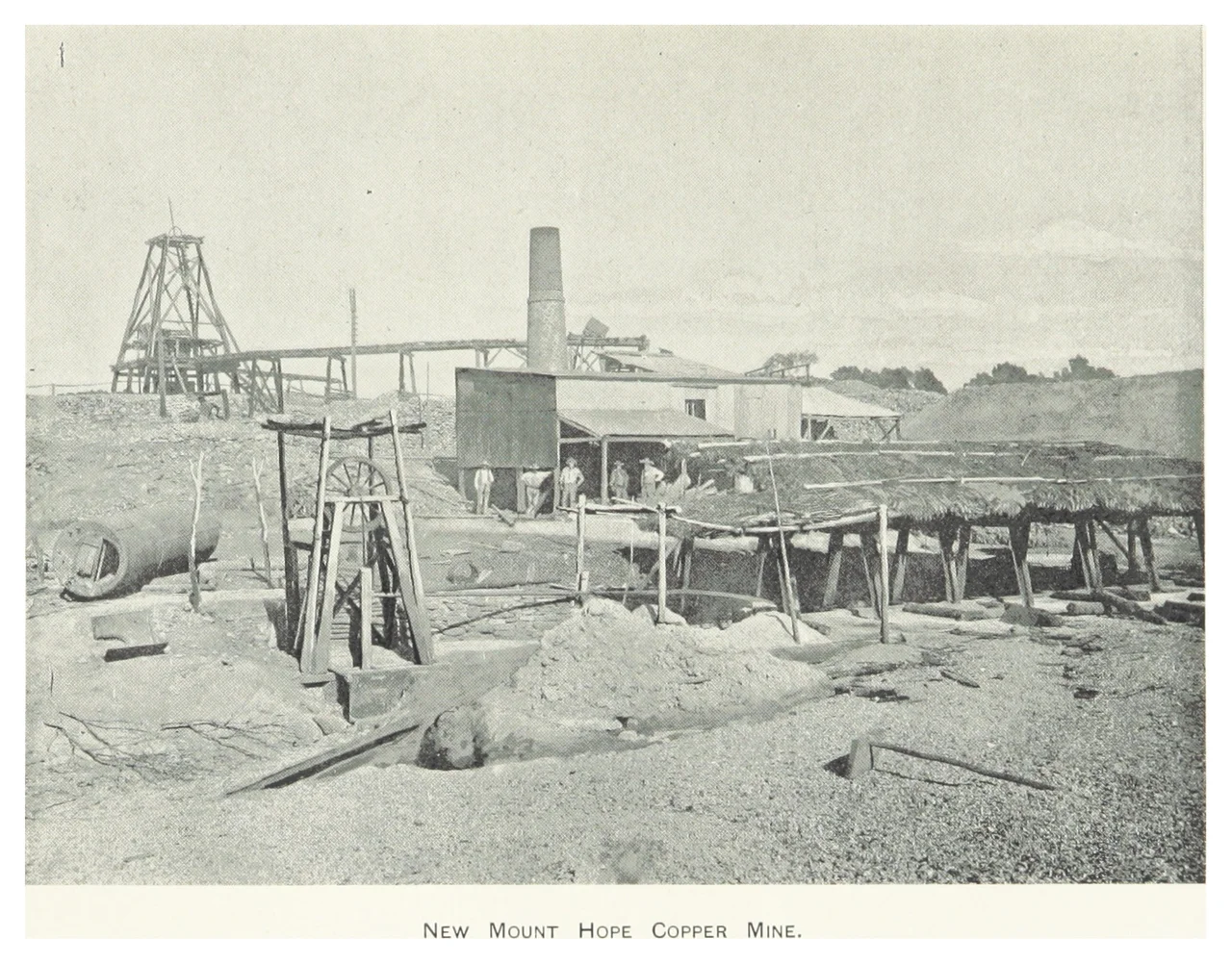
_p197_NEW_MOUNT_HOPE_COPPER_MINE.jpg)
Mount Hope, New South Wales
In 1873, a shepherd named Robert Fisher walked up an unremarkable hill on Coan Downs station and noticed the vegetation was wrong - withered, yellowed, sick. The ground beneath it was green with copper. Within months a dray decorated with flags was hauling the first ten tons of ore toward Hay, and a township was rising out of what one visitor called "a desert of rocks." They named the hill Mount Hope, and for the next half-century the name would be tested against drought, falling copper prices, fire, and the slow exhaustion of the ore body. Today fewer than twenty people live here. The hope, it turns out, was always provisional.
Ore by the Mountainful
The men who chased Fisher's discovery did not lack confidence. Henry Viviain, a Hay auctioneer, arrived at Booligal with rich specimens and the claim that "the mountain is formed entirely of this ore." An early assay in Melbourne reportedly returned 60 percent copper. Speculators from Hay called for tenders to cart a thousand tons of ore 150 miles to the smelting works in Adelaide, by land and water. More finds followed: the Great Central mine three miles south, others scattered through the porphyry country. Richard Hollow, a manager with thirty years in the copper grounds of Cornwall and South Australia, took charge of the main mine. The reality proved harder than the assays promised. The first company foundered on unpaid calls - 2,000 shares forfeited by late 1878 - and in 1882 it was dissolved and reborn as the New Mount Hope Copper Mining Company.
Like an Ant Bed
When the new company built its smelting furnaces, Mount Hope roared to life. By 1882 the population exceeded 500 souls; a government tank was dug, a post office and bank opened, stores multiplied. A resident wrote that the blasting startled the town "eight or ten times a day," and another marvelled at the children: "it is like an ant bed, but they all seem healthy and happy." Four hotels took out licenses in 1881 alone. The town that had been a desert of rocks a few months before, one writer boasted, "may soon rival Cobar." For a brief, loud span of years it almost felt true - furnaces glowing against the night, ore carts grinding, the whole improbable enterprise humming on the strength of a green-stained hill.
Living on Hopes and Memories
Copper is a fickle master. Prices collapsed in the mid-1880s, and the "unprecedented depression in the copper market" gnawed at the company's balance sheets. There were revivals - new concentrating machinery in 1899, an acquisition by Mount Hope Ltd in 1913, 150 men employed in 1918 - but the trend ran one way. The branch railway from Matakana, built to serve the mine, opened in 1919, four months after the mine had already ceased full-time work; the trains stopped in 1924 "because of the paucity of business," and the machinery was dismantled and carted away. By 1927 Mount Hope was a "decayed mining town" that, as one observer put it, "has been living on hopes and memories for years." Over its working life the main mine yielded around 7,500 tonnes of copper - a real fortune, dug out one blast at a time, and never quite enough to last.
The Pub That Refused to Die
Mount Hope's survivor is the Royal Hotel, licensed in July 1881 to William Clark and run by the Clark family for decades. After William died in 1910, his widow Sarah held the license, then passed it to their son. The original Royal burned to the ground in December 1930 - a fire that consumed a building made "chiefly of concrete and iron with an absolute minimum of wood" in an incredibly short time, leaving the coroner with an open verdict. The pub came back, as Mount Hope things tend to, and it still trades today as the town's last business: food, beer, beds, and a claim worth stopping for - the only concrete bar in New South Wales. Around it stretch the Yathong, Nombinnie and Round Hill nature reserves, holding the largest unbroken stand of mallee left in the state, where the rare malleefowl quietly tends its mound while the old mountain keeps its copper and its silence.
From the Air
Mount Hope lies at roughly 32.75 degrees south, 145.94 degrees east, on the Kidman Way about 95 km north of Hillston and 160 km south of Cobar, in central-western NSW. The namesake hill - around 300 ft of relief standing "in bold relief from the surrounding hills," as an early prospector described it - is the chief landmark in otherwise low, scrubby mallee-and-ridge country; old mine workings and tailings scar the ground around it. The settlement itself is tiny, a cluster centred on the Royal Hotel beside the highway. Nearest airfields are Cobar Airport (YCBA) to the north and Hillston Airport (YHLS) to the south. Recommended viewing altitude is 3,000-5,000 ft; the surrounding nature reserves spread a near-continuous dark mallee canopy that contrasts with cleared paddocks. Expect excellent winter visibility and significant afternoon heat haze and occasional smoke from controlled burns in the warmer months.
Nearby Stories
- Nymagee 45 km away
- Willandra National Park 50 km away
- Ivanhoe 117 km away
- Mount Grenfell 137 km away
- Mossgiel 154 km away
- Lake Burley Griffin 340 km away
- Canberra 363 km away
- Roxy Theatre and Peters Greek Cafe Complex 479 km away